Thank you for visiting SNEWPapers!
Sign up free
Foreign News
April 3, 1870
The Morning Star And Catholic Messenger
New Orleans, Orleans County, Louisiana
What is this article about?
A Dublin Freeman's Journal correspondent in Rome on the 18th describes dining with the Papal Zouave battalion officers, led by Colonel de la Moriciere, praising their geniality, devotion to the Pope, and pious conduct amid service defending papal dominions.
Clipping
OCR Quality
95%
Excellent
Full Text
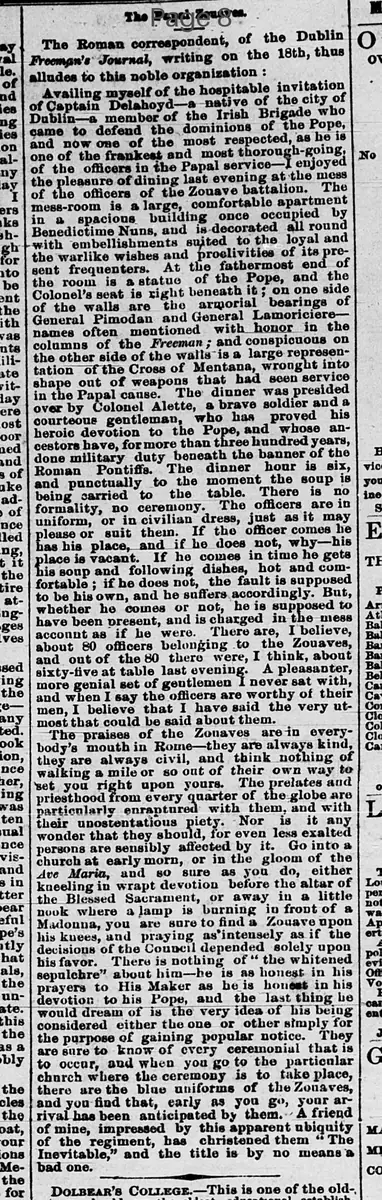
The Roman correspondent, of the Dublin Freeman's Journal, writing on the 18th, thus alludes to this noble organization:
Availing myself of the hospitable invitation of Captain Delahoyd—a native of the city of Dublin—a member of the Irish Brigade who came to defend the dominions of the Pope, and now one of the most respected, as he is one of the frankest and most thorough-going, of the officers in the Papal service—I enjoyed the pleasure of dining last evening at the mess of the officers of the Zouave battalion. The mess-room is a large, comfortable apartment in a spacious building once occupied by Benedictine Nuns, and is decorated all round with embellishments suited to the loyal and warlike wishes and proclivities of its present frequenters. At the farthest end of the room is a statue of the Pope, and the Colonel's seat is right beneath it; on one side of the walls are the armorial bearings of General Pimodan and General Lamoriciere—names often mentioned with honor in the columns of the Freeman; and conspicuous on the other side of the walls is a large representation of the Cross of Mentana, wrought into shape out of weapons that had seen service over by Colonel Alette, a brave soldier and a tried servant in the Papal cause.
The dinner was presided over by Colonel de la Moriciere, a courteous gentleman, who has proved his devotion to the Holy See, as his ancestors have, for more than three hundred years, done military duty beneath the banner of the Roman Pontiffs. The dinner hour is six, and punctually to the moment the soup is being carried to the table. There is no formality, no ceremony. The officers are in uniform, or in civilian dress, just as it may please or suit them. If the officer comes he has his place, and if he does not, why—his place is vacant. If he comes in time he gets his soup and following dishes, hot and comfortable; if he does not, the fault is supposed to be his own, and he suffers accordingly. But, whether he comes or not, he is supposed to have been present, and is charged in the mess account as if he were. There are, I believe, about 80 officers belonging to the Zouaves, and out of the 80 there were, I think, about sixty-five at table last evening. A pleasanter, more genial set of gentlemen I never sat with, and when I say the officers are worthy of their men, I believe that I have said the very utmost that could be said about them.
The praises of the Zouaves are in everybody's mouth in Rome they are always kind, they are always civil, and think nothing of walking a mile or so out of their own way to set you right upon yours. The prelates and priesthood from every quarter of the globe are particularly enraptured with them, and with their unostentatious piety. Nor is it any wonder that they should, for even less exalted persons are sensibly affected by it. Go into a church at early morn, or in the gloom of the Ave Maria, and so sure as you do, either kneeling in wrapt devotion before the altar of the Blessed Sacrament, or away in a little nook where a lamp is burning in front of a Madonna, you are sure to find a Zouave upon his knees, and praying as intensely as if the decisions of the Council depended solely upon his favor. There is nothing of "the whitened sepulchre" about him—he is as honest in his prayers to His Maker as he is honest in his devotion to his Pope, and the last thing he would dream of is the very idea of his being considered either the one or other simply for the purpose of gaining popular notice. They are sure to know of every ceremonial that is to occur, and when you go to the particular church where the ceremony is to take place, there are the blue uniforms of the Zouaves, and you find that, early as you go, your arrival has been anticipated by them. A friend of mine, impressed by this apparent ubiquity of the regiment, has christened them "The Inevitable," and the title is by no means a bad one.
Availing myself of the hospitable invitation of Captain Delahoyd—a native of the city of Dublin—a member of the Irish Brigade who came to defend the dominions of the Pope, and now one of the most respected, as he is one of the frankest and most thorough-going, of the officers in the Papal service—I enjoyed the pleasure of dining last evening at the mess of the officers of the Zouave battalion. The mess-room is a large, comfortable apartment in a spacious building once occupied by Benedictine Nuns, and is decorated all round with embellishments suited to the loyal and warlike wishes and proclivities of its present frequenters. At the farthest end of the room is a statue of the Pope, and the Colonel's seat is right beneath it; on one side of the walls are the armorial bearings of General Pimodan and General Lamoriciere—names often mentioned with honor in the columns of the Freeman; and conspicuous on the other side of the walls is a large representation of the Cross of Mentana, wrought into shape out of weapons that had seen service over by Colonel Alette, a brave soldier and a tried servant in the Papal cause.
The dinner was presided over by Colonel de la Moriciere, a courteous gentleman, who has proved his devotion to the Holy See, as his ancestors have, for more than three hundred years, done military duty beneath the banner of the Roman Pontiffs. The dinner hour is six, and punctually to the moment the soup is being carried to the table. There is no formality, no ceremony. The officers are in uniform, or in civilian dress, just as it may please or suit them. If the officer comes he has his place, and if he does not, why—his place is vacant. If he comes in time he gets his soup and following dishes, hot and comfortable; if he does not, the fault is supposed to be his own, and he suffers accordingly. But, whether he comes or not, he is supposed to have been present, and is charged in the mess account as if he were. There are, I believe, about 80 officers belonging to the Zouaves, and out of the 80 there were, I think, about sixty-five at table last evening. A pleasanter, more genial set of gentlemen I never sat with, and when I say the officers are worthy of their men, I believe that I have said the very utmost that could be said about them.
The praises of the Zouaves are in everybody's mouth in Rome they are always kind, they are always civil, and think nothing of walking a mile or so out of their own way to set you right upon yours. The prelates and priesthood from every quarter of the globe are particularly enraptured with them, and with their unostentatious piety. Nor is it any wonder that they should, for even less exalted persons are sensibly affected by it. Go into a church at early morn, or in the gloom of the Ave Maria, and so sure as you do, either kneeling in wrapt devotion before the altar of the Blessed Sacrament, or away in a little nook where a lamp is burning in front of a Madonna, you are sure to find a Zouave upon his knees, and praying as intensely as if the decisions of the Council depended solely upon his favor. There is nothing of "the whitened sepulchre" about him—he is as honest in his prayers to His Maker as he is honest in his devotion to his Pope, and the last thing he would dream of is the very idea of his being considered either the one or other simply for the purpose of gaining popular notice. They are sure to know of every ceremonial that is to occur, and when you go to the particular church where the ceremony is to take place, there are the blue uniforms of the Zouaves, and you find that, early as you go, your arrival has been anticipated by them. A friend of mine, impressed by this apparent ubiquity of the regiment, has christened them "The Inevitable," and the title is by no means a bad one.
What sub-type of article is it?
Religious Affairs
Military Campaign
What keywords are associated?
Zouave Battalion
Papal Service
Irish Brigade
Rome Officers Mess
Zouave Piety
What entities or persons were involved?
Captain Delahoyd
Colonel De La Moriciere
General Pimodan
General Lamoriciere
Colonel Alette
Where did it happen?
Rome
Foreign News Details
Primary Location
Rome
Event Date
The 18th
Key Persons
Captain Delahoyd
Colonel De La Moriciere
General Pimodan
General Lamoriciere
Colonel Alette
Event Details
The correspondent dines at the Zouave battalion mess, hosted by Captain Delahoyd, presided over by Colonel de la Moriciere. Describes the room's decorations honoring papal figures and battles. Praises the officers' geniality, devotion to the Pope, and the soldiers' piety, kindness, and attendance at religious ceremonies in Rome.