Thank you for visiting SNEWPapers!
Sign up free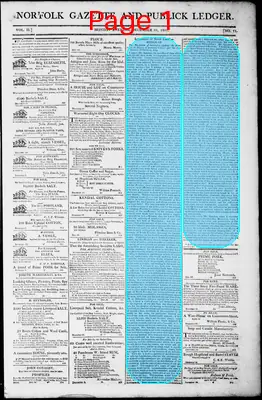
Norfolk Gazette And Publick Ledger
Norfolk, Virginia
What is this article about?
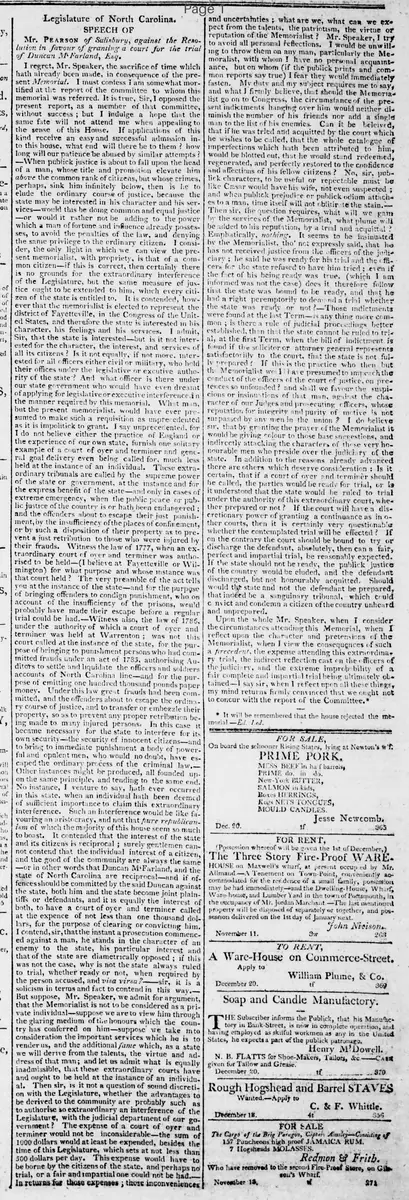
In the North Carolina Legislature, Mr. Pearson of Salisbury delivers a speech opposing a resolution to grant a special court for the trial of Duncan McFarland, Esq., arguing it undermines equal justice, sets a dangerous precedent, and questions the state's interest in his character amid indictments.
Merged-components note: Merged continuation of the legislative speech story based on text flow and sequential reading order.
Clipping
OCR Quality
Full Text
SPEECH OF
Mr. Pearson of Salisbury, against the Resolution in favour of granting a court for the trial
of Duncan McFarland, Esq.
I regret, Mr. Speaker, the sacrifice of time which
hath already been made, in consequence of the present Memorial. I must confess I am somewhat mortified at the report of the committee to whom this
memorial was referred. It is true, Sir, I opposed the
present report, as a member of that committee,
without success; but I indulge a hope that the
same fate will not attend me when appealing to
the sense of this House. If applications of this
kind receive an easy and successful admission into this house, what end will there be to them? how
long will our patience be abused by similar attempts?
—When publick justice is about to fall upon the head
of a man, whose title and promotion elevate him
above the common rank of citizens, but whose crimes,
perhaps, sink him infinitely below, then is he to
elude the ordinary course of justice, because the
state may be interested in his character and his services—would this be doing common and equal justice
—or would it rather not be adding to the power
which a man of fortune and influence already possesses, to avoid the penalties of the law, and denying
the same privilege to the ordinary citizen. I consider, the only light in which we can view the present memorialist, with propriety, is that of a common citizen—if this is correct, then certainly there
is no grounds for the extraordinary interference
of the Legislature, but the same measure of justice ought to be extended to him, which every citizen of the state is entitled to. It is contended, however that the memorialist is elected to represent the
district of Fayetteville, in the Congress of the United
States, and therefore the state is interested in his
character, his feelings and his services. I admit,
Sir, that the state is interested—but is it not interested for the character, the interest, and services of
all its citizens? Is it not equally, if not more, interested for all officers either civil or military, who hold
their offices under the legislative or executive authority of the state? And what officer is there under
our state government who would have even dreamt
of applying for legislative or executive interference, in
the manner required by this memorial. What man,
but the present memorialist, would have ever presumed to make such a requisition as unprecedented
as it is impolitick to grant. I say unprecedented, for
I do not believe either the practice of England or
the experience of our own state, furnish one solitary
example of a court of oyer and terminer and general gaol delivery even being called for, much less
held at the instance of an individual. These extraordinary tribunals are called by the supreme power
of the state or government, at the instance and for
the express benefit of the state—and only in cases of
extreme emergency, when the public peace or public
justice of the country is or hath been endangered;
and the offenders about to escape their just punishment, by the insufficiency of the places of confinement,
or by such a disposition of their property as to prevent a just retribution to those who were injured by
their frauds. Witness the law of 1777, when an extraordinary court of oyer and terminer was authorised to be held—(I believe at Fayetteville or Wilmington) for what purpose and whose instance was
that court held? The very preamble of the act tells
you at the instance of the state—and for the purpose
of bringing offenders to condign punishment, who on
account of the insufficiency of the prisons, would
probably have made their escape before a regular
trial could be had.—Witness also, the law of 1786.
under the authority of which a court of oyer and
terminer was held at Warrenton; was not this
court called at the instance of the state, for the purpose of bringing to punishment persons who had committed frauds under an act of 1785, authorising Auditors to settle and liquidate the officers and soldiers
accounts of North Carolina line—and for the purpose of emitting one hundred thousand pounds paper
money. Under this law great frauds had been committed, and the offenders about to escape the ordinary course of justice, and to transfer or embezzle their
property, so as to prevent any proper retribution being made to many injured persons. In this case it
became necessary for the state to interfere for its
own security—the security of innocent citizens—and
to bring to immediate punishment a body of powerful and opulent men, who would no doubt, have escaped the ordinary process of the criminal law.—
Other instances might be produced, all founded upon the same principle, and tending to the same end.
No instance, I venture to say, hath ever occurred
in this state, when an individual hath been deemed
of sufficient importance to claim this extraordinary
interference. Such an interference would be like favouring an aristocracy, and not that pure republicanism of which the majority of this house seem so much
to boast. It is contended that the interest of the state
and its citizens is reciprocal; surely gentlemen cannot contend that the individual interest of a citizen,
and the good of the community are always the same
—or in other words that Duncan McFarland, and the
state of North Carolina are reciprocal—and if offences should be committed by the said Duncan against
the state, both him and the state become joint plaintiffs or defendants, and it is equally the interest of
both, to have a court of oyer and terminer called
at the expense of not less than one thousand dollars, for the purpose of clearing or convicting him.
I contend, sir, that the instant a prosecution commenced against a man, he stands in the character of an
enemy to the state, his particular interest and
that of the state are diametrically opposed; if this
was not the case, why is not the state always ruled
to trial, whether ready or not, when required by
the person accused, and vice versa?—sir, it is a
solecism in terms and fact to contend in this way.—
But suppose, Mr. Speaker, we admit for argument,
that the Memorialist is not to be considered as a private individual—suppose we are to view him through
the glaring medium of the honours which the country has conferred on him—suppose we take into
consideration the important services which he is to
render us, and the additional fame which, as a state
we will derive from the talents, the virtue and address of that man; and let us admit what is equally
inadmissible, that these extraordinary courts have
and ought to be held at the instance of an individual. Then sir, is it not a question of sound discretion with the Legislature, whether the advantages to
be derived to the community are probably such as
to authorise so extraordinary an interference of the
Legislature, with the judicial department of our government? The expense of a court of oyer and
terminer would not be inconsiderable—the sum of
1000 dollars would at least be expended, besides the
time of this Legislature, which sits at not less than
500 dollars per day. This expense would have to
be borne by the citizens of the state, and perhaps no
trial, or a fair and impartial one could not be had.
In return for those expenses; those inconveniences
and uncertainties; what are we, what can we expect from the talents, the patriotism, the virtue or
reputation of the Memorialist? Mr. Speaker, I try
to avoid all personal reflections. I would be unwilling to throw them on any man, particularly the Memorialist, with whom I have no personal acquaintance, but on whom (if the publick prints and common reports say true) I fear they would immediately
fasten. My duty and my subject requires me to say,
and what I firmly believe, that should the Memorialist
go on to Congress, the circumstance of the present indictments hanging over him would neither diminish the number of his friends nor add a single
man to the list of his enemies. Can it be believed,
that if he was tried and acquitted by the court which
he wishes to be called, that the whole catalogue of
imperfections which hath been attributed to him,
would be blotted out, that he would stand redeemed,
regenerated, and perfectly restored to the confidence
and affections of his fellow citizens? No, sir, public
characters, to be useful or respectable must be
like Caesar would have his wife, not even suspected;
and when publick prejudice or publick odium attaches to a man, time itself will not obliterate the stain.—
Then sir, the question recurs, what will we gain
by the services of the Memorialist, what plume will
be added to his reputation, by a trial and acquittal?
Emphatically, nothing. It seems to be insinuated
by the Memorialist, though not expressly said, that he
has not received justice from the officers of the judiciary; he said he was ready for his trial and the officers for the state refused to have him tried: even if
the fact of his being ready was true. (which I am
informed was not the case) does it therefore follow
that the state was bound to be ready, and that he
had a right peremptorily to demand a trial whether
the state was ready or not? Those indictments
were found at the last Term—is any thing more common; is there a rule of judicial proceedings better
established, than that the state cannot be ruled to trial, at the first Term, when the bill of indictment is
found if the solicitor or attorney general represents
satisfactorily to the court, that the state is not fully
prepared? If this is the practice who then but
the Memorialist would have presumed to impeach the
conduct of the officers of the court of justice, on pretences so unfounded? and shall we favour the suspicions or insinuations of that man, against the character of our Judges and prosecuting officers, whose
reputation for integrity and purity of motive is not
surpassed by any men in the union? I do believe
sir, that by granting the prayer of the Memorialist it
would be giving colour to those base suggestions, and
indirectly attacking the characters of these very honourable men who preside over the judiciary of the
state. In addition to the reasons already advanced
there are others which deserve consideration: Is it
certain, that if a court of oyer and terminer should
be called, the parties would be ready for trial, or is
it understood that the state would be ruled to trial
under the authority of this extraordinary court, whether prepared or not? If the court will have a discretionary power of granting a continuance as in other courts, then it is certainly very questionable
whether the contemplated trial will be effected? If
on the contrary the court should be bound to try or
discharge the defendant, absolutely, then can a fair,
perfect and impartial trial, be reasonably expected.
If the state should not be ready, the publick justice
of the country would be eluded, and the defendant
discharged, but not honourably acquitted. Should
would the state and not the defendant be prepared,
that indeed be a sanguinary tribunal, which could
convict and condemn a citizen of the country unheard
and unprepared.
Upon the whole Mr. Speaker, when I consider
the circumstances attending this Memorial, when I
reflect upon the character and pretensions of the
Memorialist, when I view the consequences of such
a precedent, the expense attending this extraordinary
trial, the indirect reflection cast on the officers of
the judiciary, and the extreme improbability of a
fair complete and impartial trial being ultimately obtained—I say sir, when I reflect upon all these things,
my mind returns firmly convinced that we ought not
to concur with the report of the Committee.*
It will be remembered that the house rejected the memorial—Ed. Led.
What sub-type of article is it?
What themes does it cover?
What keywords are associated?
What entities or persons were involved?
Where did it happen?
Story Details
Key Persons
Location
North Carolina
Story Details
Mr. Pearson opposes a special legislative court for Duncan McFarland's trial, arguing it favors the influential, ignores precedents for state-initiated courts in emergencies, and questions benefits to the state given McFarland's indictments and reputation.