Thank you for visiting SNEWPapers!
Sign up free
The Hillsborough Recorder
Hillsboro, Orange County, North Carolina
What is this article about?
An address circulates in Virginia urging free white men without voting rights to demand suffrage through a structured plan involving local meetings, a convention at Charlottesville, and potential new elections if petitions fail. It cites Thomas Jefferson's support for popular sovereignty and Declaration of Independence principles.
Clipping
OCR Quality
Full Text
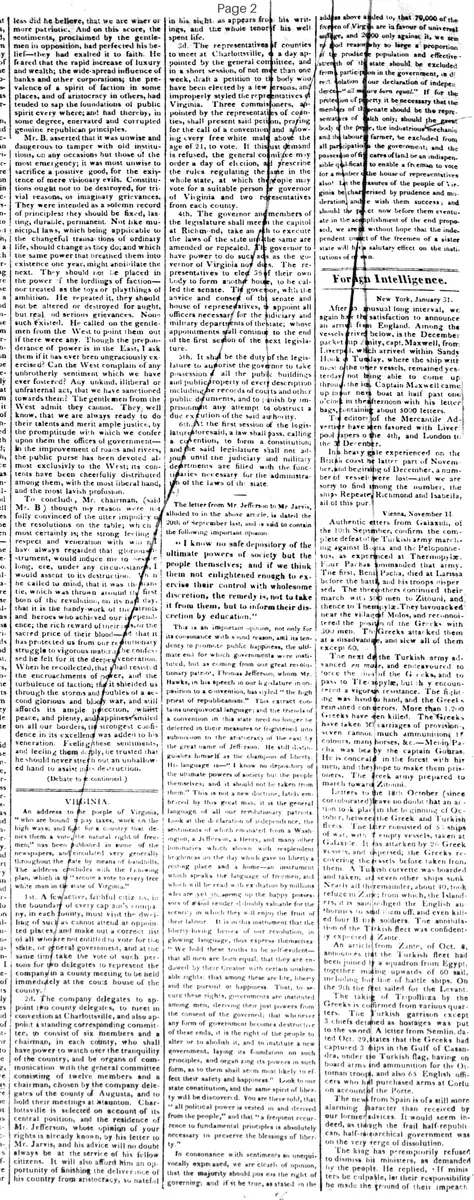
An address to the people of Virginia, 'who are bound to pay taxes; work on the high ways: and fight for a country that denies them a vote, the natural right of freemen:' has been published in some of the newspapers, and circulated very generally throughout the state by means of handbills. The address concludes with the following plan, which is to 'secure a vote to every free white man in the state of Virginia.'
1st. A few active, faithful citizens, in the boundary of every captain's company, in each county, must visit the dwelling of such as cannot attend at appointed places, and make out a correct list of all who are not entitled to vote for the state, or general government, and at the same time take the vote of such persons for two delegates to represent the company in a county meeting to be held immediately at the court house of the county.
2d. The company delegates to appoint two county delegates, to meet in convention at Charlottesville, and also appoint a standing corresponding committee, to consist of six members and a chairman, in each county, who shall have power to watch over the tranquility of the country, and be organs of communication with the general committee consisting of twelve members and a chairman, chosen by the company delegates of the county of Augusta, and to hold their meetings at Staunton. Charlottesville is selected on account of its central position, and the residence of Mr. Jefferson, whose opinion of your rights is already known, by his letter to Mr. Jarvis, and his advice will no doubt always be at the service of his fellow citizens. It will also afford him an opportunity of finishing the deliverance of his country from aristocracy, so hateful in his sight, as appears from his writings, and the whole tenor of his well spent life.
3d. The representatives of counties to meet at Charlottesville, on a day appointed by the general committee, and in a short session, of not more than one week, draft a petition to the body who have been elected by a few persons, and improperly styled the representatives of Virginia. Three commissioners, appointed by the representatives of counties, shall present said petition, praying for the call of a convention and allowing every free white male above the age of 21, to vote. If this just demand is refused, the general committee may order a day of election, and prescribe the rules regulating the same in the whole state, at which the people may vote for a suitable person for governor of Virginia and two representatives from each county.
4th. The governor and members of the legislature shall meet at the capitol at Richmond, take an oath to execute the laws of the state until the same are amended or repealed. The governor to have power to do such acts as the governor of Virginia now does. The representatives to elect 35 of their own body to form another house, to be called the senate. The governor, with the advice and consent of the senate and house of representatives, appoint all officers necessary for the judiciary and military departments of the state; whose appointments shall continue to the end of the first session of the next legislature.
5th. It shall be the duty of the legislature to authorize the governor to take possession of all the public buildings and public property of every description including the records of courts and other public documents, and to punish by imprisonment any attempt to obstruct a due execution of the said authority.
6th. At the first session of the legislature aforesaid, a law shall pass, calling a convention, to form a constitution; and the said legislature shall not adjourn until the judiciary and military departments are filled with the functionaries necessary for the administration of the laws of the state.
The letter from Mr. Jefferson to Mr. Jarvis, alluded to in the above article, is dated the 20th of September last, and is said to contain the following important opinion:
'I know no safe depository of the ultimate powers of society but the people themselves; and if we think them not enlightened enough to exercise their control with wholesome discretion, the remedy is, not to take it from them, but to inform their discretion by education.'
This is an important opinion, not only for its consonance with sound reason, and its tendency to promote public happiness, the ultimate end for which governments were instituted; but as coming from our great revolutionary patriot, Thomas Jefferson; whom Mr. Hawks, in his speech in our legislature in opposition to a convention, has styled 'the high priest of republicanism.' This extract contains unequivocal language: and the friends of a convention in this state need no longer be deterred in their measures or frightened unto submission to the aristocracy of the east by the great name of Jefferson. He still distinguishes himself as the champion of liberty. His language is—'I know no depository of the ultimate powers of society but the people themselves; and it should not be taken from them.' This is not a new doctrine, lately embraced by this great man: it is the general language of all our revolutionary patriots. Look at the declaration of independence, the sentiments of which emanated from a Washington, a Jefferson, a Henry, and many other luminaries which shone with resplendent brightness on the day which gave to liberty a resting place and a home—an instrument which speaks the language of freemen, and which will be read with exultation by millions who are yet to spring up the happy possessors of soil rendered doubly valuable for the security in which they will enjoy the fruit of their labour. It is in this instrument that the liberty-loving heroes of our revolution, in glowing language, thus express themselves:
'We hold these truths to be self-evident—that all men are born equal, that they are endowed by their Creator with certain unalienable rights: that among these are life, liberty and the pursuit of happiness. That, to secure these rights, governments are instituted among men, deriving their just powers from the consent of the governed: that whenever any form of government becomes destructive of these ends, it is the right of the people to alter or to abolish it, and to institute a new government, laying its foundation on such principles, and organizing its powers in such form, as to them shall seem most likely to effect their safety and happiness.' Look to our state constitution, and the same spirit of liberty will be discovered. You are there told, that 'all political power is vested in and derived from the people,' and that 'a frequent recurrence to fundamental principles is absolutely necessary to preserve the blessings of liberty.'
In consonance with sentiments so unequivocally expressed, we are clearly of opinion, that the majority should possess the right of governing: and if it be true, as stated in the address above alluded to, that 70,000 of the freemen of Virginia are in favour of universal suffrage, and 20,000 only against it, we see no reason why so large a proportion of the productive population and effective strength of the state should be excluded from participation in the government, in direct violation of our declaration of independence—'all men are born equal.' If for the protection of property it be necessary that the members of the senate should be the representatives of wealth only; should the great body of the people, the industrious mechanic and the labouring farmer, be excluded from all participation in the government; and the possession of fifty acres of land be an indispensable qualification to enable a freeman to vote for a member of the house of representatives also! Let the measures of the people of Virginia be characterized by prudence and moderation, and we wish them success: and should the plan now before them eventuate in the accomplishment of the end proposed, we are not without hope that the independent conduct of the freemen of a sister state will have a salutary effect on the institutions of our own.
What sub-type of article is it?
What keywords are associated?
What entities or persons were involved?
Where did it happen?
Domestic News Details
Primary Location
Virginia
Key Persons
Outcome
proposed plan for universal suffrage among free white men over 21; potential new elections and constitutional convention if petition refused.
Event Details
An address published in newspapers and circulated via handbills calls on Virginia's free white men without voting rights to organize locally for suffrage. The plan outlines company-level voting for delegates, county meetings, a convention at Charlottesville to petition for voting rights, and fallback elections for governor and representatives if denied. Cites Jefferson's letter supporting popular sovereignty and Declaration of Independence.