Thank you for visiting SNEWPapers!
Sign up free
Letter to Editor
February 27, 1793
National Gazette
Philadelphia, Philadelphia County, Pennsylvania
What is this article about?
An anonymous correspondent defends a Gazette's openness to free discussion against critics who liken it to a 'Tar Kettle,' satirizes aristocratic and monarchical sympathizers amid French revolutionary successes, and argues for abolishing the clerical title 'reverend' as implying undue veneration.
Clipping
OCR Quality
95%
Excellent
Full Text
Communications from Correspondents.
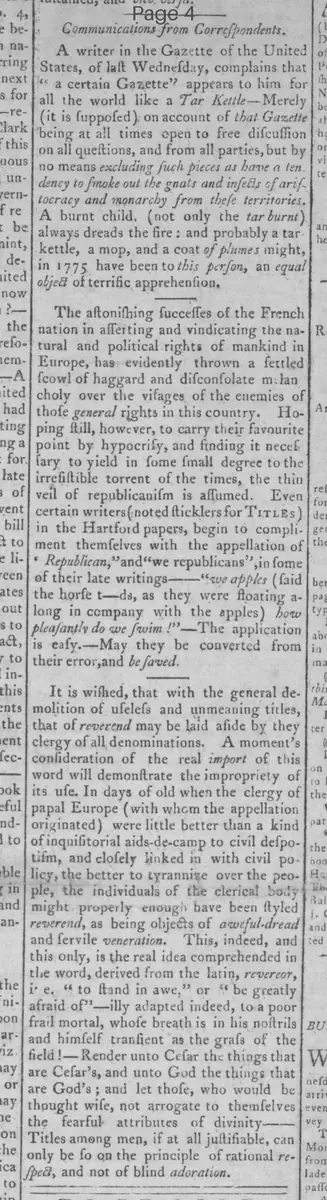
A writer in the Gazette of the United States, of last Wednesday, complains that a certain Gazette" appears to him for all the world like a Tar Kettle--Merely (it is supposed) on account of that Gazette being at all times open to free discussion on all questions, and from all parties, but by no means excluding such pieces as have a tendency to smoke out the gnats and insects of aristocracy and monarchy from these territories. A burnt child, (not only the tar burnt) always dreads the fire: and probably a tar-kettle, a mop, and a coat of plumes might, in 1775 have been to this person, an equal object of terrific apprehension. The astonishing success of the French nation in asserting and vindicating the natural and political rights of mankind in Europe, has evidently thrown a settled cowl of haggard and disconsolate melancholy over the visages of the enemies of those general rights in this country. Hoping still, however, to carry their favourite point by hypocrisy, and finding it necessary to yield in some small degree to the irresistible torrent of the times, the thin veil of republicanism is assumed. Even certain writers (noted sticklers for Titles) in the Hartford papers, begin to compliment themselves with the appellation of "Republican," and "we republicans," in some of their late writings--"True apples (said the horse turds, as they were floating along in company with the apples) how pleasantly do we swim!" The application is easy. May they be converted from their error, and be saved.
It is wished, that with the general demolition of useless and unmeaning titles, that of reverend may be laid aside by the clergy of all denominations. A moment's consideration of the real import of this word will demonstrate the impropriety of its use. In days of old when the clergy of papal Europe (with whom the appellation originated) were little better than a kind of inquisitorial aids-de-camp to civil despotism, and closely linked in with civil policy, the better to tyrannize over the people, the individuals of the clerical body might properly enough have been styled reverend, as being objects of awful-dread and servile veneration. This, indeed, and this only, is the real idea comprehended in the word, derived from the latin, revereor, i. e. "to stand in awe," or "be greatly afraid of"--ill adapted indeed, to a frail mortal, whose breath is in his nostrils and himself transient as the grass of the field! Render unto Caesar the things that are Caesar's, and unto God the things that are God's: and let those, who would be thought wise, not arrogate to themselves the fearful attributes of divinity-- Titles among men, if at all justifiable, can only be so on the principle of rational respect, and not of blind adoration.
A writer in the Gazette of the United States, of last Wednesday, complains that a certain Gazette" appears to him for all the world like a Tar Kettle--Merely (it is supposed) on account of that Gazette being at all times open to free discussion on all questions, and from all parties, but by no means excluding such pieces as have a tendency to smoke out the gnats and insects of aristocracy and monarchy from these territories. A burnt child, (not only the tar burnt) always dreads the fire: and probably a tar-kettle, a mop, and a coat of plumes might, in 1775 have been to this person, an equal object of terrific apprehension. The astonishing success of the French nation in asserting and vindicating the natural and political rights of mankind in Europe, has evidently thrown a settled cowl of haggard and disconsolate melancholy over the visages of the enemies of those general rights in this country. Hoping still, however, to carry their favourite point by hypocrisy, and finding it necessary to yield in some small degree to the irresistible torrent of the times, the thin veil of republicanism is assumed. Even certain writers (noted sticklers for Titles) in the Hartford papers, begin to compliment themselves with the appellation of "Republican," and "we republicans," in some of their late writings--"True apples (said the horse turds, as they were floating along in company with the apples) how pleasantly do we swim!" The application is easy. May they be converted from their error, and be saved.
It is wished, that with the general demolition of useless and unmeaning titles, that of reverend may be laid aside by the clergy of all denominations. A moment's consideration of the real import of this word will demonstrate the impropriety of its use. In days of old when the clergy of papal Europe (with whom the appellation originated) were little better than a kind of inquisitorial aids-de-camp to civil despotism, and closely linked in with civil policy, the better to tyrannize over the people, the individuals of the clerical body might properly enough have been styled reverend, as being objects of awful-dread and servile veneration. This, indeed, and this only, is the real idea comprehended in the word, derived from the latin, revereor, i. e. "to stand in awe," or "be greatly afraid of"--ill adapted indeed, to a frail mortal, whose breath is in his nostrils and himself transient as the grass of the field! Render unto Caesar the things that are Caesar's, and unto God the things that are God's: and let those, who would be thought wise, not arrogate to themselves the fearful attributes of divinity-- Titles among men, if at all justifiable, can only be so on the principle of rational respect, and not of blind adoration.
What sub-type of article is it?
Persuasive
Political
Satirical
What themes does it cover?
Politics
Constitutional Rights
Morality
What keywords are associated?
French Revolution
Republicanism
Aristocracy
Monarchy
Clergy Titles
Reverend
Political Rights
Titles Abolition
Letter to Editor Details
Main Argument
the letter defends the gazette's openness to free discussion, mocks aristocratic hypocrites adopting republican veneers in response to french revolutionary successes, and urges the abolition of the title 'reverend' for clergy as it implies servile veneration unfit for mortals.
Notable Details
Satirical Analogy Of Horse Turds Floating With Apples
Reference To French Nation's Success In Rights Vindication
Etymology Of 'Reverend' From Latin 'Revereor' Meaning To Stand In Awe
Biblical Quote: 'Render Unto Caesar The Things That Are Caesar's, And Unto God The Things That Are God's'