Thank you for visiting SNEWPapers!
Sign up free
Henderson Daily Dispatch
Henderson, Vance County, North Carolina
What is this article about?
In Raleigh, public sentiment largely supports Governor J. C. B. Ehringhaus's refusal to grant a full pardon to Colonel Luke Lea, convicted of conspiracy in the Asheville bank failure and serving a 6-10 year sentence, despite tremendous pressure from influential politicians and friends.
Merged-components note: Continuation of Lea pardon refusal story.
Clippings
1 of 2
OCR Quality
Full Text
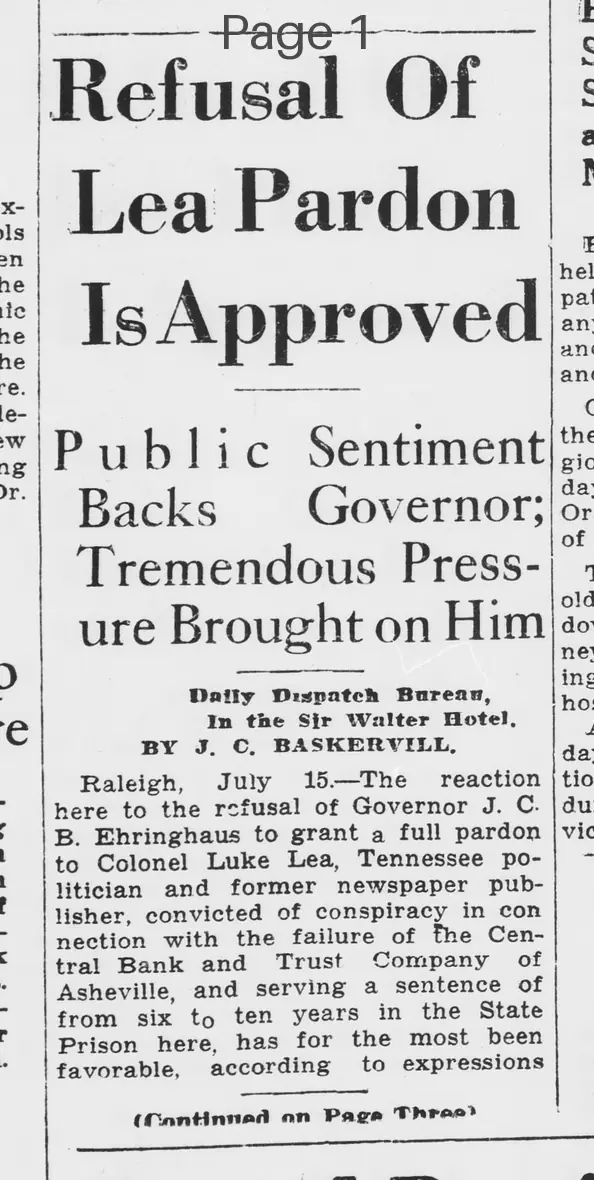
Public Sentiment Backs Governor; Tremendous Pressure Brought on Him
Daily Dispatch Bureau,
In the Sir Walter Hotel.
BY J. C. BASKERVILL.
Raleigh, July 15.—The reaction here to the refusal of Governor J. C. B. Ehringhaus to grant a full pardon to Colonel Luke Lea, Tennessee politician and former newspaper publisher, convicted of conspiracy in connection with the failure of the Central Bank and Trust Company of Asheville, and serving a sentence of from six to ten years in the State Prison here, has for the most been favorable,
according to expressions
(Continued on Page Three)
Refusal of Lea Pardon Is Approved
(Continued from Page One.)
...heard here today. It was also in line with what had been expected and predicted by newspaper men generally despite the fact that friends of Colonel Lea and his attorneys, who had been using every means known to politicians and high-powered lawyers to sway the governor, seemed confident to the last that the pardon would be granted.
But those here who have been following the Lea case for years who either heard the trial or had read the voluminous records, were long ago convinced that the "new evidence" in which Lea's friends put so much faith and upon which they based the application for pardon, would not overbalance the evidence of guilt presented during the trial and his conviction by a jury.
The reaction of the every-day run of people in the street here is that the governor acted wisely and justly in refusing to grant a parole to Colonel Lea. They also realize that it took a tremendous amount of devotion to duty for him to withstand the terrific pressure to which he was subjected by powerful political influences in this state, Tennessee and other states. For it is no secret that Governor Ehringhaus and Commissioner of Paroles Edwin M. Gill were probably subjected to more intensive pressure in behalf of the pardon petition for Colonel Lea than for any other similar petition in the history of the State. Literally hundreds of letters were received from prominent and influential people in all sections of the country asking for clemency for Lea, while hundreds of personal and political friends of Colonel Lea came here in person to plead with Commissioner Gill and the governor in behalf of the pardon petition. Just a few hours before the statement by Governor Ehringhaus was released, in which he declined to grant a pardon, three "very influential men" conferred with Commissioner Gill, and it is believed with the governor, in a last-minute effort to persuade Commissioner Gill and Governor Ehringhaus to at least delay action on the Lea pardon petition, it was learned today. In fact, this was virtually admitted by Commissioner Gill although he would not reveal who these men were.
That Governor Ehringhaus had become somewhat wearied by the intensive pressure to which he had been subjected by friends of Colonel Lea was indicated in that portion of his statement in which he said:
"Hundreds of people have called in person upon both the governor and the parole commissioner and urged favorable action, in addition to hundreds of letters from prominent and respected citizens of North Carolina, Tennessee and other states. Every one has been heard patiently and considerately and without thought or suggestion that the numerous appeals might take on the semblance of an effort to drive us into a wearied assent. The prisoner has every right to be proud of his friends, though we cannot permit either their prominence or number to influence our action."
The governor also pointed out that most of the letters received asking clemency did not go into the merits of the case whatever, but were based entirely upon "sympathy and personal regard" for Colonel Lea.
What sub-type of article is it?
What keywords are associated?
What entities or persons were involved?
Where did it happen?
Domestic News Details
Primary Location
Raleigh
Event Date
July 15
Key Persons
Outcome
refusal to grant full pardon; colonel lea continues serving 6-10 year sentence in state prison
Event Details
Public reaction in Raleigh favorable to Governor Ehringhaus's refusal of pardon for Colonel Lea, convicted of conspiracy in Central Bank and Trust Company failure; despite intense pressure from hundreds of letters and personal pleas by influential figures from North Carolina, Tennessee, and other states.