Thank you for visiting SNEWPapers!
Sign up free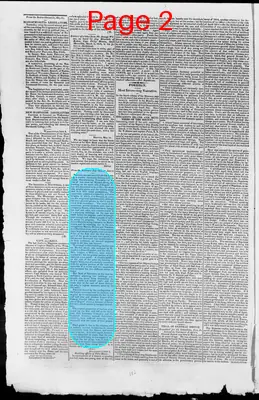
Virginia Argus
Richmond, Virginia
What is this article about?
A fire broke out early morning on June 5 in a Baltimore warehouse owned by the Union Manufacturing Company, destroying it and adjacent buildings including stores and shops. Cotton bales suspected as origin, possibly arson. Significant property loss, mostly insured; no casualties reported. Water supply issues noted.
Clipping
OCR Quality
Full Text
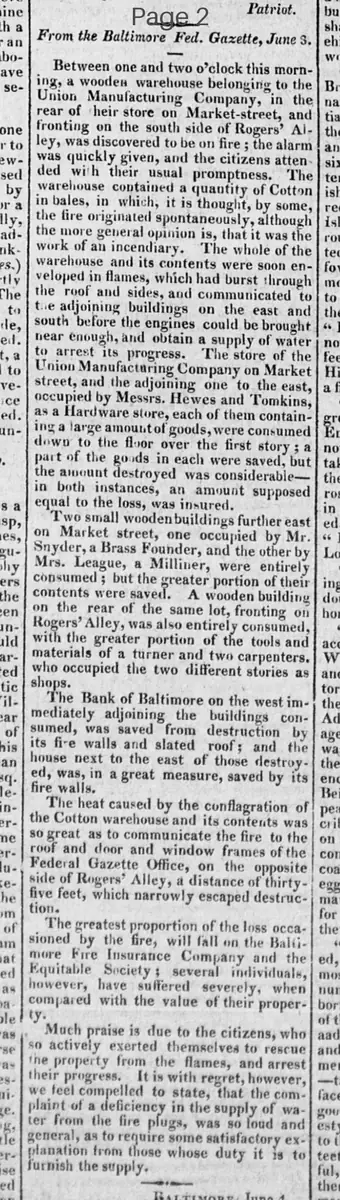
Between one and two o'clock this morning, a wooden warehouse belonging to the Union Manufacturing Company, in the rear of their store on Market-street, and fronting on the south side of Rogers' Alley, was discovered to be on fire; the alarm was quickly given, and the citizens attended with their usual promptness. The warehouse contained a quantity of Cotton in bales, in which, it is thought, by some, the fire originated spontaneously, although the more general opinion is, that it was the work of an incendiary. The whole of the warehouse and its contents were soon enveloped in flames, which had burst through the roof and sides, and communicated to the adjoining buildings on the east and south before the engines could be brought near enough, and obtain a supply of water to arrest its progress. The store of the Union Manufacturing Company on Market street, and the adjoining one to the east, occupied by Messrs. Hewes and Tomkins, as a Hardware store, each of them containing a large amount of goods, were consumed down to the floor over the first story; a part of the goods in each were saved, but the amount destroyed was considerable—in both instances, an amount supposed equal to the loss, was insured.
Two small wooden buildings further east on Market street, one occupied by Mr. Snyder, a Brass Founder, and the other by Mrs. League, a Milliner, were entirely consumed; but the greater portion of their contents were saved. A wooden building on the rear of the same lot, fronting on Rogers' Alley, was also entirely consumed, with the greater portion of the tools and materials of a turner and two carpenters, who occupied the two different stories as shops.
The Bank of Baltimore on the west immediately adjoining the buildings consumed, was saved from destruction by its fire walls and slated roof; and the house next to the east of those destroyed, was, in a great measure, saved by its fire walls.
The heat caused by the conflagration of the Cotton warehouse and its contents was so great as to communicate the fire to the roof and door and window frames of the Federal Gazette Office, on the opposite side of Rogers' Alley, a distance of thirty-five feet, which narrowly escaped destruction.
The greatest proportion of the loss occasioned by the fire, will fall on the Baltimore Fire Insurance Company and the Equitable Society; several individuals, however, have suffered severely, when compared with the value of their property.
Much praise is due to the citizens, who so actively exerted themselves to rescue the property from the flames, and arrest their progress. It is with regret, however, we feel compelled to state, that the complaint of a deficiency in the supply of water from the fire plugs, was so loud and general, as to require some satisfactory explanation from those whose duty it is to furnish the supply.
What sub-type of article is it?
What keywords are associated?
What entities or persons were involved?
Where did it happen?
Domestic News Details
Primary Location
Baltimore
Event Date
June 5
Key Persons
Outcome
warehouse and contents fully destroyed; union manufacturing company store and hewes and tomkins hardware store partially consumed with considerable goods lost but insured; snyder's and league's buildings fully consumed but most contents saved; rear shop building fully consumed with tools and materials lost; bank of baltimore and adjacent house saved by fire walls; federal gazette office narrowly escaped; losses mainly on baltimore fire insurance company and equitable society; no human casualties mentioned.
Event Details
Fire discovered between 1-2 AM in wooden warehouse of Union Manufacturing Company on Rogers' Alley, containing cotton bales; possibly spontaneous or arson. Flames spread to adjacent Market Street buildings before engines could act due to water supply issues; citizens assisted in saving property.