Thank you for visiting SNEWPapers!
Sign up free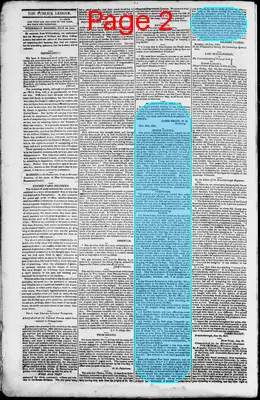
Norfolk Gazette And Publick Ledger
Norfolk, Virginia
What is this article about?
On June 9, 1805, the Philadelphia Society for Promoting Agriculture read Richard Peters' report on hoven (bloat) in cattle from wet clover feeding, detailing symptoms like swelling and pain, and cures such as stabbing to vent gas, urging prompt intervention to save livestock.
Clipping
OCR Quality
Full Text
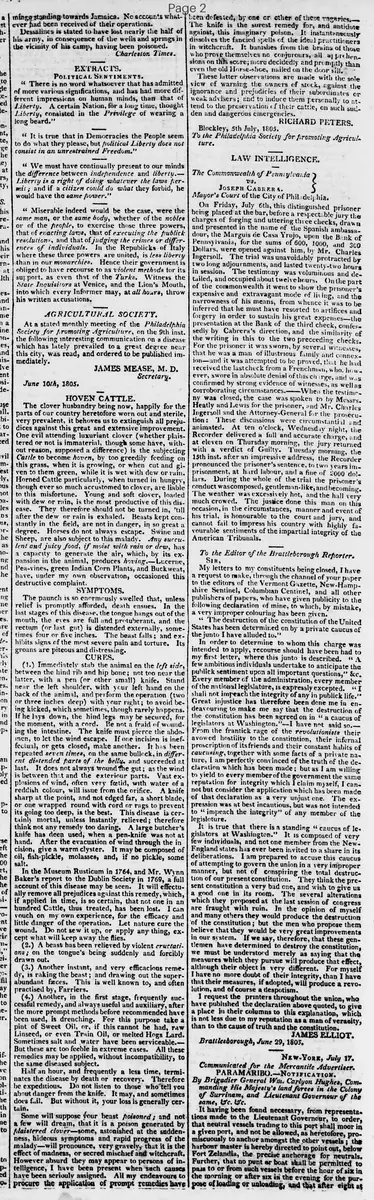
At a stated monthly meeting of the Philadelphia Society for Promoting Agriculture, on the 9th inst. the following interesting communication on a disease which has lately prevailed to a great degree near this city, was read, and ordered to be published immediately.
JAMES MEASE, M. D.
Secretary.
June 10th, 1805.
HOVEN CATTLE.
The clover husbandry being now, happily for the parts of our country heretofore worn out and sterile, very prevalent, it behoves us to extinguish all prejudices against this great and extensive improvement. One evil attending luxuriant clover (whether plaistered or not is immaterial, though some have, without reason, supposed a difference) is the subjecting Cattle to become hoven, by too greedily feeding on this grass, when it is growing, or when cut and given to them green, while it is wet with dew or rain. Horned Cattle particularly, when turned in hungry, though ever so much accustomed to clover, are liable to this misfortune. Young and soft clover, loaded with dew or rain, is the most productive of this disease. They therefore should not be turned in, 'till after the dew or rain is exhaled. Beasts kept constantly in the field, are not in danger, in so great a degree. Horses do not always escape. Swine and Sheep, are also subject to this malady. Any succulent and juicy food, if moist with rain or dew, has a capacity to generate the air, which, by its expansion in the animal, produces hoving.—Lucerne, Pea-vines, green Indian Corn Plants, and Buckwheat, have, under my own observation, occasioned this destructive complaint.
SYMPTOMS.
The paunch is so enormously swelled that, unless relief is promptly afforded, death ensues. In the last stages of this disease, the tongue hangs out of the mouth, the eyes are full and protuberant, and the rectum (or last gut) is distended externally, sometimes four or five inches. The beast falls: and exhibits signs of the most severe pain and torture. Its groans are piteous and distressing.
CURES.
(1.) Immediately stab the animal on the left side, between the hind rib and hip bone; not too near the latter, with a pen (or other small) knife. Stand near the left shoulder, with your left hand on the back of the animal, and perform the operation (two or three inches deep) with your right; to avoid being kicked, which sometimes, though rarely happens. If he lays down, the hind legs may be secured, for the moment, with a cord. Be not afraid of wounding the intestine. The knife must pierce the abdomen, to let the wind escape. If one incision is ineffectual, or gets closed, make another. It has been repeated seven times, on the same bullock, in different distended parts of the belly, and succeeded at last. It does not always wound the gut; as the wind is between that and the exterior parts. Vast explosions of wind, often very fetid, with water of a reddish colour, will issue from the orifice. A knife sharp at the point, and not edged far, a short blade, or one wrapped round with cord or rags to prevent its going too deep, is the best. This disease is certainly mortal, unless instantly relieved; therefore think not any remedy too daring. A large butcher's knife has been used; when a pen-knife was not at hand. After the evacuation of wind through the incision, give a warm clyster. It may be composed of oil, fish-pickle, molasses, and, if no pickle, some salt.
In the Museum Rusticum in 1764, and Mr. Wynn Baker's report to the Dublin Society in 1769, a full account of this disease may be seen. It will effectually remove all prejudices against this remedy, which, if applied in time, is so certain, that not one in an hundred Cattle, thus treated, has been lost. I can vouch on my own experience, for the efficacy and little danger of the operation. Let nature cure the wound. Do not sew it up, or apply any thing, except what will keep away the flies.
(2.) A beast has been relieved by violent cruciations; on the tongue's being suddenly and forcibly drawn out.
(3.) Another instant, and very efficacious remedy, is raking the beast; and drawing out the superabundant feces. This is well known to, and often practised by, Farriers.
(4.) Another, in the first stage, frequently successful remedy, and always useful and auxiliary, after the more prompt methods before recommended have been used, is drenching. For this purpose take a pint of Sweet Oil, or, if this cannot be had, raw Linseed, or even Train Oil, or melted Hogs Lard. Sometimes salt and water have been serviceable.—But these are too feeble in extreme cases. All these remedies may be applied, without incompatibility, to the same diseased subject.
Half an hour, and frequently a less time, terminates the disease by death or recovery. Therefore be expeditious. Do not listen to those who tell you about danger from the knife. It may, and sometimes does fail. But without it, your loss is generally certain.
Some will suppose your beast poisoned: and not a few will dream, that it is a poison generated by plaistered clover—some, astonished at the suddenness, hideous symptoms and rapid progress of the malady—will pronounce, very gravely, that it is the effect of madness, or secret mischief and witchcraft. However absurd they may appear to persons of intelligence, I have been present when such causes have been seriously assigned. All my endeavours to procure the application of prompt remedies have been defeated, by one or other of these vagaries.—The knife is the surest remedy for, and antidote against, this imaginary poison. It instantaneously dissolves the fancied spells of, the ideal practitioners in witchcraft. It banishes from the brains of those who prove themselves no conjurors, all apprehensions on this score; more decidedly and promptly than even the old Horse-shoe, nailed on the door sill.
These latter observations are made with the sole view of warning the owners of stock, against the ignorance and prejudices of their subordinates or weak advisers; and to induce them personally to attend to the preservation of their cattle, on such sudden and dangerous emergencies.
RICHARD PETERS.
Blockley, 5th July, 1805.
To the Philadelphia Society for promoting Agriculture.
What sub-type of article is it?
What keywords are associated?
What entities or persons were involved?
Where did it happen?
Domestic News Details
Primary Location
Philadelphia
Event Date
June 9, 1805
Key Persons
Outcome
cattle death from hoven unless promptly treated; cures like stabbing to release gas are effective, with rare losses if applied in time.
Event Details
At a monthly meeting of the Philadelphia Society for Promoting Agriculture, a communication by Richard Peters on hoven in cattle caused by feeding on luxuriant, dew- or rain-wet clover or similar succulent plants was read. It describes symptoms including severe abdominal swelling, protruding eyes, distended rectum, and painful distress leading to death. Cures include stabbing the left side to release gas, drawing out the tongue, raking feces, and drenching with oils; emphasizes prompt action over superstitions.