Thank you for visiting SNEWPapers!
Sign up free
Edgefield Advertiser
Edgefield, Edgefield County, South Carolina
What is this article about?
Historical document from year 1000 details compensation values in England: horse at 30 shillings, mare or colt at 20 shillings, mule or young ass at 12 shillings, compared to ox at 30 pence, cow at 24 pence, pig at 8 pence, and a man at 1 pound. Welsh laws of Hywel Dda value foals from 4 pence to broken horses at 120 pence.
Clipping
OCR Quality
Full Text
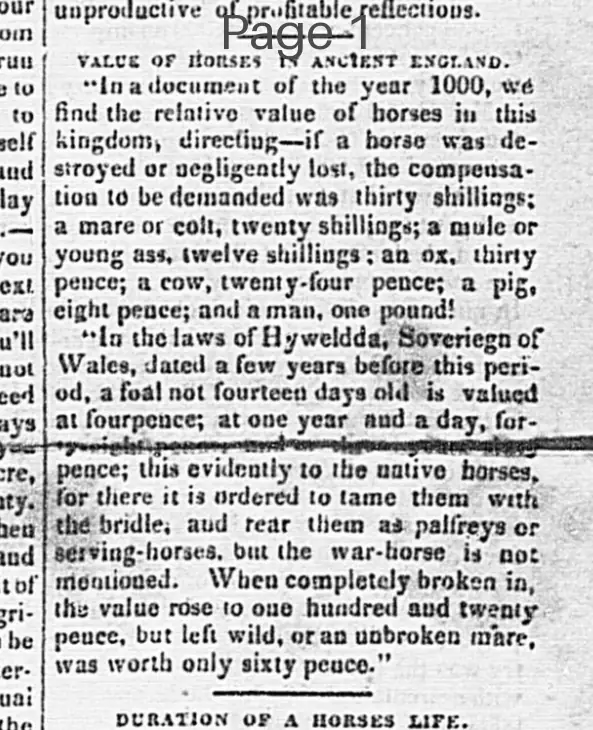
"In a document of the year 1000, we find the relative value of horses in this kingdom, directing—if a horse was destroyed or negligently lost, the compensation to be demanded was thirty shillings: a mare or colt, twenty shillings; a mule or young ass, twelve shillings: an ox, thirty pence; a cow, twenty-four pence; a pig, eight pence; and a man, one pound!
"In the laws of Hywel Dda, Sovereign of Wales, dated a few years before this period, a foal not fourteen days old is valued at four pence; at one year and a day, four pence; this evidently to the native horses, for there it is ordered to tame them with the bridle; and rear them as palfreys or serving-horses, but the war-horse is not mentioned. When completely broken in, the value rose to one hundred and twenty pence, but lest wild, or an unbroken mare, was worth only sixty pence."
What sub-type of article is it?
What keywords are associated?
What entities or persons were involved?
Where did it happen?
Filler Details
Topic
Relative Values Of Horses And Other Livestock In Ancient England And Wales
Location
England, Wales
Key Persons
Event Details
Document from year 1000 sets horse value at 30 shillings if destroyed or lost, mare or colt at 20 shillings, mule or young ass at 12 shillings; ox at 30 pence, cow at 24 pence, pig at 8 pence, man at 1 pound. Laws of Hywel Dda value foal under 14 days at 4 pence, one-year-old at 4 pence; broken horse at 120 pence, unbroken mare at 60 pence.