Thank you for visiting SNEWPapers!
Sign up free
Editorial
March 17, 1820
Kentucky Gazette
Lexington, Fayette County, Kentucky
What is this article about?
This editorial from the National Intelligencer critiques Federalist leaders in New England for fostering sectionalism and secessionist sentiments against the Jefferson and Madison administrations, citing British agent Henry's 1809 letter and Samuel Dexter's opposition to a proposed state convention in 1812.
Clipping
OCR Quality
95%
Excellent
Full Text
Hartford Convention.
From the National Intelligencer.
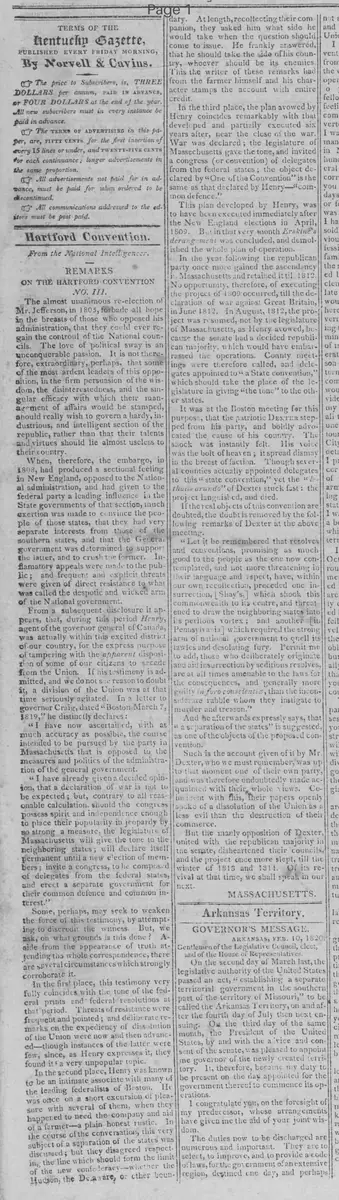
REMARKS ON THE HARTFORD CONVENTION NO. III.
The almost unanimous re-election of Mr. Jefferson, in 1805, forbade all hope in the breasts of those who opposed his administration, that they could ever regain the controul of the National councils. The love of political sway is an unconquerable passion. It is not therefore, extraordinary, perhaps, that some of the most ardent leaders of this opposition, in the firm persuasion of the wisdom, the disinterestedness, and the singular efficacy with which their management of affairs would be stamped, should really wish to govern a hardy, industrious, and intelligent section of the republic, rather than that their talents and virtues should lie almost useless to their country.
When, therefore, the embargo, in 1808, had produced a sectional feeling in New England, opposed to the National administration, and had given to the federal party a leading influence in the State governments of that section, much exertion was made to convince the people of those states, that they had very separate interests from those of the southern states, and that the General government was determined to support the latter, and to crush the former. Inflammatory appeals were made to the public; and frequent and explicit threats were given of direct resistance to what was called the despotic and wicked arm of the National government.
From a subsequent disclosure it appears, that, during this period Henry, agent of the governor general of Canada, was actually within this excited district of our country, for the express purpose of tampering with the apparent disposition of some of our citizens to secede from the Union. If his testimony is admitted, and we see no reason to doubt it, a division of the Union was at that time seriously agitated. In a letter to governor Craig, dated "Boston March 7, 1819," he distinctly declares:
"I have now ascertained, with as much accuracy as possible, the course intended to be pursued by the party in Massachusetts that is opposed to the measures and politics of the administration of the general government.
"I have already given a decided opinion, that a declaration of war is not to be expected; but, contrary to all reasonable calculation, should the congress possess spirit and independence enough to place their popularity in jeopardy by so strong a measure, the legislature of Massachusetts will give the tone to the neighboring states; will declare itself permanent until a new election of members; invite a congress, to be composed of delegates from the federal states, and erect a separate government for their common defence and common interest."
Some, perhaps, may seek to weaken the force of this testimony, by attempting to discredit the witness. But, we ask, on what grounds is this done? Aside from the appearance of truth attending the whole correspondence, there are several circumstances which strongly corroborate it.
In the first place, this testimony very fully coincides with the tone of the federal prints and federal resolutions at that period. Threats of resistance were frequent and pointed; and deliberate remarks on the expediency of dissolution of the Union were now and then advanced—though instances of the latter were few, since, as Henry expresses it, they found it 'a very unpopular topic.'
In the second place, Henry was known to be an intimate associate with many of the leading federalists of Boston. He was once on a short excursion of pleasure with several of them, when they happened to need the company and aid of a farmer—a plain honest rustic. In the course of the conversation, this very subject of a separation of the states was discussed; but they disagreed respecting the line which should form the limit of the new confederacy—whether the Hudson, the Delaware, or other boundary.
At length, recollecting their companion, they asked him what side he would take when the question should come to issue. He frankly answered, that he should take the side of his country, whoever should be its enemies. This the writer of these remarks had from the farmer himself and his character stamps the account with entire credit.
In the third place, the plan avowed by Henry coincides remarkably with that developed and partially executed six years after, near the close of the war. War was declared: the legislature of Massachusetts gave the tone, and invited a congress (or convention) of delegates from the federal states; the object declared by "One of the Convention" is the same as that declared by Henry—"common defence."
This plan developed by Henry, was to have been executed immediately after the New England elections in April, 1809. But in that very month Erskine's arrangement was concluded, and demolished the whole plan of operation. In the year following the republican party once more gained the ascendancy in Massachusetts and retained it till 1812. No opportunity, therefore, of executing the project of 1809 occurred, till the declaration of war against Great Britain, in June 1812. In August, 1812, the project was resumed, not by the legislature of Massachusetts, as Henry avowed, because the senate had a decided republican majority, which would have embarrassed the operations. County meetings were therefore called, and delegates appointed to "a State convention," which should take the place of the legislature in giving "the tone" to the other states.
It was at the Boston meeting for this purpose, that the patriotic Dexter stepped from his party, and boldly advocated the cause of his country. The shock was instantly felt. His voice was the bolt of heaven; it spread dismay in the breast of faction. Though several counties actually appointed delegates to this "state convention," yet the "lethatis arundo" of Dexter stuck fast: the project languished, and died.
If the real objects of this convention are doubted, the doubt is removed by the following remarks of Dexter at the above meeting.
"Let it be remembered that resolves and conventions, promising as much good to the people as the one now contemplated, and not more threatening in their language and aspect, have, within our own recollection, preceded one insurrection, [Shay's,] which shook this commonwealth to its centre, and threatened to draw the neighboring states into its perilous vortex; and another in Pennsylvania] which required the strong arm of national government to quell its lawless and desolating fury. Permit me to add, those who deliberately originate and aid insurrection by seditious resolves, are at all times amenable to the laws for the consequences, and generally more guilty in foro conscientiae, than the inconsiderate rabble whom they instigate to murder and treason."
And he afterwards expressly says, that "a separation of the states" is suggested, as one of the objects of the proposed convention.
Such is the account given of it by Mr. Dexter, who we must remember, was up to that moment one of their own party, and was therefore undoubtedly made acquainted with their whole views. Coincident with this, their papers openly spoke of a dissolution of the Union as a less evil than the destruction of their commerce.
But the manly opposition of Dexter, united with the republican majority in the senate, disheartened their councils, and the project once more slept, till the winter of 1813 and 1814. Of its revival at that time, we shall speak in our next.
From the National Intelligencer.
REMARKS ON THE HARTFORD CONVENTION NO. III.
The almost unanimous re-election of Mr. Jefferson, in 1805, forbade all hope in the breasts of those who opposed his administration, that they could ever regain the controul of the National councils. The love of political sway is an unconquerable passion. It is not therefore, extraordinary, perhaps, that some of the most ardent leaders of this opposition, in the firm persuasion of the wisdom, the disinterestedness, and the singular efficacy with which their management of affairs would be stamped, should really wish to govern a hardy, industrious, and intelligent section of the republic, rather than that their talents and virtues should lie almost useless to their country.
When, therefore, the embargo, in 1808, had produced a sectional feeling in New England, opposed to the National administration, and had given to the federal party a leading influence in the State governments of that section, much exertion was made to convince the people of those states, that they had very separate interests from those of the southern states, and that the General government was determined to support the latter, and to crush the former. Inflammatory appeals were made to the public; and frequent and explicit threats were given of direct resistance to what was called the despotic and wicked arm of the National government.
From a subsequent disclosure it appears, that, during this period Henry, agent of the governor general of Canada, was actually within this excited district of our country, for the express purpose of tampering with the apparent disposition of some of our citizens to secede from the Union. If his testimony is admitted, and we see no reason to doubt it, a division of the Union was at that time seriously agitated. In a letter to governor Craig, dated "Boston March 7, 1819," he distinctly declares:
"I have now ascertained, with as much accuracy as possible, the course intended to be pursued by the party in Massachusetts that is opposed to the measures and politics of the administration of the general government.
"I have already given a decided opinion, that a declaration of war is not to be expected; but, contrary to all reasonable calculation, should the congress possess spirit and independence enough to place their popularity in jeopardy by so strong a measure, the legislature of Massachusetts will give the tone to the neighboring states; will declare itself permanent until a new election of members; invite a congress, to be composed of delegates from the federal states, and erect a separate government for their common defence and common interest."
Some, perhaps, may seek to weaken the force of this testimony, by attempting to discredit the witness. But, we ask, on what grounds is this done? Aside from the appearance of truth attending the whole correspondence, there are several circumstances which strongly corroborate it.
In the first place, this testimony very fully coincides with the tone of the federal prints and federal resolutions at that period. Threats of resistance were frequent and pointed; and deliberate remarks on the expediency of dissolution of the Union were now and then advanced—though instances of the latter were few, since, as Henry expresses it, they found it 'a very unpopular topic.'
In the second place, Henry was known to be an intimate associate with many of the leading federalists of Boston. He was once on a short excursion of pleasure with several of them, when they happened to need the company and aid of a farmer—a plain honest rustic. In the course of the conversation, this very subject of a separation of the states was discussed; but they disagreed respecting the line which should form the limit of the new confederacy—whether the Hudson, the Delaware, or other boundary.
At length, recollecting their companion, they asked him what side he would take when the question should come to issue. He frankly answered, that he should take the side of his country, whoever should be its enemies. This the writer of these remarks had from the farmer himself and his character stamps the account with entire credit.
In the third place, the plan avowed by Henry coincides remarkably with that developed and partially executed six years after, near the close of the war. War was declared: the legislature of Massachusetts gave the tone, and invited a congress (or convention) of delegates from the federal states; the object declared by "One of the Convention" is the same as that declared by Henry—"common defence."
This plan developed by Henry, was to have been executed immediately after the New England elections in April, 1809. But in that very month Erskine's arrangement was concluded, and demolished the whole plan of operation. In the year following the republican party once more gained the ascendancy in Massachusetts and retained it till 1812. No opportunity, therefore, of executing the project of 1809 occurred, till the declaration of war against Great Britain, in June 1812. In August, 1812, the project was resumed, not by the legislature of Massachusetts, as Henry avowed, because the senate had a decided republican majority, which would have embarrassed the operations. County meetings were therefore called, and delegates appointed to "a State convention," which should take the place of the legislature in giving "the tone" to the other states.
It was at the Boston meeting for this purpose, that the patriotic Dexter stepped from his party, and boldly advocated the cause of his country. The shock was instantly felt. His voice was the bolt of heaven; it spread dismay in the breast of faction. Though several counties actually appointed delegates to this "state convention," yet the "lethatis arundo" of Dexter stuck fast: the project languished, and died.
If the real objects of this convention are doubted, the doubt is removed by the following remarks of Dexter at the above meeting.
"Let it be remembered that resolves and conventions, promising as much good to the people as the one now contemplated, and not more threatening in their language and aspect, have, within our own recollection, preceded one insurrection, [Shay's,] which shook this commonwealth to its centre, and threatened to draw the neighboring states into its perilous vortex; and another in Pennsylvania] which required the strong arm of national government to quell its lawless and desolating fury. Permit me to add, those who deliberately originate and aid insurrection by seditious resolves, are at all times amenable to the laws for the consequences, and generally more guilty in foro conscientiae, than the inconsiderate rabble whom they instigate to murder and treason."
And he afterwards expressly says, that "a separation of the states" is suggested, as one of the objects of the proposed convention.
Such is the account given of it by Mr. Dexter, who we must remember, was up to that moment one of their own party, and was therefore undoubtedly made acquainted with their whole views. Coincident with this, their papers openly spoke of a dissolution of the Union as a less evil than the destruction of their commerce.
But the manly opposition of Dexter, united with the republican majority in the senate, disheartened their councils, and the project once more slept, till the winter of 1813 and 1814. Of its revival at that time, we shall speak in our next.
What sub-type of article is it?
Partisan Politics
Constitutional
War Or Peace
What keywords are associated?
Hartford Convention
Federalist Opposition
Secession Threats
New England Sectionalism
British Intrigue
Samuel Dexter
Embargo 1808
War Of 1812
What entities or persons were involved?
Mr. Jefferson
Federal Party
Henry (British Agent)
Governor Craig
Samuel Dexter
Massachusetts Legislature
National Intelligencer
Editorial Details
Primary Topic
Federalist Secession Threats In New England During Embargo And War
Stance / Tone
Critical Of Federalist Opposition And Supportive Of National Union
Key Figures
Mr. Jefferson
Federal Party
Henry (British Agent)
Governor Craig
Samuel Dexter
Massachusetts Legislature
National Intelligencer
Key Arguments
Federalists Sought To Control New England Separately Due To Loss Of National Power After Jefferson's Re Election.
Embargo Of 1808 Fueled Sectionalism And Threats Of Resistance To National Government.
British Agent Henry Documented Plans For Secession And Separate Government In Case Of War.
Federalist Prints And Resolutions Echoed Threats Of Union Dissolution.
Henry's Associates Discussed Boundaries For A New Confederacy.
Similar Plans Resurfaced In 1812 With State Convention Proposals, Opposed By Dexter.
Dexter Warned Of Insurrection Risks And Affirmed Separation As A Convention Object.
Project Failed Due To Dexter's Opposition And Republican Senate Majority.