Thank you for visiting SNEWPapers!
Sign up free
The Virginia Gazette
Richmond, Williamsburg, Richmond County, Virginia
What is this article about?
Letter from Rotterdam details English distress in 1779 war with America: perplexed, divided society; inferior forces to French/Spanish fleets near Plymouth; rumors of invasions in Ireland; Dutch reluctance to aid Britain; widespread belief England has lost America.
Clipping
OCR Quality
Full Text
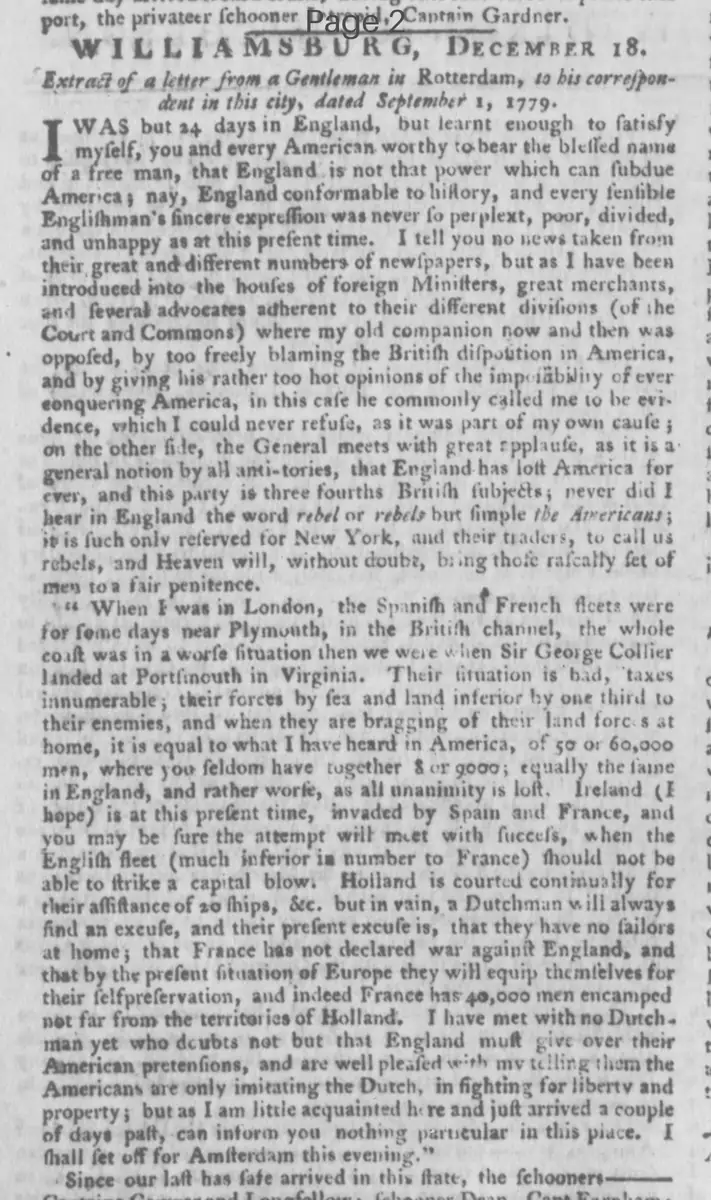
Extract of a letter from a Gentleman in Rotterdam, to his correspondent in this city, dated September 1, 1779.
I was but 24 days in England, but learnt enough to satisfy myself, you and every American worthy to bear the blessed name of a free man, that England is not that power which can subdue America; nay, England conformable to history, and every sensible Englishman's sincere expression was never so perplexed, poor, divided, and unhappy as at this present time. I tell you no news taken from their great and different numbers of newspapers, but as I have been introduced into the houses of foreign Ministers, great merchants, and several advocates adherent to their different divisions (of the Court and Commons) where my old companion now and then was opposed, by too freely blaming the British disposition in America, and by giving his rather too hot opinions of the impossibility of ever conquering America, in this case he commonly called me to be evidence, which I could never refuse, as it was part of my own cause; on the other side, the General meets with great applause, as it is a general notion by all anti-tories, that England has lost America for ever, and this party is three fourths British subjects; never did I hear in England the word rebel or rebels but simply the Americans; it is such only reserved for New York, and their traducers, to call us rebels, and Heaven will, without doubt, bring those really so to a fair penitence.
When I was in London, the Spanish and French fleets were for some days near Plymouth, in the British channel, the whole coast was in a worse situation than we were when Sir George Collier landed at Portsmouth in Virginia. Their situation is bad, taxes innumerable; their forces by sea and land inferior by one third to their enemies, and when they are bragging of their land forces at home, it is equal to what I have heard in America, of 50 or 60,000 men, where you seldom have together 8 or 9000; equally the same in England, and rather worse, as all unanimity is lost, Ireland (I hope) is at this present time, invaded by Spain and France, and you may be sure the attempt will meet with success, when the English fleet (much inferior in number to France) should not be able to strike a capital blow. Holland is courted continually for their assistance of 20 ships, &c. but in vain, a Dutchman will always find an excuse, and their present excuse is, that they have no sailors at home; that France has not declared war against England, and that by the present situation of Europe they will equip themselves for their self-preservation, and indeed France has 40,000 men encamped not far from the territories of Holland. I have met with no Dutchman yet who doubts not but that England must give over their American pretensions, and are well pleased with my telling them the Americans are only imitating the Dutch, in fighting for liberty and property; but as I am little acquainted here and just arrived a couple of days past, can inform you nothing particular in this place. I shall set off for Amsterdam this evening.
What sub-type of article is it?
What keywords are associated?
What entities or persons were involved?
Where did it happen?
Foreign News Details
Primary Location
England
Event Date
September 1, 1779
Key Persons
Outcome
england's forces inferior by one third to enemies; widespread belief that england has lost america forever; anti-tory party comprises three fourths of british subjects.
Event Details
Gentleman reports from England: society perplexed, divided, unhappy; Spanish and French fleets near Plymouth alarming coast; heavy taxes; inferior sea and land forces; exaggerated troop numbers; loss of unanimity; rumors of Spanish and French invasion of Ireland likely to succeed due to inferior English fleet; Dutch courted for aid but refuse, citing lack of sailors and self-preservation amid French encampment nearby; Dutch view Americans as imitating their fight for liberty.