Thank you for visiting SNEWPapers!
Sign up free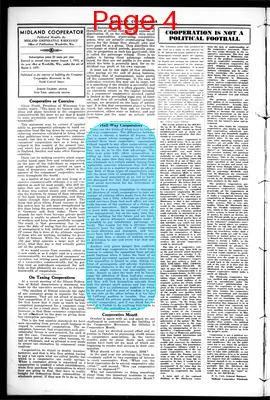
Editorial
October 1, 1936
Midland Cooperator
Minneapolis, Hennepin County, Minnesota
What is this article about?
The editorial criticizes 'half-way cooperators' who partially engage with the cooperative movement, arguing they undermine its social goals by buying from private businesses and fail to build lasting strength against opposition from profit-driven entities.
Clipping
OCR Quality
98%
Excellent
Full Text
Half-Way Cooperators
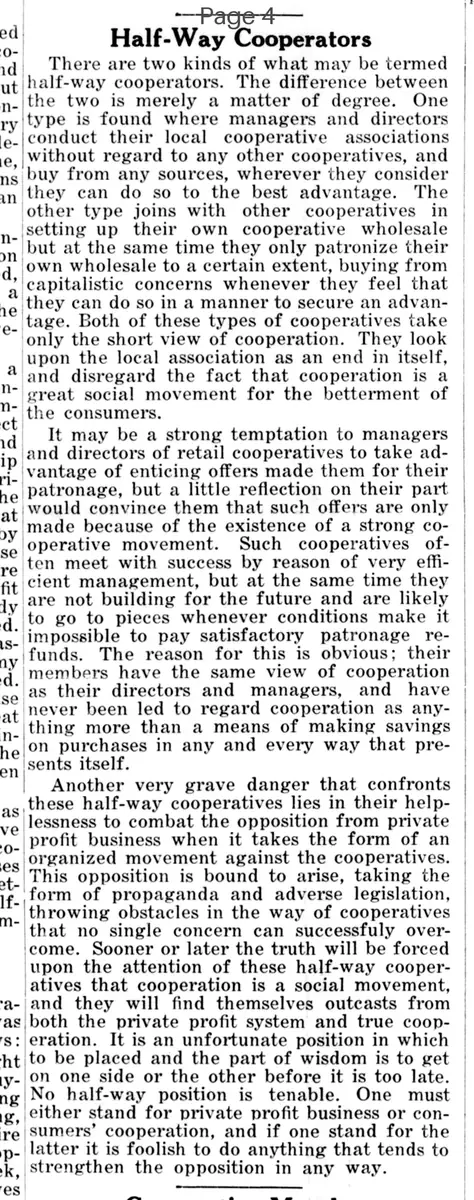
There are two kinds of what may be termed half-way cooperators. The difference between the two is merely a matter of degree. One type is found where managers and directors conduct their local cooperative associations without regard to any other cooperatives, and buy from any sources, wherever they consider they can do so to the best advantage. The other type joins with other cooperatives in setting up their own cooperative wholesale but at the same time they only patronize their own wholesale to a certain extent, buying from capitalistic concerns whenever they feel that they can do so in a manner to secure an advantage. Both of these types of cooperatives take only the short view of cooperation. They look upon the local association as an end in itself, and disregard the fact that cooperation is a great social movement for the betterment of the consumers.
It may be a strong temptation to managers and directors of retail cooperatives to take advantage of enticing offers made them for their patronage, but a little reflection on their part would convince them that such offers are only made because of the existence of a strong cooperative movement. Such cooperatives often meet with success by reason of very efficient management, but at the same time they are not building for the future and are likely to go to pieces whenever conditions make it impossible to pay satisfactory patronage refunds. The reason for this is obvious: their members have the same view of cooperation as their directors and managers, and have never been led to regard cooperation as anything more than a means of making savings on purchases in any and every way that presents itself.
Another very grave danger that confronts these half-way cooperatives lies in their helplessness to combat the opposition from private profit business when it takes the form of an organized movement against the cooperatives. This opposition is bound to arise, taking the form of propaganda and adverse legislation, throwing obstacles in the way of cooperatives that no single concern can successfully overcome. Sooner or later the truth will be forced upon the attention of these half-way cooperatives that cooperation is a social movement, and they will find themselves outcasts from both the private profit system and true cooperation. It is an unfortunate position in which to be placed and the part of wisdom is to get on one side or the other before it is too late. No half-way position is tenable. One must either stand for private profit business or consumers' cooperation, and if one stand for the latter it is foolish to do anything that tends to strengthen the opposition in any way.
There are two kinds of what may be termed half-way cooperators. The difference between the two is merely a matter of degree. One type is found where managers and directors conduct their local cooperative associations without regard to any other cooperatives, and buy from any sources, wherever they consider they can do so to the best advantage. The other type joins with other cooperatives in setting up their own cooperative wholesale but at the same time they only patronize their own wholesale to a certain extent, buying from capitalistic concerns whenever they feel that they can do so in a manner to secure an advantage. Both of these types of cooperatives take only the short view of cooperation. They look upon the local association as an end in itself, and disregard the fact that cooperation is a great social movement for the betterment of the consumers.
It may be a strong temptation to managers and directors of retail cooperatives to take advantage of enticing offers made them for their patronage, but a little reflection on their part would convince them that such offers are only made because of the existence of a strong cooperative movement. Such cooperatives often meet with success by reason of very efficient management, but at the same time they are not building for the future and are likely to go to pieces whenever conditions make it impossible to pay satisfactory patronage refunds. The reason for this is obvious: their members have the same view of cooperation as their directors and managers, and have never been led to regard cooperation as anything more than a means of making savings on purchases in any and every way that presents itself.
Another very grave danger that confronts these half-way cooperatives lies in their helplessness to combat the opposition from private profit business when it takes the form of an organized movement against the cooperatives. This opposition is bound to arise, taking the form of propaganda and adverse legislation, throwing obstacles in the way of cooperatives that no single concern can successfully overcome. Sooner or later the truth will be forced upon the attention of these half-way cooperatives that cooperation is a social movement, and they will find themselves outcasts from both the private profit system and true cooperation. It is an unfortunate position in which to be placed and the part of wisdom is to get on one side or the other before it is too late. No half-way position is tenable. One must either stand for private profit business or consumers' cooperation, and if one stand for the latter it is foolish to do anything that tends to strengthen the opposition in any way.
What sub-type of article is it?
Social Reform
Economic Policy
What keywords are associated?
Cooperatives
Half Way Cooperators
Consumers Cooperation
Social Movement
Private Profit Opposition
What entities or persons were involved?
Half Way Cooperators
Private Profit Business
Consumers' Cooperation
Editorial Details
Primary Topic
Critique Of Half Way Cooperators
Stance / Tone
Advocating Full Commitment To Consumers' Cooperation
Key Figures
Half Way Cooperators
Private Profit Business
Consumers' Cooperation
Key Arguments
Half Way Cooperators Take A Short View, Treating Local Associations As Ends In Themselves Rather Than Part Of A Social Movement.
Tempting Offers From Private Sources Exist Due To The Cooperative Movement But Undermine Long Term Stability.
Such Cooperatives Risk Collapse Without Satisfactory Refunds And Fail To Educate Members On True Cooperation.
They Are Helpless Against Organized Opposition Like Propaganda And Adverse Legislation From Private Profit Businesses.
No Half Way Position Is Tenable; One Must Fully Commit To Either Private Profit Or True Cooperation.