Thank you for visiting SNEWPapers!
Sign up free
The Daily Alaska Empire
Juneau, Juneau County, Alaska
What is this article about?
In 1931, aviation set new records for speed, distance, and altitude. Highlights include Wiley Post and Harold Gatty's 8-day world flight, G.H. Stainforth's 406.69 mph speed record, Russell Boardman and John Poland's 5,011-mile nonstop flight to Istanbul, and various transatlantic and transpacific crossings, with commercial aviation expanding.
Merged-components note: Aviation article spans multiple blocks on page 1 and continues on page 3; all parts form a single coherent story on aviation achievements in 1931.
Clippings
1 of 2
OCR Quality
Full Text
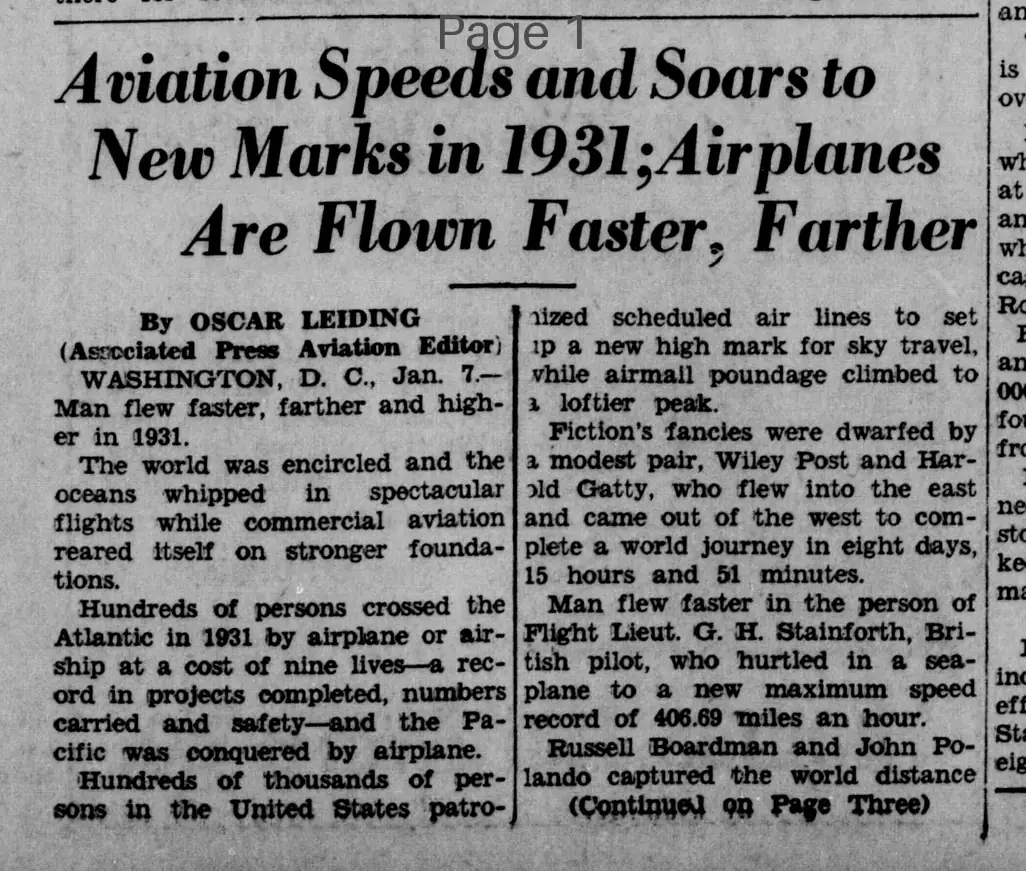
By OSCAR LEIDING
(Associated Press Aviation Editor)
WASHINGTON, D.C., Jan. 7.-
Man flew faster, farther and higher in 1931.
The world was encircled and the oceans whipped in spectacular flights while commercial aviation reared itself on stronger foundations.
Hundreds of persons crossed the Atlantic in 1931 by airplane or airship at a cost of nine lives—a record in projects completed, numbers carried and safety—and the Pacific was conquered by airplane.
Hundreds of thousands of persons in the United States patronized scheduled air lines to set up a new high mark for sky travel, while airmail poundage climbed to a loftier peak.
Fiction's fancies were dwarfed by a modest pair, Wiley Post and Harold Gatty, who flew into the east and came out of the west to complete a world journey in eight days, 15 hours and 51 minutes.
Man flew faster in the person of Flight Lieut. G. H. Stainforth, British pilot, who hurtled in a seaplane to a new maximum speed record of 406.69 miles an hour.
Russell Boardman and John Poland captured the world distance mark by flying nonstop 5,011.8 miles from New York to Istanbul, Turkey.
Into Stratosphere
Prof. August Piccard and Charles Kipfer, sealed in an aluminum ball made a balloon voyage into the stratosphere 51,755 feet above the earth, an altitude of nearly 10 miles.
Balked from beating the Post-Gatty time, Clyde Panghorn and Hugh Herndon, Jr., achieved the first nonstop flight from Japan to the United States.
Gen. Italo Balbo added a new touch to ocean flying by leading a squadron of Italian planes across the south Atlantic in formation.
The fever of new exploits was caught by Col. Charles A. Lindbergh, who, with his wife, on a "vacation" trip, blazed the trail from the east coast of the United States upward to the Arctic Circle and down to Japan and China.
Flying Boat
Germany's giant flying boat, the DO-X, flew the south Atlantic; the Graf Zeppelin made three round-trip commercial flights between Germany and Brazil, and Captain Bert Hinkler spanned the ocean in an eastward hop.
Successful nonstop flights over the north Atlantic were made from Newfoundland by Otto Hillig and Holger Hoiriis to Germany and by Capts. Alexander Maygar and George Endres to Hungary.
Lighter-than-air leadership was assumed by the United States on completion of the world's largest airship, the U. S. S. Akron.
Other feats of the year included England's gaining permanent possession of the Schneider trophy and Maj. James H. Doolittle's west to east transcontinental record flight of 11 hours and 16 minutes.
What sub-type of article is it?
What themes does it cover?
What keywords are associated?
What entities or persons were involved?
Where did it happen?
Story Details
Key Persons
Location
Worldwide, Including Atlantic, Pacific, United States, Turkey, Japan, China, Brazil, Newfoundland, Hungary
Event Date
1931
Story Details
Aviation achievements in 1931 included world encircling flights, ocean crossings, speed and distance records, stratosphere balloon ascent, and expansion of commercial air travel.