Thank you for visiting SNEWPapers!
Sign up free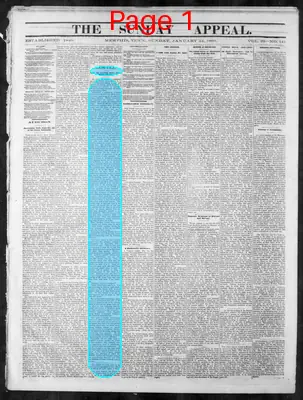
Story
January 24, 1869
Memphis Daily Appeal
Memphis, Shelby County, Tennessee
What is this article about?
A correspondent describes the harsh living and working conditions of female factory operatives in Lowell, Massachusetts, likening their exploitation to 'white slavery.' Details include long hours, low wages, strict rules, and meager accommodations for over 25,000 workers in 48 mills.
Clipping

OCR Quality
95%
Excellent
Full Text
LOWELL.
How the Factory Girls Live—White Slavery.
Mr. Jerome B. Stillson, a correspondent of the World, (better known as "J. B. S.,") has been flirting a trifle with the Lowell factory girls, of which he publishes an account in Saturday's World, from which we learn the following interesting facts:
Lowell has a population of thirty-two thousand females and fifteen thousand males, comprising six thousand four hundred families. Sixteen thousand of the population are bachelors, maids, orphans "and people disconnected from home." About 25,000 men, women and children are employed about the cotton, woolen and iron mills, of which there are forty-eight of large size, run by water of 10,000 horse power. Fourteen millions of dollars of capital stock are used here: the mills have 500,000 spindles and 13,000 looms; 2,250,000 yards of cotton goods, 20,000 yards of woolen goods, 35,000 yards of carpets, 25,000 shawls, and 6000 dozen pairs of hose are manufactured every week.
The female laborers work from $3 to $3.75 per week; the male from $1.20 to $2.00 per day, and board themselves. The Merrimac Manufacturing Company's mills are the most extensive, and employ a capital of two and a half millions of dollars. Nearly all the manufacturing corporations here own land adjacent to the mills, upon which dwelling and boarding houses are erected at the companies' cost. The dwelling houses are leased to the officers of the companies. The boarding houses are leased to landlords or landladies, with whom the companies arrange for the board of a certain number of operatives, or for the price of board of each operative. The price of board is determined between the companies' agents and the landlords and landladies, as, also, are the variations of the price which may result from the stringency or the ease of the times. The operatives have, therefore, no bargaining to do in the matter. They simply pay the price which may be established, a price the most economical that can be maintained. The keepers of the boarding houses are held to a strict account by the agents. Rules are established, according to which none of the girls are suffered to be out after a certain hour in the evening, and the houses are closed at 10 o'clock p.m. On the grounds of this company a watchman is detailed, whose duty it is to report any violations of these rules or any irregularities that may come under his notice. Their meals have to be on the table at just such a minute. Breakfast at six o'clock, so they can be in the mills and at work at half past six. The first bell rings at half past four in the morning, the second bell at half past five, and the bell for them to go to the factory, at twenty minutes past six. They have thirty-five minutes to eat their dinner in. The bell rings at noon, and they must commence work at a quarter to one. They stop at half-past six in the afternoon, except Saturdays, when they let them out at five.
These boarding houses have a very nice parlor and sitting room in which the girls huddle together during the winter evenings, as they can not afford to have fire in their rooms.
A gossiping landlady showed the correspondent to some of the girls' rooms, and entertained him with the following discourse:
"You can't expect to find Brussels carpets and fine chimney ornaments everywhere," she proceeded, with a shrewd, sad smile. "This is how girls live who have to work for it, and who may thank their stars and me that things are kept clean, anyway. There's a specimen wardrobe, hanging against the wall. Look for yourself—dresses, night gowns, underclothes, and all. Not many fine dresses, you say. Well, if that little trunk over there was unlocked and thrown open, you'd be astonished to see what is in it. Trust me; there ain't many girls who don't keep one nice suit stowed away to wear on Sundays and at parties, or when a gentleman comes to take them to a lecture. There are some who don't, to be sure. I've got some girls who haven't been out of the house after they came home from work since I can remember."
"They get too tired, I suppose?"
"Tired! Tired is no name for it. I've seen girls come in here at night trembling all over like leaves, with no more appetite than as if they hadn't stomachs. All they wanted to do was to crawl up stairs and fall down on their beds and groan."
The correspondent expressing a desire to have a conversation with some of the girls, was invited to call in the evening, which he did, and was shown into a parlor, where to him "reflecting upon the number and variety of flirtations which had been carried on in that very parlor," presently appeared "three dignified young women of repressed demeanor, who curtsied extremely low."
After quite a lengthy conversation, portions of which are detailed and show that their tittle-tattle was no more or no less insipid than that of an accomplished boarding-school miss; but which, nevertheless, Jenkins informs us, "served, from first to last, to strengthen the fibre of his respect for the young women who granted him their presence." He left them to indulge the following evidently very appropriate and just reflections:
Their pride did not suffer them to complain, or reveal one-half the straits of their condition: they defended what was suggested as cruel or unfortunate, and palliated what was indefensible. It was easy enough to see that they toiled and lived under a system of slavery as absolute as that dead-and-gone system against the phantasm of which Mr. Wendell Phillips still thunders through the Anti-Slavery Standard and from the rostrums of lecture halls throughout the land.
How the Factory Girls Live—White Slavery.
Mr. Jerome B. Stillson, a correspondent of the World, (better known as "J. B. S.,") has been flirting a trifle with the Lowell factory girls, of which he publishes an account in Saturday's World, from which we learn the following interesting facts:
Lowell has a population of thirty-two thousand females and fifteen thousand males, comprising six thousand four hundred families. Sixteen thousand of the population are bachelors, maids, orphans "and people disconnected from home." About 25,000 men, women and children are employed about the cotton, woolen and iron mills, of which there are forty-eight of large size, run by water of 10,000 horse power. Fourteen millions of dollars of capital stock are used here: the mills have 500,000 spindles and 13,000 looms; 2,250,000 yards of cotton goods, 20,000 yards of woolen goods, 35,000 yards of carpets, 25,000 shawls, and 6000 dozen pairs of hose are manufactured every week.
The female laborers work from $3 to $3.75 per week; the male from $1.20 to $2.00 per day, and board themselves. The Merrimac Manufacturing Company's mills are the most extensive, and employ a capital of two and a half millions of dollars. Nearly all the manufacturing corporations here own land adjacent to the mills, upon which dwelling and boarding houses are erected at the companies' cost. The dwelling houses are leased to the officers of the companies. The boarding houses are leased to landlords or landladies, with whom the companies arrange for the board of a certain number of operatives, or for the price of board of each operative. The price of board is determined between the companies' agents and the landlords and landladies, as, also, are the variations of the price which may result from the stringency or the ease of the times. The operatives have, therefore, no bargaining to do in the matter. They simply pay the price which may be established, a price the most economical that can be maintained. The keepers of the boarding houses are held to a strict account by the agents. Rules are established, according to which none of the girls are suffered to be out after a certain hour in the evening, and the houses are closed at 10 o'clock p.m. On the grounds of this company a watchman is detailed, whose duty it is to report any violations of these rules or any irregularities that may come under his notice. Their meals have to be on the table at just such a minute. Breakfast at six o'clock, so they can be in the mills and at work at half past six. The first bell rings at half past four in the morning, the second bell at half past five, and the bell for them to go to the factory, at twenty minutes past six. They have thirty-five minutes to eat their dinner in. The bell rings at noon, and they must commence work at a quarter to one. They stop at half-past six in the afternoon, except Saturdays, when they let them out at five.
These boarding houses have a very nice parlor and sitting room in which the girls huddle together during the winter evenings, as they can not afford to have fire in their rooms.
A gossiping landlady showed the correspondent to some of the girls' rooms, and entertained him with the following discourse:
"You can't expect to find Brussels carpets and fine chimney ornaments everywhere," she proceeded, with a shrewd, sad smile. "This is how girls live who have to work for it, and who may thank their stars and me that things are kept clean, anyway. There's a specimen wardrobe, hanging against the wall. Look for yourself—dresses, night gowns, underclothes, and all. Not many fine dresses, you say. Well, if that little trunk over there was unlocked and thrown open, you'd be astonished to see what is in it. Trust me; there ain't many girls who don't keep one nice suit stowed away to wear on Sundays and at parties, or when a gentleman comes to take them to a lecture. There are some who don't, to be sure. I've got some girls who haven't been out of the house after they came home from work since I can remember."
"They get too tired, I suppose?"
"Tired! Tired is no name for it. I've seen girls come in here at night trembling all over like leaves, with no more appetite than as if they hadn't stomachs. All they wanted to do was to crawl up stairs and fall down on their beds and groan."
The correspondent expressing a desire to have a conversation with some of the girls, was invited to call in the evening, which he did, and was shown into a parlor, where to him "reflecting upon the number and variety of flirtations which had been carried on in that very parlor," presently appeared "three dignified young women of repressed demeanor, who curtsied extremely low."
After quite a lengthy conversation, portions of which are detailed and show that their tittle-tattle was no more or no less insipid than that of an accomplished boarding-school miss; but which, nevertheless, Jenkins informs us, "served, from first to last, to strengthen the fibre of his respect for the young women who granted him their presence." He left them to indulge the following evidently very appropriate and just reflections:
Their pride did not suffer them to complain, or reveal one-half the straits of their condition: they defended what was suggested as cruel or unfortunate, and palliated what was indefensible. It was easy enough to see that they toiled and lived under a system of slavery as absolute as that dead-and-gone system against the phantasm of which Mr. Wendell Phillips still thunders through the Anti-Slavery Standard and from the rostrums of lecture halls throughout the land.
What sub-type of article is it?
Historical Event
Curiosity
What themes does it cover?
Misfortune
Social Manners
What keywords are associated?
Factory Girls
Lowell Mills
White Slavery
Working Conditions
Boarding Houses
Labor Exploitation
What entities or persons were involved?
Jerome B. Stillson
J. B. S.
Wendell Phillips
Where did it happen?
Lowell
Story Details
Key Persons
Jerome B. Stillson
J. B. S.
Wendell Phillips
Location
Lowell
Story Details
Correspondent Jerome B. Stillson reports on the grueling work schedules, low wages, strict boarding house rules, and exhausting conditions faced by female factory operatives in Lowell mills, comparing their situation to slavery.