Thank you for visiting SNEWPapers!
Sign up free
Poem
October 11, 1824
New Hampshire Statesman
Concord, Merrimack County, New Hampshire
What is this article about?
An ode by Henry Ware versifying dreams from around 1794 envisioning the fall of despotism and rise of Liberty, symbolized by a burning castle and a radiant temple inscribed with 'FAYETTE.' It celebrates revolutionary fervor in Europe, Columbia, and reviving Greece, calling for support of Greek independence.
Clipping
OCR Quality
98%
Excellent
Full Text
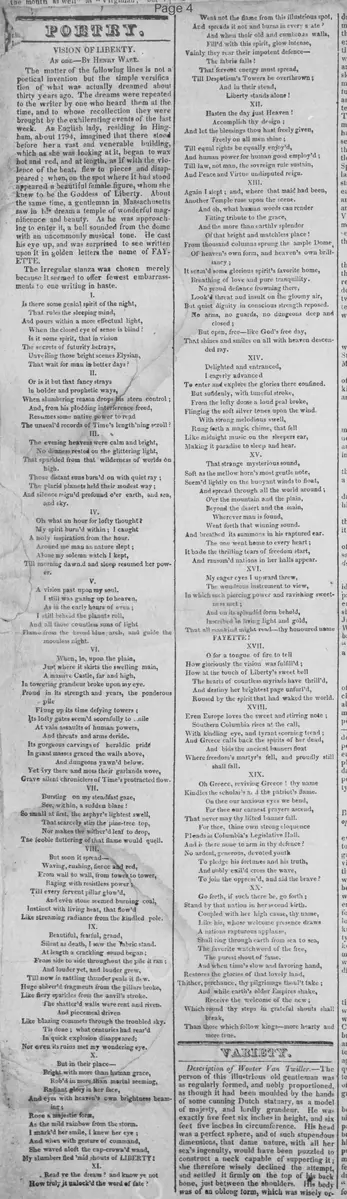
POETRY.
VISION OF LIBERTY.
An ode By Henry Ware.
The matter of the following lines is not a poetical invention but the simple versification of what was actually dreamed about thirty years ago. The dreams were repeated to the writer by one who heard them at the time, and to whose recollection they were brought by the exhilarating events of the last week. An English lady, residing in Hingham, about 1794, imagined that there stood before her a vast and venerable building, which as she was looking at it, began to wax hot and red, and at length, as if with the violence of the heat, flew to pieces and disappeared; when, on the spot where it had stood appeared a beautiful female figure, whom she knew to be the Goddess of Liberty. About the same time, a gentleman in Massachusetts saw in a dream a temple of wonderful magnificence and beauty. As he was approaching to enter it, a bell sounded from the dome with an uncommonly musical tone. He cast his eye up, and was surprised to see written upon it in golden letters the name of FAYETTE.
The irregular stanza was chosen merely because it seemed to offer fewest embarrassments to one writing in haste.
I.
Is there some genial spirit of the night,
That rules the sleeping mind,
And pours within a more effectual light,
When the closed eye of sense is blind?
Is it some spirit, that in vision
The secrets of futurity betrays,
Unveiling those bright scenes Elysian
That wait for man in better days!
II.
Or is it but that fancy strays
In bolder and prophetic ways,
When slumbering reason drops his stern control:
And, from his plodding interference freed,
Resumes some native power to read
The unseal'd records of Time's length'ning scroll?
III.
The evening heavens were calm and bright,
No dimness rested on the glittering light,
That sparkled from that wilderness of worlds on high.
Those distant suns burn'd on with quiet ray;
The placid planets held their modest way:
And silence reign'd profound o'er earth, and sea, and sky.
IV.
Oh what an hour for lofty thought!
My spirit burn'd within; I caught
A holy inspiration from the hour.
Around me man and nature slept;
Alone my solemn watch I kept,
Till morning dawn'd, and sleep resumed her power.
V.
A vision pass'd upon my soul.
I still was gazing up to heaven,
As in the early hours of even;
I still beheld the planets roll,
And all those countless suns of light
Flame from the broad blue arch, and guide the moonless night.
VI.
When, lo, upon the plain,
Just where it skirts the swelling main,
A massive Castle, far and high,
In towering grandeur broke upon my eye.
Proud in its strength and years, the ponderous pile
Flung up its time-defying towers;
Its lofty gates seem'd scornfully to smile
At vain assaults of human powers,
And threats and arms deride,
Its gorgeous carvings of heraldic pride
In giant masses graced the walls above,
And dungeons yawn'd below:
Yet ivy there and moss their garlands wove,
Grave silent chroniclers of Time's protracted flow.
VII.
Bursting on my steadfast gaze,
See! within, a sudden blaze!
So small at first, the zephyr's lightest swell,
That scarcely stirs the pine-tree top,
Nor makes the wither'd leaf to drop,
The feeble fluttering of that flame would quell.
VIII.
But soon it spread—
Waving, rushing, fierce and red,
From wall to wall, from tower to tower,
Raging with resistless power
Till every fervent pillar glow'd,
And even stone seemed burning coal,
Instinct with living heat, that flow'd
Like streaming radiance from the kindled pole.
IX.
Beautiful, fearful, grand,
Silent as death, I saw the fabric stand.
At length a crackling sound began;
From side to side throughout the pile it ran;
And louder yet, and louder grew,
Till now in rattling thunder peals it flew.
Huge shiver'd fragments from the pillars broke
Like fiery sparkles from the anvil's stroke.
The shatter'd walls were rent and riven,
And piecemeal driven
Like blazing comets through the troubled sky.
'Tis done: what centuries had rear'd
In quick explosion disappear'd;
Nor even its ruins met my wondering eye.
X.
But in their place—
Bright with more than human grace,
Rob'd in more than mortal seeming,
Radiant glory in her face,
And eyes with heaven's own brightness beamings
Rose a majestic form,
As the mild rainbow from the storm.
I mark'd her smile, I knew her eye;
And when with gesture of command,
She waved aloft the cap-crown'd wand,
My slumbers fled 'mid shouts of LIBERTY!
XI.
Read ye the dream? and know ye not
How truly it unlock'd the word of fate?
Went not the flame from this illustrious spot,
And spreads it not and burns in every state?
And when their old and cumbrous walls,
Fill'd with this spirit, glow intense,
Vainly they rear their impotent defence—The fabric fall!
That fervent energy must spread,
Till Despotism's Towers be overthrown;
And in their stead,
Liberty stands alone!
XII.
Hasten the day just Heaven!
Accomplish thy design:
And let the blessings thou hast freely given,
Freely on all men shine;
Till equal rights be equally enjoy'd,
And human power for human good employ'd;
Till law, not man, the sovereign rule sustain,
And Peace and Virtue undisputed reign.
XIII.
Again I slept; and, where that maid had been,
Another Temple rose upon the scene.
And oh, what human words can render
Fitting tribute to the grace,
And the more than earthly splendor
Of that bright and matchless place!
From thousand columns sprung the ample Dome
Of heaven's own form, and heaven's own brilliancy;
It seem'd some glorious spirit's favorite home,
Breathing of love and pure tranquility.
No proud defiance frowning there,
Look'd threat and insult on the gloomy air,
But quiet dignity in conscious strength reposed.
No arms, no guards, no dungeons deep and closed:
But open, free—like God's free day,
That shines and smiles on all with heaven descended ray.
XIV.
Delighted and entranced,
I eagerly advanced
To enter and explore the glories there confined.
But suddenly, with tuneful stroke,
From the lofty dome a loud peal broke,
Flinging the soft silver tones upon the wind.
With strong melodious swell
Rung forth a magic chime, that fell
Like midnight music on the sleeper's ear,
Making it paradise to sleep and hear.
XV.
That strange mysterious sound,
Soft as the mellow horn's most gentle note,
Seem'd lightly on the buoyant winds to float,
And spread through all the world around;
O'er the mountain and the plain,
Beyond the desert and the main,
Wherever man is found,
Went forth that winning sound,
And breathed its summons in his raptured ear.
The tone went home to every heart;
It bade the thrilling tears of freedom start,
And ransom'd nations in her halls appear.
XVI.
My eager eyes I upward threw,
The wondrous instrument to view,
In which such piercing power and ravishing sweetness met;
And on its splendid form behold,
Inscribed in living light and gold,
That all mankind might read—thy honoured name FAYETTE!
XVII.
O for a tongue of fire to tell
How gloriously the vision was fulfill'd;
How at the touch of Liberty's sweet bell
The hearts of countless myriads have thrill'd,
And destiny her brightest page unfurl'd,
Roused by the spirit that had waked the world.
XVIII.
Even Europe loves the sweet and stirring note;
Southern Columbia rises at the call,
With kindling eye, and tyrant scorning tread;
And Greece calls back the spirits of her dead,
And bids the ancient banners float
Where freedom's martyrs fell, and proudly still shall fall.
XIX.
Oh Greece, reviving Greece! thy name
Kindles the scholar's and the patriot's flame.
On thee our anxious eyes we bend,
For thee our earnest prayers ascend,
That never may thy lifted banner fall.
For thee, thine own strong eloquence
Pleads in Columbia's Legislative Hall,
And is there none to arm in thy defence?
No ardent, generous, devoted youth
To pledge his fortunes and his truth,
And nobly exiled cross the wave,
To join the oppress'd, and aid the brave?
XX.
Go forth, if such there be, go forth;
Stand by that nation in her second birth.
Coupled with her high cause, thy name,
Like his, whose welcome presence draws
A nation's rapturous applause,
Shall ring through earth from sea to sea,
The favorite watchword of the free,
The purest shout of fame.
And when time's slow and favoring hand,
Restores the glories of that lovely land,
Thither, perchance, thy pilgrimage thou't take:
And while earth's older Empires shake,
Receive the welcome of the new;
Which round thy steps in grateful shouts shall break,
Than those which follow kings—more hearty and more true.
VISION OF LIBERTY.
An ode By Henry Ware.
The matter of the following lines is not a poetical invention but the simple versification of what was actually dreamed about thirty years ago. The dreams were repeated to the writer by one who heard them at the time, and to whose recollection they were brought by the exhilarating events of the last week. An English lady, residing in Hingham, about 1794, imagined that there stood before her a vast and venerable building, which as she was looking at it, began to wax hot and red, and at length, as if with the violence of the heat, flew to pieces and disappeared; when, on the spot where it had stood appeared a beautiful female figure, whom she knew to be the Goddess of Liberty. About the same time, a gentleman in Massachusetts saw in a dream a temple of wonderful magnificence and beauty. As he was approaching to enter it, a bell sounded from the dome with an uncommonly musical tone. He cast his eye up, and was surprised to see written upon it in golden letters the name of FAYETTE.
The irregular stanza was chosen merely because it seemed to offer fewest embarrassments to one writing in haste.
I.
Is there some genial spirit of the night,
That rules the sleeping mind,
And pours within a more effectual light,
When the closed eye of sense is blind?
Is it some spirit, that in vision
The secrets of futurity betrays,
Unveiling those bright scenes Elysian
That wait for man in better days!
II.
Or is it but that fancy strays
In bolder and prophetic ways,
When slumbering reason drops his stern control:
And, from his plodding interference freed,
Resumes some native power to read
The unseal'd records of Time's length'ning scroll?
III.
The evening heavens were calm and bright,
No dimness rested on the glittering light,
That sparkled from that wilderness of worlds on high.
Those distant suns burn'd on with quiet ray;
The placid planets held their modest way:
And silence reign'd profound o'er earth, and sea, and sky.
IV.
Oh what an hour for lofty thought!
My spirit burn'd within; I caught
A holy inspiration from the hour.
Around me man and nature slept;
Alone my solemn watch I kept,
Till morning dawn'd, and sleep resumed her power.
V.
A vision pass'd upon my soul.
I still was gazing up to heaven,
As in the early hours of even;
I still beheld the planets roll,
And all those countless suns of light
Flame from the broad blue arch, and guide the moonless night.
VI.
When, lo, upon the plain,
Just where it skirts the swelling main,
A massive Castle, far and high,
In towering grandeur broke upon my eye.
Proud in its strength and years, the ponderous pile
Flung up its time-defying towers;
Its lofty gates seem'd scornfully to smile
At vain assaults of human powers,
And threats and arms deride,
Its gorgeous carvings of heraldic pride
In giant masses graced the walls above,
And dungeons yawn'd below:
Yet ivy there and moss their garlands wove,
Grave silent chroniclers of Time's protracted flow.
VII.
Bursting on my steadfast gaze,
See! within, a sudden blaze!
So small at first, the zephyr's lightest swell,
That scarcely stirs the pine-tree top,
Nor makes the wither'd leaf to drop,
The feeble fluttering of that flame would quell.
VIII.
But soon it spread—
Waving, rushing, fierce and red,
From wall to wall, from tower to tower,
Raging with resistless power
Till every fervent pillar glow'd,
And even stone seemed burning coal,
Instinct with living heat, that flow'd
Like streaming radiance from the kindled pole.
IX.
Beautiful, fearful, grand,
Silent as death, I saw the fabric stand.
At length a crackling sound began;
From side to side throughout the pile it ran;
And louder yet, and louder grew,
Till now in rattling thunder peals it flew.
Huge shiver'd fragments from the pillars broke
Like fiery sparkles from the anvil's stroke.
The shatter'd walls were rent and riven,
And piecemeal driven
Like blazing comets through the troubled sky.
'Tis done: what centuries had rear'd
In quick explosion disappear'd;
Nor even its ruins met my wondering eye.
X.
But in their place—
Bright with more than human grace,
Rob'd in more than mortal seeming,
Radiant glory in her face,
And eyes with heaven's own brightness beamings
Rose a majestic form,
As the mild rainbow from the storm.
I mark'd her smile, I knew her eye;
And when with gesture of command,
She waved aloft the cap-crown'd wand,
My slumbers fled 'mid shouts of LIBERTY!
XI.
Read ye the dream? and know ye not
How truly it unlock'd the word of fate?
Went not the flame from this illustrious spot,
And spreads it not and burns in every state?
And when their old and cumbrous walls,
Fill'd with this spirit, glow intense,
Vainly they rear their impotent defence—The fabric fall!
That fervent energy must spread,
Till Despotism's Towers be overthrown;
And in their stead,
Liberty stands alone!
XII.
Hasten the day just Heaven!
Accomplish thy design:
And let the blessings thou hast freely given,
Freely on all men shine;
Till equal rights be equally enjoy'd,
And human power for human good employ'd;
Till law, not man, the sovereign rule sustain,
And Peace and Virtue undisputed reign.
XIII.
Again I slept; and, where that maid had been,
Another Temple rose upon the scene.
And oh, what human words can render
Fitting tribute to the grace,
And the more than earthly splendor
Of that bright and matchless place!
From thousand columns sprung the ample Dome
Of heaven's own form, and heaven's own brilliancy;
It seem'd some glorious spirit's favorite home,
Breathing of love and pure tranquility.
No proud defiance frowning there,
Look'd threat and insult on the gloomy air,
But quiet dignity in conscious strength reposed.
No arms, no guards, no dungeons deep and closed:
But open, free—like God's free day,
That shines and smiles on all with heaven descended ray.
XIV.
Delighted and entranced,
I eagerly advanced
To enter and explore the glories there confined.
But suddenly, with tuneful stroke,
From the lofty dome a loud peal broke,
Flinging the soft silver tones upon the wind.
With strong melodious swell
Rung forth a magic chime, that fell
Like midnight music on the sleeper's ear,
Making it paradise to sleep and hear.
XV.
That strange mysterious sound,
Soft as the mellow horn's most gentle note,
Seem'd lightly on the buoyant winds to float,
And spread through all the world around;
O'er the mountain and the plain,
Beyond the desert and the main,
Wherever man is found,
Went forth that winning sound,
And breathed its summons in his raptured ear.
The tone went home to every heart;
It bade the thrilling tears of freedom start,
And ransom'd nations in her halls appear.
XVI.
My eager eyes I upward threw,
The wondrous instrument to view,
In which such piercing power and ravishing sweetness met;
And on its splendid form behold,
Inscribed in living light and gold,
That all mankind might read—thy honoured name FAYETTE!
XVII.
O for a tongue of fire to tell
How gloriously the vision was fulfill'd;
How at the touch of Liberty's sweet bell
The hearts of countless myriads have thrill'd,
And destiny her brightest page unfurl'd,
Roused by the spirit that had waked the world.
XVIII.
Even Europe loves the sweet and stirring note;
Southern Columbia rises at the call,
With kindling eye, and tyrant scorning tread;
And Greece calls back the spirits of her dead,
And bids the ancient banners float
Where freedom's martyrs fell, and proudly still shall fall.
XIX.
Oh Greece, reviving Greece! thy name
Kindles the scholar's and the patriot's flame.
On thee our anxious eyes we bend,
For thee our earnest prayers ascend,
That never may thy lifted banner fall.
For thee, thine own strong eloquence
Pleads in Columbia's Legislative Hall,
And is there none to arm in thy defence?
No ardent, generous, devoted youth
To pledge his fortunes and his truth,
And nobly exiled cross the wave,
To join the oppress'd, and aid the brave?
XX.
Go forth, if such there be, go forth;
Stand by that nation in her second birth.
Coupled with her high cause, thy name,
Like his, whose welcome presence draws
A nation's rapturous applause,
Shall ring through earth from sea to sea,
The favorite watchword of the free,
The purest shout of fame.
And when time's slow and favoring hand,
Restores the glories of that lovely land,
Thither, perchance, thy pilgrimage thou't take:
And while earth's older Empires shake,
Receive the welcome of the new;
Which round thy steps in grateful shouts shall break,
Than those which follow kings—more hearty and more true.
What sub-type of article is it?
Ode
What themes does it cover?
Liberty Independence
Political
Patriotism
What keywords are associated?
Liberty Vision
Despotism Fall
Fayette Temple
Greek Independence
Revolutionary Dreams
Political Ode
Freedom Bell
What entities or persons were involved?
By Henry Ware.
Poem Details
Title
Vision Of Liberty.
Author
By Henry Ware.
Subject
Versification Of Dreams From About 1794 Inspired By Recent Exhilarating Events
Form / Style
Irregular Stanza
Key Lines
Rose A Majestic Form,
As The Mild Rainbow From The Storm.
I Mark'd Her Smile, I Knew Her Eye;
And When With Gesture Of Command,
She Waved Aloft The Cap Crown'd Wand,
My Slumbers Fled 'Mid Shouts Of Liberty!
And On Its Splendid Form Behold,
Inscribed In Living Light And Gold,
That All Mankind Might Read—Thy Honoured Name Fayette!
Hasten The Day Just Heaven!
Accomplish Thy Design:
And Let The Blessings Thou Hast Freely Given,
Freely On All Men Shine;
Till Equal Rights Be Equally Enjoy'd,
And Human Power For Human Good Employ'd;
Till Law, Not Man, The Sovereign Rule Sustain,
And Peace And Virtue Undisputed Reign.
Oh Greece, Reviving Greece! Thy Name
Kindles The Scholar's And The Patriot's Flame.
Go Forth, If Such There Be, Go Forth;
Stand By That Nation In Her Second Birth.