Thank you for visiting SNEWPapers!
Sign up free
Story
August 9, 1922
Great Falls Tribune
Great Falls, Cascade County, Montana
What is this article about?
Washington, D.C. article from Aug. 6 explores flapper slang, its metaphors from everyday words, agricultural terms, and spread among young people, contrasting with general slang.
Clipping
OCR Quality
98%
Excellent
Full Text
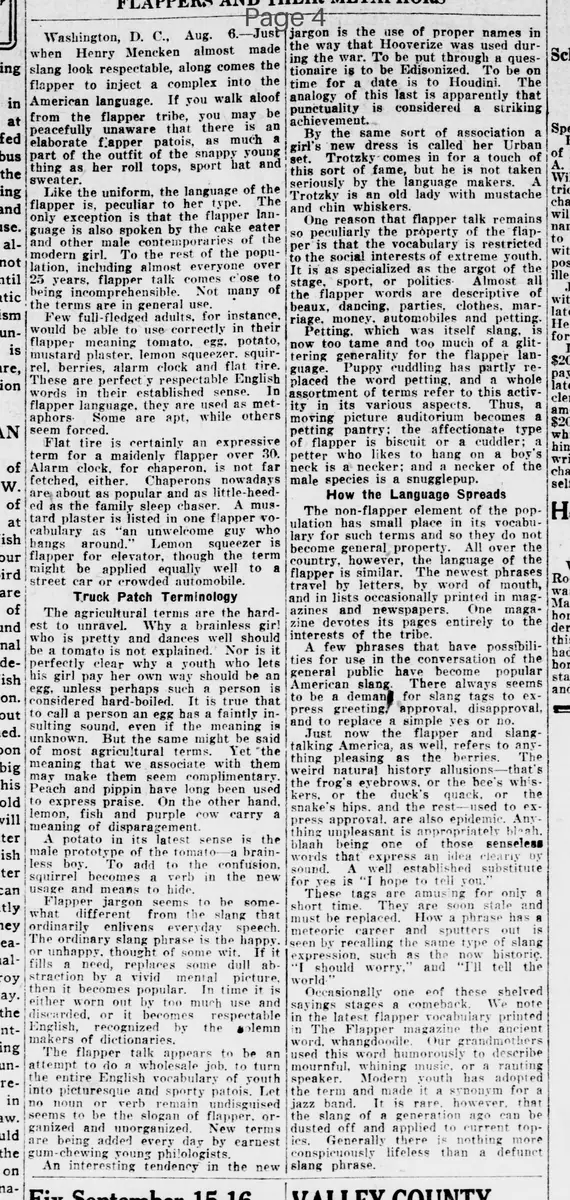
Washington, D. C., Aug. 6.-Just when Henry Mencken almost made slang look respectable, along comes the flapper to inject a complex into the American language. If you walk aloof from the flapper tribe, you may be peacefully unaware that there is an elaborate flapper patois, as much a part of the outfit of the snappy young thing as her roll tops, sport hat and sweater.
Like the uniform, the language of the flapper is peculiar to her type. The only exception is that the flapper language is also spoken by the cake eater and other male contemporaries of the modern girl. To the rest of the population, including almost everyone over 25 years, flapper talk comes close to being incomprehensible. Not many of the terms are in general use.
Few full-fledged adults, for instance, would be able to use correctly in their flapper meaning tomato, egg, potato, mustard plaster, lemon squeezer, squirrel, berries, alarm clock and flat tire.
These are perfectly respectable English words in their established sense. In flapper language, they are used as metaphors. Some are apt, while others seem forced.
Flat tire is certainly an expressive term for a maidenly flapper over 30. Alarm clock, for chaperon, is not far fetched, either. Chaperons nowadays are about as popular and as little-heeded as the family sleep chaser. A mustard plaster is listed in one flapper vocabulary as "an unwelcome guy who hangs around." Lemon squeezer is flapper for elevator, though the term might be applied equally well to a street car or crowded automobile.
Truck Patch Terminology
The agricultural terms are the hardest to unravel. Why a brainless girl who is pretty and dances well should be a tomato is not explained. Nor is it perfectly clear why a youth who lets his girl pay her own way should be an egg, unless perhaps such a person is considered hard-boiled. It is true that to call a person an egg has a faintly insulting sound, even if the meaning is unknown. But the same might be said of most agricultural terms. Yet the meaning that we associate with them may make them seem complimentary.
Peach and pippin have long been used to express praise. On the other hand, lemon, fish and purple cow carry a meaning of disparagement.
A potato in its latest sense is the male prototype of the tomato--a brainless boy. To add to the confusion, squirrel becomes a verb in the new usage and means to hide.
Flapper jargon seems to be somewhat different from the slang that ordinarily enlivens everyday speech. The ordinary slang phrase is the happy, or unhappy, thought of some wit. If it fills a need, replaces some dull abstraction by a vivid mental picture, then it becomes popular. In time it is either worn out by too much use and discarded, or it becomes respectable English, recognized by the solemn makers of dictionaries.
The flapper talk appears to be an attempt to do a wholesale job, to turn the entire English vocabulary of youth into picturesque and sporty patois. Let no noun or verb remain undisguised seems to be the slogan of flapper, organized and unorganized. New terms are being added every day by earnest gum-chewing young philologists.
An interesting tendency in the new jargon is the use of proper names in the way that Hooverize was used during the war. To be put through a questionnaire is to be Edisonized. To be on time for a date is to Houdini. The analogy of this last is apparently that punctuality is considered a striking achievement.
By the same sort of association a girl's new dress is called her Urban set. Trotzky comes in for a touch of this sort of fame, but he is not taken seriously by the language makers. A Trotzky is an old lady with mustache and chin whiskers.
One reason that flapper talk remains so peculiarly the property of the flapper is that the vocabulary is restricted to the social interests of extreme youth. It is as specialized as the argot of the stage, sport, or politics. Almost all the flapper words are descriptive of beaux, dancing, parties, clothes, marriage, money, automobiles and petting.
Petting, which was itself slang, is now too tame and too much of a glittering generality for the flapper language. Puppy cuddling has partly replaced the word petting, and a whole assortment of terms refer to this activity in its various aspects. Thus, a moving picture auditorium becomes a petting pantry; the affectionate type of flapper is biscuit or a cuddler; a petter who likes to hang on a boy's neck is a necker; and a necker of the male species is a snugglepup.
How the Language Spreads
The non-flapper element of the population has small place in its vocabulary for such terms and so they do not become general property. All over the country, however, the language of the flapper is similar. The newest phrases travel by letters, by word of mouth, and in lists occasionally printed in magazines and newspapers. One magazine devotes its pages entirely to the interests of the tribe.
A few phrases that have possibilities for use in the conversation of the general public have become popular American slang. There always seems to be a demand for slang tags to express greeting, approval, disapproval, and to replace a simple yes or no.
Just now the flapper and slang-talking America, as well, refers to anything pleasing as the berries. The weird natural history allusions--that's the frog's eyebrows, or the bee's whiskers, or the duck's quack, or the snake's hips, and the rest--used to express approval, are also epidemic. Anything unpleasant is appropriately blaah, blaah being one of those senseless words that express an idea clearly by sound. A well established substitute for yes is "I hope to tell you."
These tags are amusing for only a short time. They are soon stale and must be replaced. How a phrase has a meteoric career and sputters out is seen by recalling the same type of slang expression, such as the now historic, "I should worry," and "I'll tell the world."
Occasionally one of these shelved sayings stages a comeback. We note in the latest flapper vocabulary printed in The Flapper magazine the ancient word, whangdoodle. Our grandmothers used this word humorously to describe mournful, whining music, or a ranting speaker. Modern youth has adopted the term and made it a synonym for a jazz band. It is rare, however, that the slang of a generation ago can be dusted off and applied to current topics. Generally there is nothing more conspicuously lifeless than a defunct slang phrase.
Like the uniform, the language of the flapper is peculiar to her type. The only exception is that the flapper language is also spoken by the cake eater and other male contemporaries of the modern girl. To the rest of the population, including almost everyone over 25 years, flapper talk comes close to being incomprehensible. Not many of the terms are in general use.
Few full-fledged adults, for instance, would be able to use correctly in their flapper meaning tomato, egg, potato, mustard plaster, lemon squeezer, squirrel, berries, alarm clock and flat tire.
These are perfectly respectable English words in their established sense. In flapper language, they are used as metaphors. Some are apt, while others seem forced.
Flat tire is certainly an expressive term for a maidenly flapper over 30. Alarm clock, for chaperon, is not far fetched, either. Chaperons nowadays are about as popular and as little-heeded as the family sleep chaser. A mustard plaster is listed in one flapper vocabulary as "an unwelcome guy who hangs around." Lemon squeezer is flapper for elevator, though the term might be applied equally well to a street car or crowded automobile.
Truck Patch Terminology
The agricultural terms are the hardest to unravel. Why a brainless girl who is pretty and dances well should be a tomato is not explained. Nor is it perfectly clear why a youth who lets his girl pay her own way should be an egg, unless perhaps such a person is considered hard-boiled. It is true that to call a person an egg has a faintly insulting sound, even if the meaning is unknown. But the same might be said of most agricultural terms. Yet the meaning that we associate with them may make them seem complimentary.
Peach and pippin have long been used to express praise. On the other hand, lemon, fish and purple cow carry a meaning of disparagement.
A potato in its latest sense is the male prototype of the tomato--a brainless boy. To add to the confusion, squirrel becomes a verb in the new usage and means to hide.
Flapper jargon seems to be somewhat different from the slang that ordinarily enlivens everyday speech. The ordinary slang phrase is the happy, or unhappy, thought of some wit. If it fills a need, replaces some dull abstraction by a vivid mental picture, then it becomes popular. In time it is either worn out by too much use and discarded, or it becomes respectable English, recognized by the solemn makers of dictionaries.
The flapper talk appears to be an attempt to do a wholesale job, to turn the entire English vocabulary of youth into picturesque and sporty patois. Let no noun or verb remain undisguised seems to be the slogan of flapper, organized and unorganized. New terms are being added every day by earnest gum-chewing young philologists.
An interesting tendency in the new jargon is the use of proper names in the way that Hooverize was used during the war. To be put through a questionnaire is to be Edisonized. To be on time for a date is to Houdini. The analogy of this last is apparently that punctuality is considered a striking achievement.
By the same sort of association a girl's new dress is called her Urban set. Trotzky comes in for a touch of this sort of fame, but he is not taken seriously by the language makers. A Trotzky is an old lady with mustache and chin whiskers.
One reason that flapper talk remains so peculiarly the property of the flapper is that the vocabulary is restricted to the social interests of extreme youth. It is as specialized as the argot of the stage, sport, or politics. Almost all the flapper words are descriptive of beaux, dancing, parties, clothes, marriage, money, automobiles and petting.
Petting, which was itself slang, is now too tame and too much of a glittering generality for the flapper language. Puppy cuddling has partly replaced the word petting, and a whole assortment of terms refer to this activity in its various aspects. Thus, a moving picture auditorium becomes a petting pantry; the affectionate type of flapper is biscuit or a cuddler; a petter who likes to hang on a boy's neck is a necker; and a necker of the male species is a snugglepup.
How the Language Spreads
The non-flapper element of the population has small place in its vocabulary for such terms and so they do not become general property. All over the country, however, the language of the flapper is similar. The newest phrases travel by letters, by word of mouth, and in lists occasionally printed in magazines and newspapers. One magazine devotes its pages entirely to the interests of the tribe.
A few phrases that have possibilities for use in the conversation of the general public have become popular American slang. There always seems to be a demand for slang tags to express greeting, approval, disapproval, and to replace a simple yes or no.
Just now the flapper and slang-talking America, as well, refers to anything pleasing as the berries. The weird natural history allusions--that's the frog's eyebrows, or the bee's whiskers, or the duck's quack, or the snake's hips, and the rest--used to express approval, are also epidemic. Anything unpleasant is appropriately blaah, blaah being one of those senseless words that express an idea clearly by sound. A well established substitute for yes is "I hope to tell you."
These tags are amusing for only a short time. They are soon stale and must be replaced. How a phrase has a meteoric career and sputters out is seen by recalling the same type of slang expression, such as the now historic, "I should worry," and "I'll tell the world."
Occasionally one of these shelved sayings stages a comeback. We note in the latest flapper vocabulary printed in The Flapper magazine the ancient word, whangdoodle. Our grandmothers used this word humorously to describe mournful, whining music, or a ranting speaker. Modern youth has adopted the term and made it a synonym for a jazz band. It is rare, however, that the slang of a generation ago can be dusted off and applied to current topics. Generally there is nothing more conspicuously lifeless than a defunct slang phrase.
What sub-type of article is it?
Curiosity
What themes does it cover?
Social Manners
What keywords are associated?
Flapper Slang
Youth Jargon
1920s Language
Cake Eater
Petting Terms
Where did it happen?
Washington, D. C.
Story Details
Location
Washington, D. C.
Event Date
Aug. 6.
Story Details
Article explains flapper slang, its terms like 'tomato' for pretty girl, 'flat tire' for older woman, and how it spreads among youth, distinct from general slang.