Thank you for visiting SNEWPapers!
Sign up free
Story
April 21, 1933
Seward Daily Gateway
Seward, Seward County, Alaska
What is this article about?
Rep. J. S. Hofman recounts a visit by territorial legislators to the Alaska Juneau mine on March 29, describing underground levels, ore handling with skips and cars, glory holes, rock formation, milling process, and daily operations handling 12,000 tons of rock.
Clipping
OCR Quality
98%
Excellent
Full Text
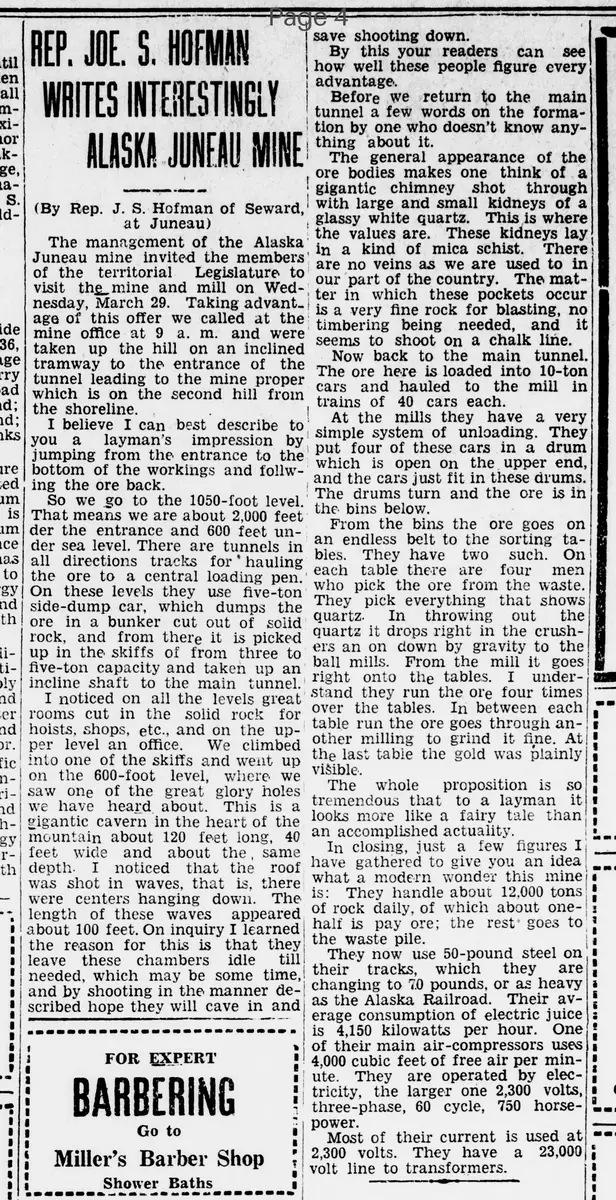
REP. JOE. S. HOFMAN
WRITES INTERESTINGLY
ALASKA JUNEAU MINE
(By Rep. J. S. Hofman of Seward, at Juneau)
The management of the Alaska Juneau mine invited the members of the territorial Legislature to visit the mine and mill on Wednesday, March 29. Taking advantage of this offer we called at the mine office at 9 a. m. and were taken up the hill on an inclined tramway to the entrance of the tunnel leading to the mine proper which is on the second hill from the shoreline.
I believe I can best describe to you a layman's impression by jumping from the entrance to the bottom of the workings and following the ore back.
So we go to the 1050-foot level. That means we are about 2,000 feet under the entrance and 600 feet under sea level. There are tunnels in all directions tracks for hauling the ore to a central loading pen. On these levels they use five-ton side-dump car, which dumps the ore in a bunker cut out of solid rock, and from there it is picked up in the skiffs of from three to five-ton capacity and taken up an incline shaft to the main tunnel. I noticed on all the levels great rooms cut in the solid rock for hoists, shops, etc., and on the upper level an office. We climbed into one of the skiffs and went up on the 600-foot level, where we saw one of the great glory holes we have heard about. This is a gigantic cavern in the heart of the mountain about 120 feet long, 40 feet wide and about the same depth. I noticed that the roof was shot in waves. that is. there were centers hanging down. The length of these waves appeared about 100 feet. On inquiry I learned the reason for this is that they leave these chambers idle till needed, which may be some time, and by shooting in the manner described hope they will cave in and save shooting down.
By this your readers can see how well these people figure every advantage.
Before we return to the main tunnel a few words on the formation by one who doesn't know anything about it.
The general appearance of the ore bodies makes one think of a gigantic chimney shot through with large and small kidneys of a glassy white quartz. This is where the values are. These kidneys lay in a kind of mica schist. There are no veins as we are used to in our part of the country. The matter in which these pockets occur is a very fine rock for blasting, no timbering being needed, and it seems to shoot on a chalk line.
Now back to the main tunnel.
The ore here is loaded into 10-ton cars and hauled to the mill in trains of 40 cars each.
At the mills they have a very simple system of unloading. They put four of these cars in a drum which is open on the upper end, and the cars just fit in these drums. The drums turn and the ore is in the bins below.
From the bins the ore goes on an endless belt to the sorting tables. They have two such. On each table there are four men who pick the ore from the waste. They pick everything that shows quartz. In throwing out the quartz it drops right in the crushers an on down by gravity to the ball mills. From the mill it goes right onto the tables. I understand they run the ore four times over the tables. In between each table run the ore goes through another milling to grind it fine. At the last table the gold was plainly visible.
The whole proposition is so tremendous that to a layman it looks more like a fairy tale than an accomplished actuality.
In closing, just a few figures I have gathered to give you an idea what a modern wonder this mine is: They handle about 12,000 tons of rock daily, of which about one-half is pay ore; the rest' goes to the waste pile.
They now use 50-pound steel on their tracks, which they are changing to 70 pounds, or as heavy as the Alaska Railroad. Their average consumption of electric juice is 4,150 kilowatts per hour. One of their main air-compressors uses 4,000 cubic feet of free air per minute. They are operated by electricity, the larger one 2,300 volts, three-phase, 60 cycle, 750 horsepower.
Most of their current is used at 2,300 volts. They have a 23,000 volt line to transformers.
WRITES INTERESTINGLY
ALASKA JUNEAU MINE
(By Rep. J. S. Hofman of Seward, at Juneau)
The management of the Alaska Juneau mine invited the members of the territorial Legislature to visit the mine and mill on Wednesday, March 29. Taking advantage of this offer we called at the mine office at 9 a. m. and were taken up the hill on an inclined tramway to the entrance of the tunnel leading to the mine proper which is on the second hill from the shoreline.
I believe I can best describe to you a layman's impression by jumping from the entrance to the bottom of the workings and following the ore back.
So we go to the 1050-foot level. That means we are about 2,000 feet under the entrance and 600 feet under sea level. There are tunnels in all directions tracks for hauling the ore to a central loading pen. On these levels they use five-ton side-dump car, which dumps the ore in a bunker cut out of solid rock, and from there it is picked up in the skiffs of from three to five-ton capacity and taken up an incline shaft to the main tunnel. I noticed on all the levels great rooms cut in the solid rock for hoists, shops, etc., and on the upper level an office. We climbed into one of the skiffs and went up on the 600-foot level, where we saw one of the great glory holes we have heard about. This is a gigantic cavern in the heart of the mountain about 120 feet long, 40 feet wide and about the same depth. I noticed that the roof was shot in waves. that is. there were centers hanging down. The length of these waves appeared about 100 feet. On inquiry I learned the reason for this is that they leave these chambers idle till needed, which may be some time, and by shooting in the manner described hope they will cave in and save shooting down.
By this your readers can see how well these people figure every advantage.
Before we return to the main tunnel a few words on the formation by one who doesn't know anything about it.
The general appearance of the ore bodies makes one think of a gigantic chimney shot through with large and small kidneys of a glassy white quartz. This is where the values are. These kidneys lay in a kind of mica schist. There are no veins as we are used to in our part of the country. The matter in which these pockets occur is a very fine rock for blasting, no timbering being needed, and it seems to shoot on a chalk line.
Now back to the main tunnel.
The ore here is loaded into 10-ton cars and hauled to the mill in trains of 40 cars each.
At the mills they have a very simple system of unloading. They put four of these cars in a drum which is open on the upper end, and the cars just fit in these drums. The drums turn and the ore is in the bins below.
From the bins the ore goes on an endless belt to the sorting tables. They have two such. On each table there are four men who pick the ore from the waste. They pick everything that shows quartz. In throwing out the quartz it drops right in the crushers an on down by gravity to the ball mills. From the mill it goes right onto the tables. I understand they run the ore four times over the tables. In between each table run the ore goes through another milling to grind it fine. At the last table the gold was plainly visible.
The whole proposition is so tremendous that to a layman it looks more like a fairy tale than an accomplished actuality.
In closing, just a few figures I have gathered to give you an idea what a modern wonder this mine is: They handle about 12,000 tons of rock daily, of which about one-half is pay ore; the rest' goes to the waste pile.
They now use 50-pound steel on their tracks, which they are changing to 70 pounds, or as heavy as the Alaska Railroad. Their average consumption of electric juice is 4,150 kilowatts per hour. One of their main air-compressors uses 4,000 cubic feet of free air per minute. They are operated by electricity, the larger one 2,300 volts, three-phase, 60 cycle, 750 horsepower.
Most of their current is used at 2,300 volts. They have a 23,000 volt line to transformers.
What sub-type of article is it?
Historical Event
Curiosity
What themes does it cover?
Triumph
What keywords are associated?
Alaska Juneau Mine
Legislative Visit
Gold Mining
Ore Processing
Underground Workings
Industrial Scale
What entities or persons were involved?
Rep. J. S. Hofman
Where did it happen?
Alaska Juneau Mine, Juneau
Story Details
Key Persons
Rep. J. S. Hofman
Location
Alaska Juneau Mine, Juneau
Event Date
March 29
Story Details
Legislators visit the Alaska Juneau mine; tour underground levels, observe ore extraction with side-dump cars and skips, glory holes, rock formation of quartz kidneys in mica schist, transport to mill, sorting and milling process revealing visible gold, handling 12,000 tons daily.