Thank you for visiting SNEWPapers!
Sign up free
Story
August 20, 1799
Gazette Of The United States, & Philadelphia Daily Advertiser
Philadelphia, Philadelphia County, Pennsylvania
What is this article about?
Traveler Mr. Park, caught in a storm along the Niger, is sheltered and fed by a kind African woman who sings a pitying song about his plight, highlighting female benevolence in uncivilized lands.
Clipping
OCR Quality
95%
Excellent
Full Text
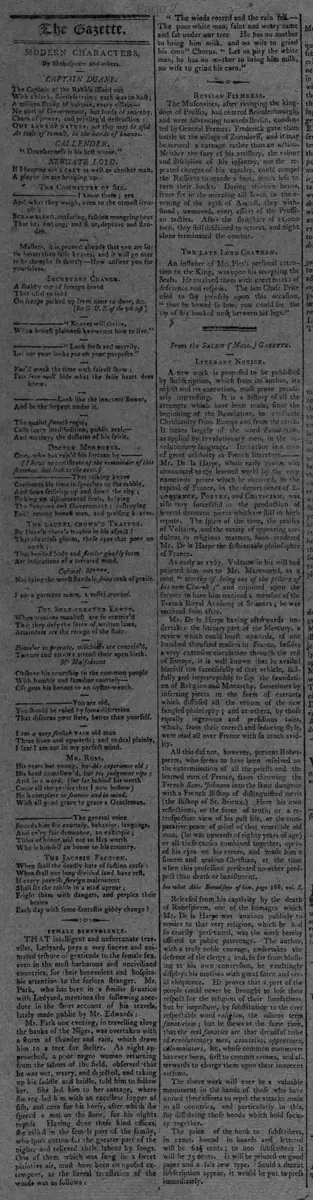
FEMALE BENEVOLENCE.
THAT intelligent and unfortunate traveller,
Ledyard, pays a very sincere and animated
tribute of gratitude to the female sex,
even in the most barbarous and uncivilized
countries, for their benevolent and hospitable
attention to the forlorn stranger. Mr.
Park, who has been in a similar situation
with Ledyard, mentions the following anecdote
in the short account of his travels,
lately made public by Mr. Edwards:
Mr. Park one evening, in travelling along
the banks of the Niger, was overtaken with
a storm of thunder and rain, which drove
him to a tree for shelter. As night approached,
a poor negro woman returning
from the labors of the field, observed that
he was wet, weary, and dejected, and taking
up his saddle and bridle, told him to follow
her. She led him to her cottage, where she
regaled him with an excellent supper of fish,
and corn for his horse, after which she
spread a mat on the floor, for his night's
repose. Having done these kind offices,
she called in the female part of the family,
who spun cotton for the greater part of the
night, and relieved their labour by songs.
One of them which was sung in a sweet
plaintive air, must have been composed extempore,
as the literal translation of the
words was as follows:
"The winds roared and the rain fell—
The poor white man, faint and weary came
and sat under our tree. He has no mother
to bring him milk, and no wife to grind
his corn." Chorus. "Let us pity the white
man, he has no mother to bring him milk,
no wife to grind his corn."
THAT intelligent and unfortunate traveller,
Ledyard, pays a very sincere and animated
tribute of gratitude to the female sex,
even in the most barbarous and uncivilized
countries, for their benevolent and hospitable
attention to the forlorn stranger. Mr.
Park, who has been in a similar situation
with Ledyard, mentions the following anecdote
in the short account of his travels,
lately made public by Mr. Edwards:
Mr. Park one evening, in travelling along
the banks of the Niger, was overtaken with
a storm of thunder and rain, which drove
him to a tree for shelter. As night approached,
a poor negro woman returning
from the labors of the field, observed that
he was wet, weary, and dejected, and taking
up his saddle and bridle, told him to follow
her. She led him to her cottage, where she
regaled him with an excellent supper of fish,
and corn for his horse, after which she
spread a mat on the floor, for his night's
repose. Having done these kind offices,
she called in the female part of the family,
who spun cotton for the greater part of the
night, and relieved their labour by songs.
One of them which was sung in a sweet
plaintive air, must have been composed extempore,
as the literal translation of the
words was as follows:
"The winds roared and the rain fell—
The poor white man, faint and weary came
and sat under our tree. He has no mother
to bring him milk, and no wife to grind
his corn." Chorus. "Let us pity the white
man, he has no mother to bring him milk,
no wife to grind his corn."
What sub-type of article is it?
Journey
Heroic Act
Curiosity
What themes does it cover?
Moral Virtue
Bravery Heroism
Misfortune
What keywords are associated?
Female Benevolence
African Hospitality
Traveler Shelter
Niger Storm
Compassionate Song
What entities or persons were involved?
Mr. Park
Ledyard
Poor Negro Woman
Where did it happen?
Banks Of The Niger
Story Details
Key Persons
Mr. Park
Ledyard
Poor Negro Woman
Location
Banks Of The Niger
Story Details
During a storm on the Niger, Mr. Park is aided by a poor negro woman who shelters him, feeds him and his horse, and leads women in singing a compassionate song about his loneliness.