Thank you for visiting SNEWPapers!
Sign up free
Editorial
December 21, 1816
Portland Gazette, And Maine Advertiser
Portland, Cumberland County, Maine
What is this article about?
Review of the second issue of 'The Friend of Peace,' praising a critique of Lord Erskine's pro-war arguments and listing preparatory events and encouraging facts for the abolition of war, including societal progress, religious groups' involvement, and concurrent peace efforts in the US and Britain around 1815.
Clipping
OCR Quality
92%
Excellent
Full Text
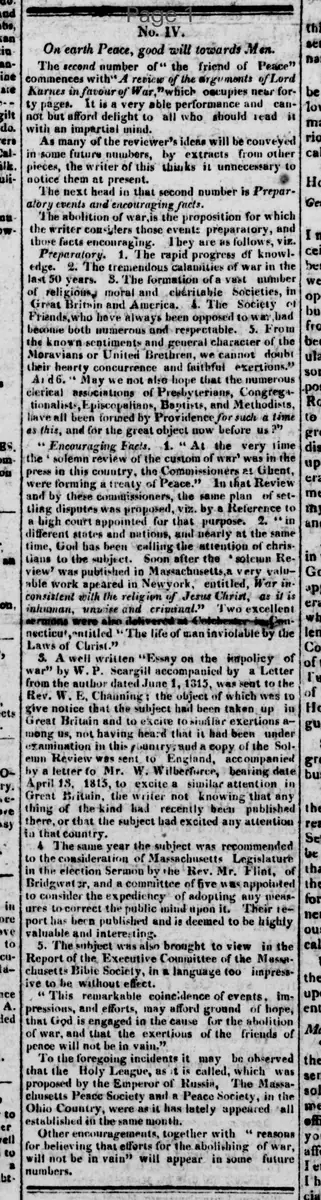
No. IV.
On earth Peace, good will towards Men
The second number of "the friend of Peace"
commences with "A review of the arguments of Lord
Erskine in favour of War," which occupies near forty
pages. It is a very able performance and cannot
but afford delight to all who should read it
with an impartial mind.
As many of the reviewer's ideas will be conveyed
in some future numbers, by extracts from other
pieces, the writer of this thinks it unnecessary to
notice them at present.
The next head in that second number is Preparatory
events and "encouraging facts."
The abolition of war, is the proposition for which
the writer considers those events preparatory, and
those facts encouraging. They are as follows, viz.
Preparatory. 1. The rapid progress of knowledge.
2. The tremendous calamities of war in the
last 50 years. 3. The formation of a vast number
of religious moral and charitable Societies, in
Great Britain and America. 4. The Society of
Friends, who have always been opposed to war, had
become both numerous and respectable. 5. From
the known sentiments and general character of the
Moravians or United Brethren, we cannot doubt
their hearty concurrence and faithful exertions."
And 6. "May we not also hope that the numerous
clerical associations of Presbyterians, Congregationalists,
Episcopalians, Baptists, and Methodists,
have all been formed by Providence for such a time
as this, and for the great object now before us?"
"Encouraging Facts. 1. "At the very time
the 'Solemn review of the custom of war' was in the
press in this country, the Commissioners at Ghent,
were forming a treaty of Peace." In that Review
and by these commissioners, the same plan of settling
disputes was proposed, viz. by a Reference to
a high court appointed for that purpose. 2. "In
different states and nations, and nearly at the same
time, God has been calling the attention of christians
to the subject. Soon after the 'Solemn Review'
was published in Massachusetts, a very valuable
work appeared in New York, entitled, War inconsistent
with the religion of Jesus Christ. as it is
inhuman, unchristian and criminal." Two excellent
sermons were also delivered in Colchester, Connecticut,
entitled "The life of man inviolable by the
Laws of Christ."
3. A well written "Essay on the impolicy of
war" by W. P. Scargill accompanied by a Letter
from the author dated June 1, 1815, was sent to the
Rev. W. E. Channing: the object of which was to
give notice that the subject had been taken up in
Great Britain and to excite similar exertions among
us, not having heard that it had been under
examination in this country; and a copy of the Solemn
Review was sent to England, accompanied
by a letter to Mr. W. Wilberforce, bearing date
April 13, 1815, to excite a similar attention in
Great Britain, the writer not knowing that any
thing of the kind had recently been published
there, or that the subject had excited any attention
in that country.
4. The same year the subject was recommended
to the consideration of Massachusetts Legislature
in the election Sermon by the Rev. Mr. Flint, of
Bridgewater, and a committee of five was appointed
to consider the expediency of adopting any measures
to correct the public mind upon it. Their report
has been published and is deemed to be highly
valuable and interesting
5. The subject was also brought to view in the
Report of the Executive Committee of the Massachusetts
Bible Society, in a language too impressive
to be without effect.
"This remarkable coincidence of events, impressions,
and efforts, may afford ground of hope,
that God is engaged in the cause of the abolition
of war, and that the exertions of the friends of
peace will not be in vain."
To the foregoing incidents it may be observed
that the Holy League, as it is called, which was
proposed by the Emperor of Russia, The Massachusetts
Peace Society and a Peace Society, in the
Ohio Country, were as it has lately appeared all
established in the same month.
Other encouragements, together with "reasons
for believing that efforts for the abolishing of war,
will not be in vain" will appear in some future
numbers.
On earth Peace, good will towards Men
The second number of "the friend of Peace"
commences with "A review of the arguments of Lord
Erskine in favour of War," which occupies near forty
pages. It is a very able performance and cannot
but afford delight to all who should read it
with an impartial mind.
As many of the reviewer's ideas will be conveyed
in some future numbers, by extracts from other
pieces, the writer of this thinks it unnecessary to
notice them at present.
The next head in that second number is Preparatory
events and "encouraging facts."
The abolition of war, is the proposition for which
the writer considers those events preparatory, and
those facts encouraging. They are as follows, viz.
Preparatory. 1. The rapid progress of knowledge.
2. The tremendous calamities of war in the
last 50 years. 3. The formation of a vast number
of religious moral and charitable Societies, in
Great Britain and America. 4. The Society of
Friends, who have always been opposed to war, had
become both numerous and respectable. 5. From
the known sentiments and general character of the
Moravians or United Brethren, we cannot doubt
their hearty concurrence and faithful exertions."
And 6. "May we not also hope that the numerous
clerical associations of Presbyterians, Congregationalists,
Episcopalians, Baptists, and Methodists,
have all been formed by Providence for such a time
as this, and for the great object now before us?"
"Encouraging Facts. 1. "At the very time
the 'Solemn review of the custom of war' was in the
press in this country, the Commissioners at Ghent,
were forming a treaty of Peace." In that Review
and by these commissioners, the same plan of settling
disputes was proposed, viz. by a Reference to
a high court appointed for that purpose. 2. "In
different states and nations, and nearly at the same
time, God has been calling the attention of christians
to the subject. Soon after the 'Solemn Review'
was published in Massachusetts, a very valuable
work appeared in New York, entitled, War inconsistent
with the religion of Jesus Christ. as it is
inhuman, unchristian and criminal." Two excellent
sermons were also delivered in Colchester, Connecticut,
entitled "The life of man inviolable by the
Laws of Christ."
3. A well written "Essay on the impolicy of
war" by W. P. Scargill accompanied by a Letter
from the author dated June 1, 1815, was sent to the
Rev. W. E. Channing: the object of which was to
give notice that the subject had been taken up in
Great Britain and to excite similar exertions among
us, not having heard that it had been under
examination in this country; and a copy of the Solemn
Review was sent to England, accompanied
by a letter to Mr. W. Wilberforce, bearing date
April 13, 1815, to excite a similar attention in
Great Britain, the writer not knowing that any
thing of the kind had recently been published
there, or that the subject had excited any attention
in that country.
4. The same year the subject was recommended
to the consideration of Massachusetts Legislature
in the election Sermon by the Rev. Mr. Flint, of
Bridgewater, and a committee of five was appointed
to consider the expediency of adopting any measures
to correct the public mind upon it. Their report
has been published and is deemed to be highly
valuable and interesting
5. The subject was also brought to view in the
Report of the Executive Committee of the Massachusetts
Bible Society, in a language too impressive
to be without effect.
"This remarkable coincidence of events, impressions,
and efforts, may afford ground of hope,
that God is engaged in the cause of the abolition
of war, and that the exertions of the friends of
peace will not be in vain."
To the foregoing incidents it may be observed
that the Holy League, as it is called, which was
proposed by the Emperor of Russia, The Massachusetts
Peace Society and a Peace Society, in the
Ohio Country, were as it has lately appeared all
established in the same month.
Other encouragements, together with "reasons
for believing that efforts for the abolishing of war,
will not be in vain" will appear in some future
numbers.
What sub-type of article is it?
War Or Peace
Moral Or Religious
Social Reform
What keywords are associated?
Abolition Of War
Friend Of Peace
Preparatory Events
Encouraging Facts
Religious Societies
Ghent Treaty
Peace Societies
Anti War Arguments
What entities or persons were involved?
Lord Erskine
Society Of Friends
Moravians Or United Brethren
Presbyterians
Congregationalists
Episcopalians
Baptists
Methodists
Commissioners At Ghent
W. P. Scargill
Rev. W. E. Channing
Mr. W. Wilberforce
Rev. Mr. Flint
Massachusetts Bible Society
Emperor Of Russia
Massachusetts Peace Society
Peace Society In The Ohio Country
Editorial Details
Primary Topic
Encouraging The Abolition Of War Through Preparatory Events And Facts
Stance / Tone
Optimistic And Supportive Of Peace Efforts
Key Figures
Lord Erskine
Society Of Friends
Moravians Or United Brethren
Presbyterians
Congregationalists
Episcopalians
Baptists
Methodists
Commissioners At Ghent
W. P. Scargill
Rev. W. E. Channing
Mr. W. Wilberforce
Rev. Mr. Flint
Massachusetts Bible Society
Emperor Of Russia
Massachusetts Peace Society
Peace Society In The Ohio Country
Key Arguments
Rapid Progress Of Knowledge Prepares For Abolition Of War
Tremendous Calamities Of War In Last 50 Years Highlight Need For Change
Formation Of Religious, Moral, And Charitable Societies In Great Britain And America Supports Peace
Society Of Friends' Opposition To War And Growing Respectability
Moravians' Sentiments Align With Peace Efforts
Clerical Associations Formed By Providence For This Purpose
Concurrent Treaty Of Peace At Ghent And 'Solemn Review' Proposing Reference To High Court
Simultaneous Publications And Sermons On War's Inconsistency With Christianity In Us And Britain
Exchange Of Essays And Letters Between Britain And Us In 1815 To Promote Peace
Recommendations In Massachusetts Election Sermon And Bible Society Report
Coincidence Of Holy League, Massachusetts Peace Society, And Ohio Peace Society In Same Month