Thank you for visiting SNEWPapers!
Sign up free
The Newport Gazette
Newport, Newport County, Rhode Island
What is this article about?
Minutes of British councils at Saratoga, Oct. 12-15, 1777: Facing superior American forces under Gates, Burgoyne and officers deem attack or retreat impossible, agree to honorable surrender after negotiations.
Merged-components note: This is a continuation of the detailed narrative report on the Saratoga council of war minutes, indicated by 'For the Remainder See last Page' on page 1, merging across pages into a single full article; label changed to 'story' as it fits a full narrative article better than brief domestic news.
Clippings
1 of 2
OCR Quality
Full Text
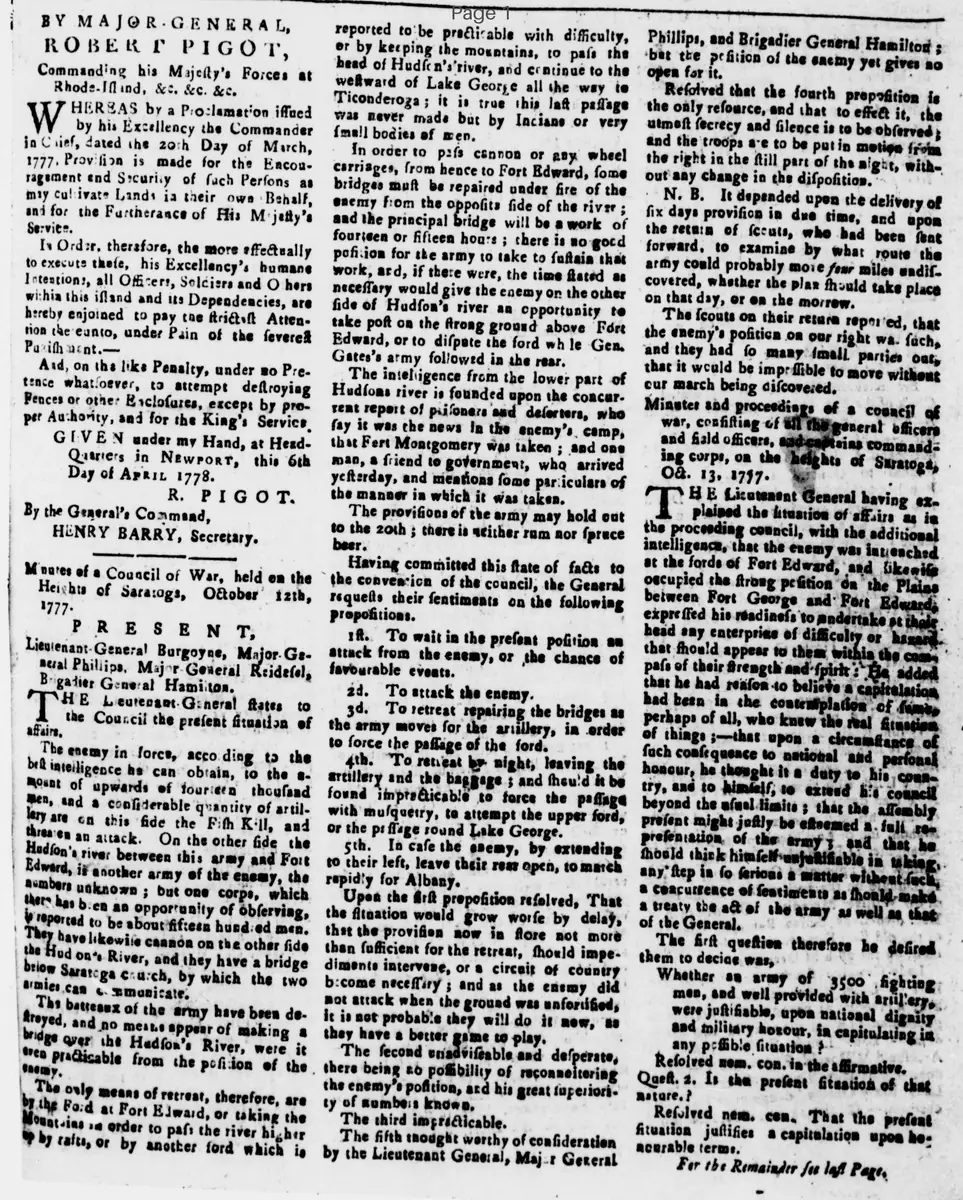
Heights of Saratoga,
October 12th,
1777.
PRESENT,
Lieutenant-General Burgoyne, Major-General
Phillips. Major-General Riedesel,
Brigadier General Hamilton.
THE Lieutenant General at
the Council [laid before]
the present situation of
affairs.
The enemy in force, according to the
best intelligence as can obtain, in the amount
of upwards of fourteen thousand
men, and a considerable quantity of artillery
are on this side the Fish Kill, and
threaten an attack. On the other side the
Hudson's river between this army and Fort
Edward, is another army of the enemy, the
numbers unknown : but one corps, which
there has been an opportunity of observing,
is reported to be about fifteen hundred men.
They have likewise cannon on the other side
the Hudson River, and they have a bridge
below Saratoga church, by which the two
armies can communicate.
The batteaux of the army have been destroyed,
and no means appear of making a
bridge over the Hudson's River, were it
even practicable from the position of the
enemy.
The only means of retreat, therefore, are
by the Ford at Fort Edward, or taking the
Mountains in order to pass the river higher
by rafts, or by another ford which is
reported to be practicable with difficulty,
or by keeping the mountains, to pass the
head of Hudson's river, and continue to the
westward of Lake George all the way to
Ticonderoga; it is true this last passage
was never made but by Indians or very
small bodies of men.
In order to pass cannon or any wheel
carriages, from hence to Fort Edward, some
bridges must be repaired under fire of the
enemy from the opposite side of the river ;
and the principal bridge will be a work of
fourteen or fifteen hours ; there is no good
position for the army to take to sustain that
work, and, if there were, the time stated as
necessary would give the enemy on the other
side of Hudson's river an opportunity to
take post on the strong ground above Fort
Edward, or to dispute the ford while Gen.
Gates's army followed in the rear.
The intelligence from the lower part of
Hudson's river is founded upon the concurrent
report of prisoners and deserters, who
say it was the news in the enemy's camp,
that Fort Montgomery was taken ; and one
man, a friend to government, who arrived
yesterday, and mentions some particulars of
the manner in which it was taken.
The provisions of the army may hold out
to the 20th ; there is neither rum nor spruce
beer.
Having committed this state of facts to
the consideration of the council; the General
requests their sentiments on the following
propositions.
1st. To wait in the present position an
attack from the enemy, or the chance of
favourable events.
2d.
To attack the enemy.
3d. To retreat repairing the bridges as
the army moves for the artillery, in order
to force the passage of the ford.
4th. To retreat by night, leaving the
artillery and the baggage ; and should it be
found impracticable to force the passage
with musquetry, to attempt the upper ford,
or the passage round Lake George.
5th. In case the enemy, by extending
to their left, leave their rear open, to march
rapidly for Albany.
Upon the first proposition resolved, That
the situation would grow worse by delay,
that the provision now in store not more
than sufficient for the retreat, should impediments
intervene, or a circuit of country
become necessary; and as the enemy did
not attack when the ground was unfinished
it is not probable they will do it now, as
they have a better game to play.
The second inadvisable and desperate
there being no possibility of reconnoitering
the enemy's position, and his great superiority
of numbers known.
The third impracticable.
The fifth thought worthy of consideration
by the Lieutenant General, Major General
Phillips, and Brigadier General Hamilton :
but the position of the enemy yet gives no
open for it.
Resolved that the fourth proposition is
the only resource, and that to effect it, the
utmost secrecy and silence is to be observed ;
and the troops are to be put in motion from
the right in the still part of the night, without
any change in the disposition.
N. B. It depended upon the delivery of
six days provision in due time, and upon
the return of scouts, who had been sent
forward to examine by what route the
army could probably move four miles undiscovered,
whether the plan should take place
on that day, or on the morrow.
The scouts on their return reported, that
the enemy's position on our right was such,
and they had so many small parties out,
that it would be impossible to move without
our march being discovered.
Minutes and proceedings of a council of
war, consisting of all the general officers
and field officers, and captains commanding
corps, on the heights of Saratoga,
Oct. 13. 1777:
The Lieutenant General having
[laid before them]
the [same state of]
affairs
as
the preceding council, with the additional
intelligence, that the enemy was entrenched
at the fords of Fort Edward, and likewise
occupied the strong position on the Plains
between Fort George and Fort Edward;
expressed his readiness to undertake at their
head any enterprize of difficulty or hazard
that should appear to them within the compass
of their strength and Spirit : He added
that he had reason to believe a capitulation
had been in the contemplation of some,
perhaps of all, who knew the real situation
of things ;--that upon a circumstance of
such consequence to national and personal
honour, he thought it a duty to his country,
and to himself; to extend his council
beyond the usual limit ; that the assembly
present might justly be esteemed a full representation,
of the army ;--and that he
should think himself unjustifiable in taking
any step in so serious a matter without such
a concurrence of sentiments as should make
a treaty the act of the army as well as that
of the General.
The first question therefore he desired
them to decide was,
Whether an army of 3500 fighting
men, and well provided with artillery:
were justifiable, upon national dignity
and military honour, in capitulating in
any possible situation ?--
Resolved nem. con. in the affirmative.
Quest. 2. Is the present situation of that
nature.?
Resolved nem. con. That the present
situation justifies a capitulation upon honourable
terms.
For the Remainder See last Page.
The Lieutenant General then drew up the message, marked No. 2, in the papers relative to the negotiation, and laid it before the Council. It was unanimously approved, and upon that foundation the treaty opened.
October 14. Major Kingston having delivered the message marked No. 2, returned with the proposals marked No. 3, and the council of war being assembled again, the Lieutenant General laid it before them, when it was resolved unanimously to reject the 16th article, and not to admit of it in any extremity whatever.
The Lieutenant General then laid before the council the answers to Major General Gates's proposals as marked in the same paper, together with his own preliminary upon sundry marked No. 4, which were unanimously approved of.
Oct. 15. The council being assembled again, Major General Gates's answer to Lieutenant General Burgoyne's proposals were laid before them, whereupon it was resolved, That they were satisfactory, and a sufficient ground for proceeding to a definitive treaty.
These papers with the whole treaty have been already published in this gazette.
What sub-type of article is it?
What themes does it cover?
What keywords are associated?
What entities or persons were involved?
Where did it happen?
Story Details
Key Persons
Location
Heights Of Saratoga
Event Date
October 12th, 1777
Story Details
British officers convene councils of war on October 12-15, 1777, assessing overwhelming enemy forces, destroyed supplies, and impossible retreat routes. They reject attacking or retreating with artillery, consider but dismiss marching to Albany, and resolve to retreat by night abandoning baggage. Subsequent intelligence confirms enemy entrenchments, leading to unanimous agreement on honorable capitulation. Negotiations with Gates proceed, culminating in a treaty.