Thank you for visiting SNEWPapers!
Sign up free
Literary
July 21, 1790
Gazette Of The United States
New York, New York County, New York
What is this article about?
Discourse on Davila No. XV argues that growing enlightenment amplifies human passions like ambition and rivalry, increasing the need for governmental checks and balances. It critiques French pretensions to rationality, praises American adoption of balanced government, and quotes the 1772 Boston pamphlet on legislative power and rights.
Clipping
OCR Quality
95%
Excellent
Full Text
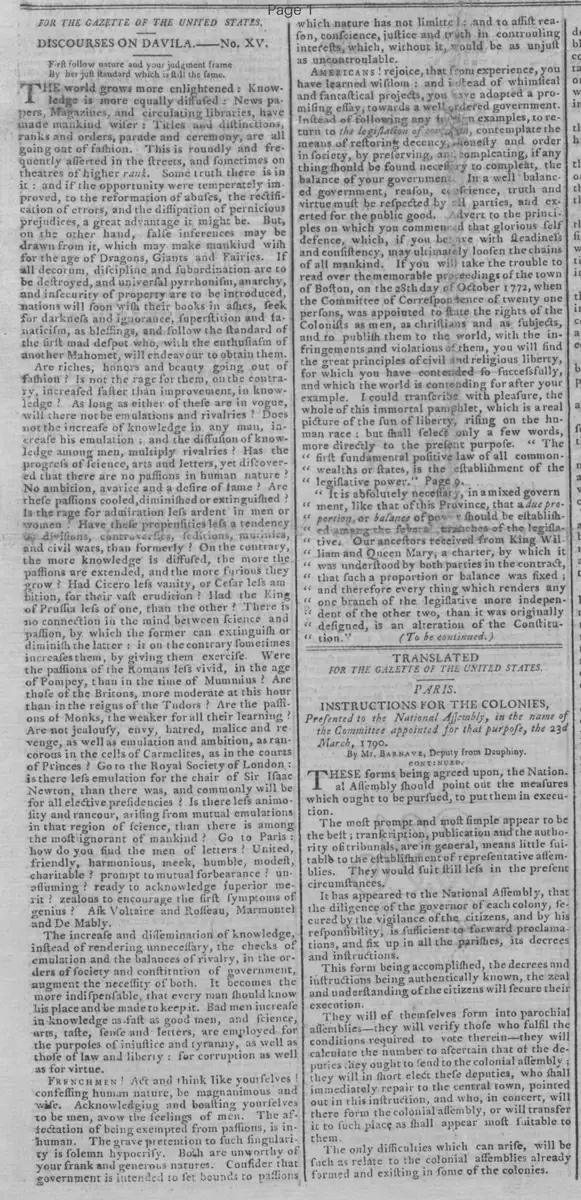
FOR THE GAZETTE OF THE UNITED STATES.
DISCOURSES ON DAVILA. NO. XV.
First follow nature and your judgment frame
By her just standard which is still the same.
THE world grows more enlightened now—
Newspapers, Magazines, and circulating libraries, have
made mankind wiser: Titles and distinctions,
ranks and orders, parade and ceremony, are all
going out of fashion. This is roundly and frequently
asserted in the streets, and sometimes on
theatres of higher rank. Some truth there is in
it: and if the opportunity were temperately improved,
to the reformation of abuses, the rectification
of errors, and the dissipation of pernicious
prejudices, a great advantage it might be. But,
on the other hand, false inferences may be
drawn from it, which may make mankind wish
for the age of Dragons, Giants and Fairies. If
all decorum, discipline and subordination are to
be destroyed, and universal pyrrhonism, anarchy,
and insecurity of property are to be introduced,
nations will soon wish their books in ashes, seek
for darkness and ignorance, superstition and fanaticism,
as blessings, and follow the standard of
the first mad despot who, with the enthusiasm of
another Mahomet, will endeavour to obtain them.
Are riches, honors and beauty going out of
fashion? Is not the rage for them, on the contrary,
increased faster than improvement, in knowledge?
As long as either of these are in vogue,
will there not be emulations and rivalries? Does
not the increase of knowledge in any man, increase
his emulation; and the diffusion of knowledge
among men, multiply rivalries? Has the
progress of science, arts and letters, yet discovered
that there are no passions in human nature?
No ambition, avarice and a desire of fame? Are
these passions cooled, diminished or extinguished?
Is the rage for admiration less ardent in men or
women: Have these propensities less a tendency
to divisions, controversies, seditions, mutinies,
and civil wars, than formerly? On the contrary,
the more knowledge is diffused, the more the
passions are extended, and the more furious they
grow? Had Cicero less vanity, or Caesar less ambition,
for their vast erudition? Had the King
of Prussia less of one, than the other? There is
no connection in the mind between science and
passion, by which the former can extinguish or
diminish the latter: it on the contrary sometimes
increases them, by giving them exercise. Were
the passions of the Romans less vivid, in the age
of Pompey, than in the time of Mummius? Are
those of the Britons, more moderate at this hour
than in the reigns of the Tudors? Are the passions
of Monks, the weaker for all their learning?
Are not jealousy, envy, hatred, malice and revenge,
as well as emulation and ambition, as rancorous
in the cells of Carmelites, as in the courts
of Princes? Go to the Royal Society of London:
is there less emulation for the chair of Sir Isaac
Newton, than there was, and commonly will be
for all elective presidencies? Is there less animosity
and rancour, arising from mutual emulations
in that region of science, than there is among
the most ignorant of mankind? Go to Paris:
how do you find the men of letters? United,
friendly, harmonious, meek, humble, modest,
charitable? prompt to mutual forbearance! un-
assuming? ready to acknowledge superior merit?
zealous to encourage the first symptoms of
genius? Ask Voltaire and Rousseau, Marmontel
and De Mably.
The increase and dissemination of knowledge,
instead of rendering unnecessary, the checks of
emulation and the balances of rivalry, in the orders
of society and constitution of government,
augment the necessity of both. It becomes the
more indispensable, that every man should know
his place and be made to keep it. Bad men increase
in knowledge as fast as good men, and science,
arts, taste, sense and letters, are employed for
the purposes of injustice and tyranny, as well as
those of law and liberty: for corruption as well
as for virtue.
Frenchmen! Act and think like yourselves!
Confess human nature, be magnanimous and
wise. Acknowledging and boasting yourselves
to be men, avow the feelings of men. The affectation
of being exempted from passions, is inhuman.
The grave pretention to such ingularity
is solemn hypocrisy. Both are unworthy of
your frank and generous natures. Consider that
government is intended to set bounds to passions
which nature has not limited; and to assist reason,
conscience, justice and truth in controuling
interests, which, without it, would be as unjust
as uncontroulable.
Americans! rejoice, that from experience, you
have learned wisdom: and instead of whimsical
and fanatical projects, you have adopted a promising
way, towards a well ordered government.
Instead of following any foreign examples, to return
to the legislation of congress, contemplate the
means of restoring decency, honesty and order
in society, by preserving, and compleating, if anything
should be found necessary to compleat, the
balance of your government. In a well balanced
government, reason, conscience, truth and
virtue must be respected by all parties, and exerted
for the public good. Advert to the principles
on which you commenced that glorious self
defence, which, if you be preserve with readiness
and consistency, may ultimately loosen the chains
of all mankind. If you will take the trouble to
read over the memorable proceedings of the town
of Boston, on the 28th day of October 1772, when
the Committee of Correspondence of twenty one
persons, was appointed to state the rights of the
Colonists as men, as christians and as Subjects,
and to publish them to the world, with the infringements
and violations of them, you will find
the great principles of civil and religious liberty,
for which you have contended so successfully,
and which the world is contending for after your
example. I could transcribe with pleasure, the
whole of this immortal pamphlet, which is a real
picture of the sun of liberty, rising on the human
race: but shall select only a few words,
more directly to the present purpose. "The
first fundamental positive law of all common-
wealths or states, is the establishment of the
legislative power." Page 9.
"It is absolutely necessary, in a mixed govern-
ment, like that of this Province, that a due pro-
portion, or balance of power should be established
among the several branches of the legislative.
Our ancestors received from King William
and Queen Mary, a charter, by which it
was understood by both parties in the contract,
that such a proportion or balance was fixed;
and therefore every thing which renders any
one branch of the legislative more independent
of the other two, than it was originally
designed, is an alteration of the Constitution."
(To be continued.)
DISCOURSES ON DAVILA. NO. XV.
First follow nature and your judgment frame
By her just standard which is still the same.
THE world grows more enlightened now—
Newspapers, Magazines, and circulating libraries, have
made mankind wiser: Titles and distinctions,
ranks and orders, parade and ceremony, are all
going out of fashion. This is roundly and frequently
asserted in the streets, and sometimes on
theatres of higher rank. Some truth there is in
it: and if the opportunity were temperately improved,
to the reformation of abuses, the rectification
of errors, and the dissipation of pernicious
prejudices, a great advantage it might be. But,
on the other hand, false inferences may be
drawn from it, which may make mankind wish
for the age of Dragons, Giants and Fairies. If
all decorum, discipline and subordination are to
be destroyed, and universal pyrrhonism, anarchy,
and insecurity of property are to be introduced,
nations will soon wish their books in ashes, seek
for darkness and ignorance, superstition and fanaticism,
as blessings, and follow the standard of
the first mad despot who, with the enthusiasm of
another Mahomet, will endeavour to obtain them.
Are riches, honors and beauty going out of
fashion? Is not the rage for them, on the contrary,
increased faster than improvement, in knowledge?
As long as either of these are in vogue,
will there not be emulations and rivalries? Does
not the increase of knowledge in any man, increase
his emulation; and the diffusion of knowledge
among men, multiply rivalries? Has the
progress of science, arts and letters, yet discovered
that there are no passions in human nature?
No ambition, avarice and a desire of fame? Are
these passions cooled, diminished or extinguished?
Is the rage for admiration less ardent in men or
women: Have these propensities less a tendency
to divisions, controversies, seditions, mutinies,
and civil wars, than formerly? On the contrary,
the more knowledge is diffused, the more the
passions are extended, and the more furious they
grow? Had Cicero less vanity, or Caesar less ambition,
for their vast erudition? Had the King
of Prussia less of one, than the other? There is
no connection in the mind between science and
passion, by which the former can extinguish or
diminish the latter: it on the contrary sometimes
increases them, by giving them exercise. Were
the passions of the Romans less vivid, in the age
of Pompey, than in the time of Mummius? Are
those of the Britons, more moderate at this hour
than in the reigns of the Tudors? Are the passions
of Monks, the weaker for all their learning?
Are not jealousy, envy, hatred, malice and revenge,
as well as emulation and ambition, as rancorous
in the cells of Carmelites, as in the courts
of Princes? Go to the Royal Society of London:
is there less emulation for the chair of Sir Isaac
Newton, than there was, and commonly will be
for all elective presidencies? Is there less animosity
and rancour, arising from mutual emulations
in that region of science, than there is among
the most ignorant of mankind? Go to Paris:
how do you find the men of letters? United,
friendly, harmonious, meek, humble, modest,
charitable? prompt to mutual forbearance! un-
assuming? ready to acknowledge superior merit?
zealous to encourage the first symptoms of
genius? Ask Voltaire and Rousseau, Marmontel
and De Mably.
The increase and dissemination of knowledge,
instead of rendering unnecessary, the checks of
emulation and the balances of rivalry, in the orders
of society and constitution of government,
augment the necessity of both. It becomes the
more indispensable, that every man should know
his place and be made to keep it. Bad men increase
in knowledge as fast as good men, and science,
arts, taste, sense and letters, are employed for
the purposes of injustice and tyranny, as well as
those of law and liberty: for corruption as well
as for virtue.
Frenchmen! Act and think like yourselves!
Confess human nature, be magnanimous and
wise. Acknowledging and boasting yourselves
to be men, avow the feelings of men. The affectation
of being exempted from passions, is inhuman.
The grave pretention to such ingularity
is solemn hypocrisy. Both are unworthy of
your frank and generous natures. Consider that
government is intended to set bounds to passions
which nature has not limited; and to assist reason,
conscience, justice and truth in controuling
interests, which, without it, would be as unjust
as uncontroulable.
Americans! rejoice, that from experience, you
have learned wisdom: and instead of whimsical
and fanatical projects, you have adopted a promising
way, towards a well ordered government.
Instead of following any foreign examples, to return
to the legislation of congress, contemplate the
means of restoring decency, honesty and order
in society, by preserving, and compleating, if anything
should be found necessary to compleat, the
balance of your government. In a well balanced
government, reason, conscience, truth and
virtue must be respected by all parties, and exerted
for the public good. Advert to the principles
on which you commenced that glorious self
defence, which, if you be preserve with readiness
and consistency, may ultimately loosen the chains
of all mankind. If you will take the trouble to
read over the memorable proceedings of the town
of Boston, on the 28th day of October 1772, when
the Committee of Correspondence of twenty one
persons, was appointed to state the rights of the
Colonists as men, as christians and as Subjects,
and to publish them to the world, with the infringements
and violations of them, you will find
the great principles of civil and religious liberty,
for which you have contended so successfully,
and which the world is contending for after your
example. I could transcribe with pleasure, the
whole of this immortal pamphlet, which is a real
picture of the sun of liberty, rising on the human
race: but shall select only a few words,
more directly to the present purpose. "The
first fundamental positive law of all common-
wealths or states, is the establishment of the
legislative power." Page 9.
"It is absolutely necessary, in a mixed govern-
ment, like that of this Province, that a due pro-
portion, or balance of power should be established
among the several branches of the legislative.
Our ancestors received from King William
and Queen Mary, a charter, by which it
was understood by both parties in the contract,
that such a proportion or balance was fixed;
and therefore every thing which renders any
one branch of the legislative more independent
of the other two, than it was originally
designed, is an alteration of the Constitution."
(To be continued.)
What sub-type of article is it?
Essay
What themes does it cover?
Political
Liberty Freedom
Moral Virtue
What keywords are associated?
Political Essay
Human Passions
Balanced Government
Enlightenment
American Liberty
Boston Pamphlet
Civil Rights
Literary Details
Title
Discourses On Davila. No. Xv.
Key Lines
First Follow Nature And Your Judgment Frame
By Her Just Standard Which Is Still The Same.
Frenchmen! Act And Think Like Yourselves!
Confess Human Nature, Be Magnanimous And
Wise.
Americans! Rejoice, That From Experience, You
Have Learned Wisdom: And Instead Of Whimsical
And Fanatical Projects, You Have Adopted A Promising
Way, Towards A Well Ordered Government.
"The First Fundamental Positive Law Of All Common
Wealths Or States, Is The Establishment Of The
Legislative Power." Page 9.
"It Is Absolutely Necessary, In A Mixed Govern
Ment, Like That Of This Province, That A Due Pro
Portion, Or Balance Of Power Should Be Established
Among The Several Branches Of The Legislative."