Thank you for visiting SNEWPapers!
Sign up free
Editorial
December 24, 1858
Vermont Watchman And State Journal
Montpelier, Washington County, Vermont
What is this article about?
An editorial critiques the modern interpretation of the Monroe Doctrine, providing a historical analysis from the National Intelligencer. It argues that the original 1823 declaration addressed Spanish colonial emancipation and opposed European colonization or intervention, but was not a U.S. pledge to defend the Americas, and current views distort its intent.
Clipping
OCR Quality
98%
Excellent
Full Text
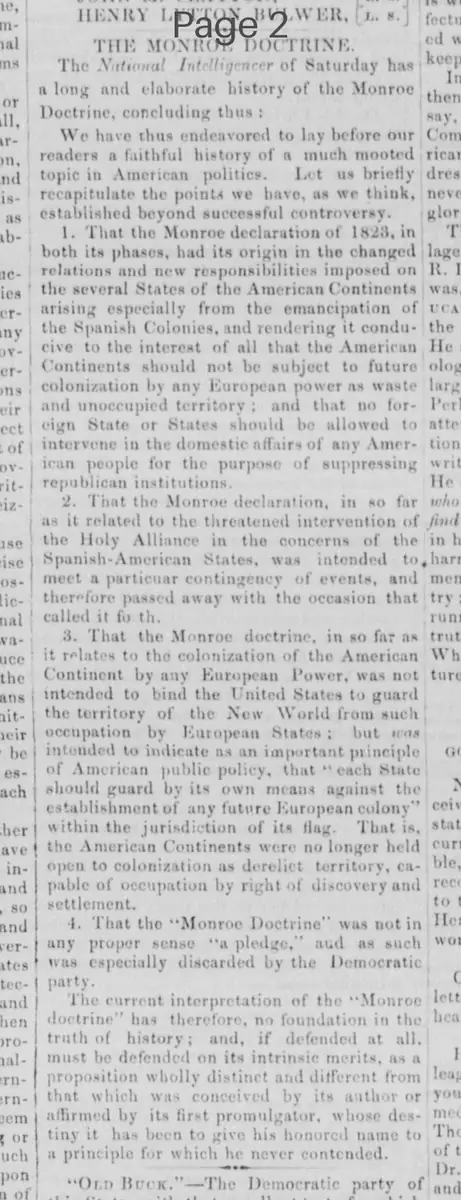
THE MONROE DOCTRINE
The National Intelligencer of Saturday has a long and elaborate history of the Monroe Doctrine, concluding thus:
We have thus endeavored to lay before our readers a faithful history of a much mooted topic in American politics. Let us briefly recapitulate the points we have, as we think, established beyond successful controversy.
1. That the Monroe declaration of 1823, in both its phases, had its origin in the changed relations and new responsibilities imposed on the several States of the American Continents arising especially from the emancipation of the Spanish Colonies, and rendering it conducive to the interest of all that the American Continents should not be subject to future colonization by any European power as waste and unoccupied territory: and that no foreign State or States should be allowed to intervene in the domestic affairs of any American people for the purpose of suppressing republican institutions.
2. That the Monroe declaration, in so far as it related to the threatened intervention of the Holy Alliance in the concerns of the Spanish-American States, was intended to meet a particular contingency of events, and therefore passed away with the occasion that called it forth.
3. That the Monroe doctrine, in so far as it relates to the colonization of the American Continent by any European Power, was not intended to bind the United States to guard the territory of the New World from such occupation by European States; but was intended to indicate as an important principle of American public policy, that "each State should guard by its own means against the establishment of any future European colony" within the jurisdiction of its flag. That is, the American Continents were no longer held open to colonization as derelict territory, capable of occupation by right of discovery and settlement.
4. That the "Monroe Doctrine" was not in any proper sense "a pledge," and as such was especially discarded by the Democratic party.
The current interpretation of the "Monroe doctrine" has therefore, no foundation in the truth of history; and, if defended at all, must be defended on its intrinsic merits, as a proposition wholly distinct and different from that which was conceived by its author or affirmed by its first promulgator, whose destiny it has been to give his honored name to a principle for which he never contended.
The National Intelligencer of Saturday has a long and elaborate history of the Monroe Doctrine, concluding thus:
We have thus endeavored to lay before our readers a faithful history of a much mooted topic in American politics. Let us briefly recapitulate the points we have, as we think, established beyond successful controversy.
1. That the Monroe declaration of 1823, in both its phases, had its origin in the changed relations and new responsibilities imposed on the several States of the American Continents arising especially from the emancipation of the Spanish Colonies, and rendering it conducive to the interest of all that the American Continents should not be subject to future colonization by any European power as waste and unoccupied territory: and that no foreign State or States should be allowed to intervene in the domestic affairs of any American people for the purpose of suppressing republican institutions.
2. That the Monroe declaration, in so far as it related to the threatened intervention of the Holy Alliance in the concerns of the Spanish-American States, was intended to meet a particular contingency of events, and therefore passed away with the occasion that called it forth.
3. That the Monroe doctrine, in so far as it relates to the colonization of the American Continent by any European Power, was not intended to bind the United States to guard the territory of the New World from such occupation by European States; but was intended to indicate as an important principle of American public policy, that "each State should guard by its own means against the establishment of any future European colony" within the jurisdiction of its flag. That is, the American Continents were no longer held open to colonization as derelict territory, capable of occupation by right of discovery and settlement.
4. That the "Monroe Doctrine" was not in any proper sense "a pledge," and as such was especially discarded by the Democratic party.
The current interpretation of the "Monroe doctrine" has therefore, no foundation in the truth of history; and, if defended at all, must be defended on its intrinsic merits, as a proposition wholly distinct and different from that which was conceived by its author or affirmed by its first promulgator, whose destiny it has been to give his honored name to a principle for which he never contended.
What sub-type of article is it?
Foreign Affairs
Partisan Politics
What keywords are associated?
Monroe Doctrine
European Colonization
Foreign Intervention
American Policy
Spanish American States
Holy Alliance
What entities or persons were involved?
Monroe
Holy Alliance
Spanish Colonies
Democratic Party
National Intelligencer
Editorial Details
Primary Topic
Historical Clarification Of The Monroe Doctrine
Stance / Tone
Critical Of Modern Expansive Interpretations
Key Figures
Monroe
Holy Alliance
Spanish Colonies
Democratic Party
National Intelligencer
Key Arguments
Monroe Declaration Originated From Emancipation Of Spanish Colonies And Opposed Future European Colonization
Declaration Addressed Specific Threat From Holy Alliance And Expired With It
Doctrine Did Not Commit U.S. To Defend Americas But Emphasized Self Guard By Each State
Monroe Doctrine Was Not A Pledge, Rejected By Democratic Party
Current Interpretations Lack Historical Foundation