Thank you for visiting SNEWPapers!
Sign up free
Story
December 20, 1954
Trainman News
Indianapolis, Marion County, Indiana
What is this article about?
Speaker Sam Rayburn plans to ban radio, TV, newsreels, and recordings of House committee hearings starting January 5, 1955, opposing any rules change to allow them. This revives a 1952 ban he enacted, despite past allowances under other speakers. Senate committees retain discretion.
Clipping
OCR Quality
100%
Excellent
Full Text
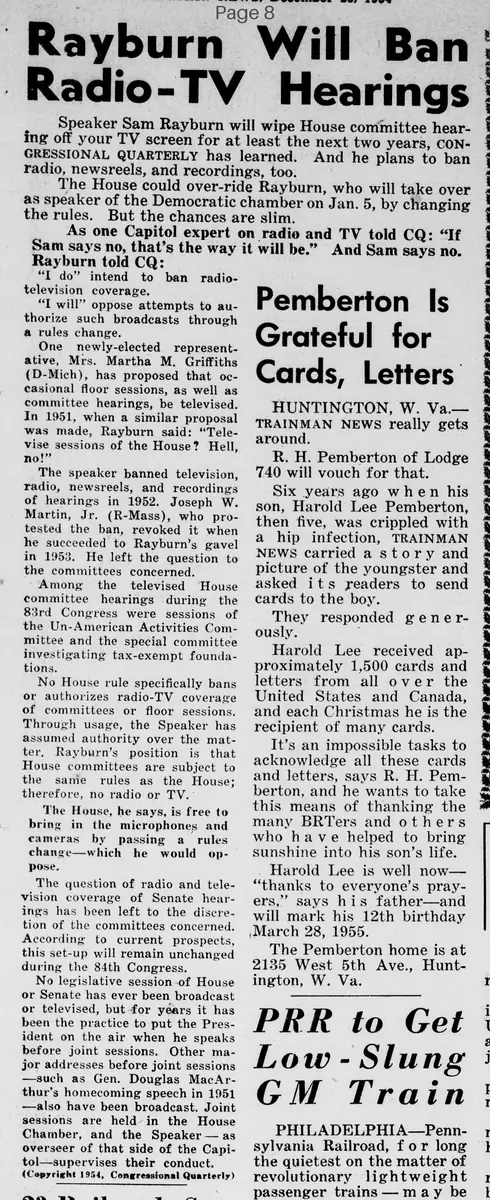
Rayburn Will Ban Radio-TV Hearings
Speaker Sam Rayburn will wipe House committee hearings off your TV screen for at least the next two years, CONGRESSIONAL QUARTERLY has learned. And he plans to ban radio, newsreels, and recordings, too.
The House could over-ride Rayburn, who will take over as speaker of the Democratic chamber on Jan. 5, by changing the rules. But the chances are slim.
As one Capitol expert on radio and TV told CQ: "If Sam says no, that's the way it will be." And Sam says no.
Rayburn told CQ:
"I do intend to ban radio-television coverage."
"I will oppose attempts to authorize such broadcasts through a rules change."
One newly-elected representative, Mrs. Martha M. Griffiths (D-Mich), has proposed that occasional floor sessions, as well as committee hearings, be televised.
In 1951, when a similar proposal was made, Rayburn said: "Televise sessions of the House? Hell, no!"
The speaker banned television, radio, newsreels, and recordings of hearings in 1952. Joseph W. Martin, Jr. (R-Mass), who protested the ban, revoked it when he succeeded to Rayburn's gavel in 1953. He left the question to the committees concerned.
Among the televised House committee hearings during the 83rd Congress were sessions of the Un-American Activities Committee and the special committee investigating tax-exempt foundations.
No House rule specifically bans or authorizes radio-TV coverage of committees or floor sessions. Through usage, the Speaker has assumed authority over the matter. Rayburn's position is that House committees are subject to the same rules as the House; therefore, no radio or TV.
The House, he says, is free to bring in the microphones and cameras by passing a rules change--which he would oppose.
The question of radio and television coverage of Senate hearings has been left to the discretion of the committees concerned. According to current prospects, this set-up will remain unchanged during the 84th Congress.
No legislative session of House or Senate has ever been broadcast or televised, but for years it has been the practice to put the President on the air when he speaks before joint sessions. Other major addresses before joint sessions--such as Gen. Douglas MacArthur's homecoming speech in 1951--also have been broadcast. Joint sessions are held in the House Chamber, and the Speaker--as overseer of that side of the Capitol--supervises their conduct.
(Copyright 1954, Congressional Quarterly)
Speaker Sam Rayburn will wipe House committee hearings off your TV screen for at least the next two years, CONGRESSIONAL QUARTERLY has learned. And he plans to ban radio, newsreels, and recordings, too.
The House could over-ride Rayburn, who will take over as speaker of the Democratic chamber on Jan. 5, by changing the rules. But the chances are slim.
As one Capitol expert on radio and TV told CQ: "If Sam says no, that's the way it will be." And Sam says no.
Rayburn told CQ:
"I do intend to ban radio-television coverage."
"I will oppose attempts to authorize such broadcasts through a rules change."
One newly-elected representative, Mrs. Martha M. Griffiths (D-Mich), has proposed that occasional floor sessions, as well as committee hearings, be televised.
In 1951, when a similar proposal was made, Rayburn said: "Televise sessions of the House? Hell, no!"
The speaker banned television, radio, newsreels, and recordings of hearings in 1952. Joseph W. Martin, Jr. (R-Mass), who protested the ban, revoked it when he succeeded to Rayburn's gavel in 1953. He left the question to the committees concerned.
Among the televised House committee hearings during the 83rd Congress were sessions of the Un-American Activities Committee and the special committee investigating tax-exempt foundations.
No House rule specifically bans or authorizes radio-TV coverage of committees or floor sessions. Through usage, the Speaker has assumed authority over the matter. Rayburn's position is that House committees are subject to the same rules as the House; therefore, no radio or TV.
The House, he says, is free to bring in the microphones and cameras by passing a rules change--which he would oppose.
The question of radio and television coverage of Senate hearings has been left to the discretion of the committees concerned. According to current prospects, this set-up will remain unchanged during the 84th Congress.
No legislative session of House or Senate has ever been broadcast or televised, but for years it has been the practice to put the President on the air when he speaks before joint sessions. Other major addresses before joint sessions--such as Gen. Douglas MacArthur's homecoming speech in 1951--also have been broadcast. Joint sessions are held in the House Chamber, and the Speaker--as overseer of that side of the Capitol--supervises their conduct.
(Copyright 1954, Congressional Quarterly)
What sub-type of article is it?
Historical Event
What themes does it cover?
Justice
What keywords are associated?
Rayburn Ban
Tv Hearings
Congress Rules
Radio Coverage
Speaker Authority
What entities or persons were involved?
Sam Rayburn
Martha M. Griffiths
Joseph W. Martin, Jr.
Douglas Macarthur
Where did it happen?
U.S. House Of Representatives, Capitol
Story Details
Key Persons
Sam Rayburn
Martha M. Griffiths
Joseph W. Martin, Jr.
Douglas Macarthur
Location
U.S. House Of Representatives, Capitol
Event Date
Jan. 5, 1955; 1951 1954
Story Details
Speaker Sam Rayburn intends to ban radio-TV coverage of House committee hearings and floor sessions starting January 5, 1955, opposing any rules changes to allow it, reviving his 1952 ban previously revoked in 1953.