Thank you for visiting SNEWPapers!
Sign up free
Literary
July 16, 1825
Phenix Gazette
Alexandria, Virginia
What is this article about?
A natural history of Mount Etna in Sicily, blending poetic descriptions with prose detailing its geography, eruptions, ascent challenges, climatic zones, and historical significance, including excerpts from West, Thompson, Akenside, and Warton.
Merged-components note: Continuation of the 'Natural History: Mount Etna' article across sequential reading orders.
Clipping
OCR Quality
92%
Excellent
Full Text
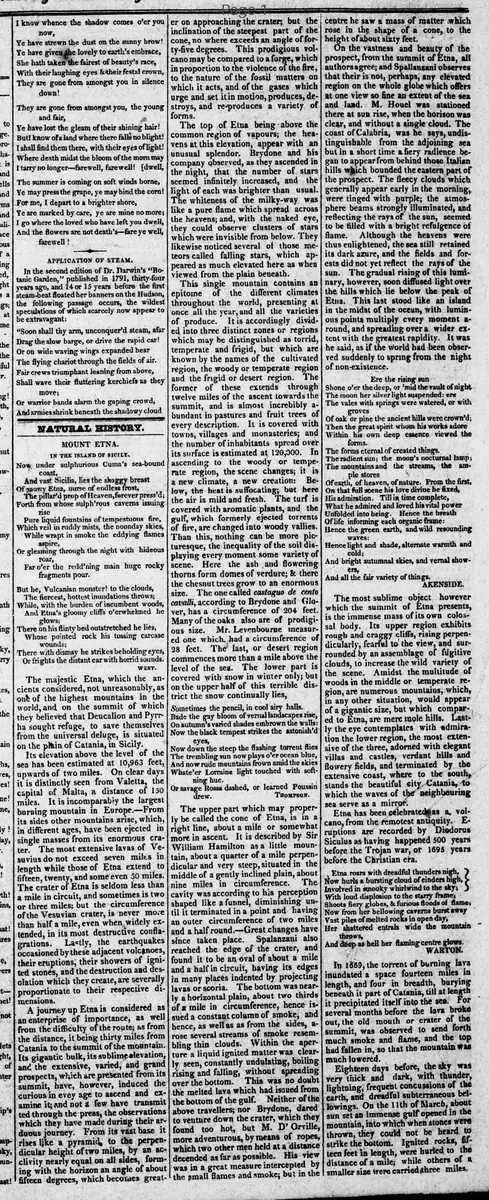
NATURAL HISTORY.
MOUNT ETNA.
IN THE ISLAND OF SICILY,
Now, under sulphurious Cumae's sea-bound
coast,
And vast Sicilia, lies the shaggy breast
Of snowy Etna, nurse of endless frost,
The pillard prop of Heaven, forever press'd;
Forth from whose sulph'rous caverns issuing
rise
Pure liquid fountains of tempestuous fire,
Which veil in ruddy mists, the noonday skies,
'While wrapt in smoke the eddying flames
aspire,
Or gleaming through the night with hideous
roar,
Far o'er the redd'ning main huge rocky
fragments pour.
But he, Vulcanian monster! to the clouds,
The fiercest, hottest inundations throws;
While, with the burthen of incumbent woods,
And Etna's gloomy cliffs o'erwhelmed he
glows;
There on his flinty bed outstretched he lies,
Whose pointed rock his tossing carcase
wounds;
There with dismay he strikes beholding eyes,
Or frights the distant ear with horrid sounds.
WEST.
The majestic Etna, which the an-
cients considered, not unreasonably, as
one of the highest mountains in the
world, and on the summit of which
they believed that Deucalion and Pyrr-
ha sought refuge, to save themselves
from the universal deluge, is situated
on the plain of Catania, in Sicily.
Its elevation above the level of the
sea has been estimated at 10,963 feet,
upwards of two miles. On clear days
it is distinctly seen from Valetta, the
capital of Malta, a distance of 150
miles. It is incomparably the largest
burning mountain in Europe.—From
its sides other mountains arise, which,
in different ages, have been ejected in
single masses from its enormous cra-
ter. The most extensive lavas of Ve-
suvius do not exceed seven miles in
length while those of Etna extend to
fifteen, twenty, and some even 30 miles.
The crater of Etna is seldom less than
a mile in circuit, and sometimes is two
or three miles; but the circumference
of the Vesuvian crater, is never more
than half a mile, even when widely ex-
tended, in its most destructive confla-
grations. Lastly, the earthquakes
occasioned by these adjacent volcanoes,
their eruptions, their showers of igni-
ted stones, and the destruction and des-
clation which they create, are severally
proportionate to their respective di-
mensions.
A journey up Etna is considered as
an enterprise of importance, as well
from the difficulty of the route; as from
the distance, it being thirty miles from
Catania to the summit of the mountain.
Its gigantic bulk, its sublime elevation,
and the extensive, varied, and grand
prospects, which are presented from its
summit, have, however, induced the
curious in every age to ascend and ex-
amine it; and not a few have transmit-
ted through the press, the observations
which they have made during their ar-
duous journey. From its vast base it
rises like a pyramid, to the perpen-
dicular height of two miles, by an ac-
clivity nearly equal on all sides, form-
ing with the horizon an angle of about
fifteen degrees, which becomes great-
er on approaching the crater; but the
inclination of the steepest part of the
cone, no where exceeds an angle of for-
ty-five degrees. This prodigious vol-
cano may be compared to a forge, which
in proportion to the violence of the fire,
to the nature of the fossil matters on
which it acts, and of the gases which
urge and set it in motion, produces, de-
stroys, and re-produces a variety of
forms.
The top of Etna being above the
common region of vapours; the hea-
vens at this elevation, appear with an
unusual splendor. Brydone and his
company observed, as they ascended in
the night, that the number of stars
seemed infinitely increased, and the
light of each was brighter than usual.
The whiteness of the milky-way was
like a pure flame which spread across
the heavens; and, with the naked eye,
they could observe clusters of stars
which were invisible from below. They
likewise noticed several of those me-
teors called falling stars, which ap-
peared as much elevated here as when
viewed from the plain beneath.
This single mountain contains an
epitome of the different climates
throughout the world, presenting at
once all the year, and all the varieties
of produce. It is accordingly divid-
ed into three distinct zones or regions
which may be distinguished as torrid,
temperate and frigid, but which are
known by the names of the cultivated
region, the woody or temperate region
and the frigid or desert region. The
former of these extends through
twelve miles of the ascent towards the
summit, and is almost incredibly a-
bundant in pastures and fruit trees of
every description. It is covered with
towns, villages and monasteries; and
the number of inhabitants spread over
its surface is estimated at 120,000. In
ascending to the woody or tempe-
rate region, the scene changes; it is
a new climate, a new creation: Be-
low, the heat is suffocating; but here
the air is mild and fresh. The turf is
covered with aromatic plants, and the
gulf, which formerly ejected torrents
of fire, are changed into woody vallies.
Than this, nothing can be more pic-
turesque, the inequality of the soil dis-
playing every moment some variety of
scene. Here the ash, and flowering
thorns form domes of verdure; & there
the chesnut trees grow to an enormous
size. The one called castagno de cento
cavalli, according to Brydone and Glo-
ver, has a circumference of 204 feet.
Many of the oaks also are of prodigi-
ous size. Mr. Levenbourne measur-
ed one which had a circumference of
28 feet. The last, or desert region
commences more than a mile above the
level of the sea. The lower part is
covered with snow in winter only; but
on the upper half of this terrible dis.
trict the snow continually lies,
Sometimes the pencil, in cool airy halls
Bade the gay bloom of vernal landscapes rise,
On autumn's varied shades embrown the walls:
Now the black tempest strikes the astonish'd
eyes,
Now down the steep the flashing torrent flies
The trembling sun now plays o'er ocean blue,
And now rude mountains frown amid the skies
Whate'er Lorraine light touched with soft-
ning hue.
Or savage Rosa dashed, or learned Poussin
drew.
THOMPSON.
The upper part which may proper-
ly be called the cone of Etna, is in a
right line, about a mile or somewhat
more in ascent. It is described by Sir
William Hamilton as a little moun-
tain, about a quarter of a mile perpen-
dicular and very steep, situated in the
middle of a gently inclined plain, about
nine miles in circumference. The
cavity was according to his perception
shaped like a funnel, diminishing un-
til it terminated in a point and having
an outer circumference of two miles
and a half round.—Great changes have
since taken place. Spalanzani also
reached the edge of the crater, and
found it to be an oval of about a mile
and a half in circuit, having its edges
in many places indented by projecting
lavas or scoria. The bottom was near-
ly a horizontal plain, about two thirds
of a mile in circumference, hence is-
sued a constant column of smoke, and
hence, as well as from the sides, a-
rose several streams of smoke resem-
bling thin clouds. Within the aper-
ture a liquid ignited matter was clear-
ly seen, constantly undulating, boiling
rising and falling, without spreading
over the bottom. This was no doubt
the melted lava which had issued from
the bottom of the gulf. Neither of the
above travellers; nor Brydone, dared
to venture down the crater, which they
found too hot, but M. D'Orville,
more adventurous, by means of ropes,
which two other men held at a distance
decended as far as possible. His view
was in a great measure intercepted by
the small flames and smoke; but in the
centre he saw a mass of matter which
rose in the shape of a cone, to the
height of about sixty feet.
On the vastness and beauty of the
prospect, from the summit of Etna, all
authors agree; and Spallanzani observes
that there is not, perhaps, any elevated
region on the whole globe which offers
at one view so fine an extent of the sea
and land. M. Houel was stationed
there at sun rise, when the horison was
clear, and without a single cloud. The
coast of Calabria, was he says, undis-
tinguishable from the adjoining sea
but in a short time a fiery radience be-
gan to appear from behind those Italian
hills which bounded the eastern part of
the prospect. The fleecy clouds which
generally appear early in the morning,
were tinged with purple; the atmos-
phere beams strongly illuminated, and
reflecting the rays of the sun, seemed
to be filled with a bright refulgence of
flame. Although the heavens were
thus enlightened, the sea still retained
its dark azure, and the fields and for-
ests did not yet reflect the rays of the
sun. The gradual rising of this lumi-
nary, however, soon diffused light over
the hills which lie below the peak of
Etna. This last stood like an island
in the midst of the ocean, with lumin-
ous points multiplying every moment a-
round, and spreading over a wider ex-
tent with the greatest rapidity. It was
he said, as if the world had been obser-
ved suddenly to spring from the night
of non-existence.
Ere the rising sun
Shone o'er the deep, or 'mid the vault of night
The moon her silver light suspended: ere
The vales with springs were watered, or with
groves
Of oak or pine the ancient hills were crown'd:
Then the great spirit whom his works adore
Within his own deep essence viewed the
forms.
The forms eternal of created things.
The radiant sun; the moon's nocturnal lamp;
The mountains and the streams, the am-
ple stores
Of earth, of heaven, of nature. From the first,
On that full scene his love divine he fixed,
His admiration. Till in time complete,
What he admired and loved his vital power
Unfolded into being. Hence the breath
Of life informing each organic frame:
Hence the green earth, and wild resounding
waves:
Hence light and shade, alternate warmth and
cold;
And bright autumnal skies, and vernal show-
ers,
And all the fair variety of things.
AKENSIDE.
The most sublime object however
which the summit of Etna presents,
is the immense mass of its own colos-
sal body. Its upper region exhibits
rough and craggy cliffs, rising perpen-
dicularly, fearful to the view, and sur-
rounded by an assemblage of fugitive
clouds, to increase the wild variety of
the scene. Amidst the multitude of
woods in the middle or temperate re-
gion, are numerous mountains, which,
in any other situation, would appear
of a gigantic size, but which compar-
ed to Etna, are mere mole hills. Last-
ly the eye contemplates with admira-
tion the lower region, the most exten-
sive of the three, adorned with elegant
villas and castles, verdant hills and
flowery fields, and terminated by the
extensive coast, where to the south,
stands the beautiful city Catania, to
which the waves of the neighbouring
sea serve as a mirror.
Etna has been celebrated as a vol-
cano, from the remotest antiquity. E-
ruptions are recorded by Diodorus
Siculus as having happened 500 years
before the Trojan war, or 1695 years
before the Christian era.
Etna roars with dreadful thunders nigh,
Now hurls a bursting cloud of cinders high,
Involved in smoky whirlwind to the sky;
With loud explosion to the starry frame,
Shoots fiery globes, & furious floods of flame;
Now from her bellowing caverns burst away
Vast piles of melted rocks in open day,
Her shattered entrails wide the mountain
throws,
And deep as hell her flaming centre glows.
WARTON.
In 1669, the torrent of burning lava
inundated a space fourteen miles in
length, and four in breadth, burying
beneath it part of Catania, till at length
several months before the lava broke
it precipitated itself into the sea. For
out, the old mouth or crater of the
summit, was observed to send forth
much smoke and flame, and the top
had fallen in, so that the mountain was
much lowered.
Eighteen days before, the sky was
very thick and dark, with thunder.
lightning, frequent concussions of the
earth, and dreadful subterraneous bel-
lowings. On the 11th of March, about
sun set an immense gulf opened in the
mountain, into which when stones were
thrown, they could not be heard to
strike the bottom. Ignited rocks, fif-
teens feet in length, were hurled to the
distance of a mile; while others of a
smaller size were carried three miles.
MOUNT ETNA.
IN THE ISLAND OF SICILY,
Now, under sulphurious Cumae's sea-bound
coast,
And vast Sicilia, lies the shaggy breast
Of snowy Etna, nurse of endless frost,
The pillard prop of Heaven, forever press'd;
Forth from whose sulph'rous caverns issuing
rise
Pure liquid fountains of tempestuous fire,
Which veil in ruddy mists, the noonday skies,
'While wrapt in smoke the eddying flames
aspire,
Or gleaming through the night with hideous
roar,
Far o'er the redd'ning main huge rocky
fragments pour.
But he, Vulcanian monster! to the clouds,
The fiercest, hottest inundations throws;
While, with the burthen of incumbent woods,
And Etna's gloomy cliffs o'erwhelmed he
glows;
There on his flinty bed outstretched he lies,
Whose pointed rock his tossing carcase
wounds;
There with dismay he strikes beholding eyes,
Or frights the distant ear with horrid sounds.
WEST.
The majestic Etna, which the an-
cients considered, not unreasonably, as
one of the highest mountains in the
world, and on the summit of which
they believed that Deucalion and Pyrr-
ha sought refuge, to save themselves
from the universal deluge, is situated
on the plain of Catania, in Sicily.
Its elevation above the level of the
sea has been estimated at 10,963 feet,
upwards of two miles. On clear days
it is distinctly seen from Valetta, the
capital of Malta, a distance of 150
miles. It is incomparably the largest
burning mountain in Europe.—From
its sides other mountains arise, which,
in different ages, have been ejected in
single masses from its enormous cra-
ter. The most extensive lavas of Ve-
suvius do not exceed seven miles in
length while those of Etna extend to
fifteen, twenty, and some even 30 miles.
The crater of Etna is seldom less than
a mile in circuit, and sometimes is two
or three miles; but the circumference
of the Vesuvian crater, is never more
than half a mile, even when widely ex-
tended, in its most destructive confla-
grations. Lastly, the earthquakes
occasioned by these adjacent volcanoes,
their eruptions, their showers of igni-
ted stones, and the destruction and des-
clation which they create, are severally
proportionate to their respective di-
mensions.
A journey up Etna is considered as
an enterprise of importance, as well
from the difficulty of the route; as from
the distance, it being thirty miles from
Catania to the summit of the mountain.
Its gigantic bulk, its sublime elevation,
and the extensive, varied, and grand
prospects, which are presented from its
summit, have, however, induced the
curious in every age to ascend and ex-
amine it; and not a few have transmit-
ted through the press, the observations
which they have made during their ar-
duous journey. From its vast base it
rises like a pyramid, to the perpen-
dicular height of two miles, by an ac-
clivity nearly equal on all sides, form-
ing with the horizon an angle of about
fifteen degrees, which becomes great-
er on approaching the crater; but the
inclination of the steepest part of the
cone, no where exceeds an angle of for-
ty-five degrees. This prodigious vol-
cano may be compared to a forge, which
in proportion to the violence of the fire,
to the nature of the fossil matters on
which it acts, and of the gases which
urge and set it in motion, produces, de-
stroys, and re-produces a variety of
forms.
The top of Etna being above the
common region of vapours; the hea-
vens at this elevation, appear with an
unusual splendor. Brydone and his
company observed, as they ascended in
the night, that the number of stars
seemed infinitely increased, and the
light of each was brighter than usual.
The whiteness of the milky-way was
like a pure flame which spread across
the heavens; and, with the naked eye,
they could observe clusters of stars
which were invisible from below. They
likewise noticed several of those me-
teors called falling stars, which ap-
peared as much elevated here as when
viewed from the plain beneath.
This single mountain contains an
epitome of the different climates
throughout the world, presenting at
once all the year, and all the varieties
of produce. It is accordingly divid-
ed into three distinct zones or regions
which may be distinguished as torrid,
temperate and frigid, but which are
known by the names of the cultivated
region, the woody or temperate region
and the frigid or desert region. The
former of these extends through
twelve miles of the ascent towards the
summit, and is almost incredibly a-
bundant in pastures and fruit trees of
every description. It is covered with
towns, villages and monasteries; and
the number of inhabitants spread over
its surface is estimated at 120,000. In
ascending to the woody or tempe-
rate region, the scene changes; it is
a new climate, a new creation: Be-
low, the heat is suffocating; but here
the air is mild and fresh. The turf is
covered with aromatic plants, and the
gulf, which formerly ejected torrents
of fire, are changed into woody vallies.
Than this, nothing can be more pic-
turesque, the inequality of the soil dis-
playing every moment some variety of
scene. Here the ash, and flowering
thorns form domes of verdure; & there
the chesnut trees grow to an enormous
size. The one called castagno de cento
cavalli, according to Brydone and Glo-
ver, has a circumference of 204 feet.
Many of the oaks also are of prodigi-
ous size. Mr. Levenbourne measur-
ed one which had a circumference of
28 feet. The last, or desert region
commences more than a mile above the
level of the sea. The lower part is
covered with snow in winter only; but
on the upper half of this terrible dis.
trict the snow continually lies,
Sometimes the pencil, in cool airy halls
Bade the gay bloom of vernal landscapes rise,
On autumn's varied shades embrown the walls:
Now the black tempest strikes the astonish'd
eyes,
Now down the steep the flashing torrent flies
The trembling sun now plays o'er ocean blue,
And now rude mountains frown amid the skies
Whate'er Lorraine light touched with soft-
ning hue.
Or savage Rosa dashed, or learned Poussin
drew.
THOMPSON.
The upper part which may proper-
ly be called the cone of Etna, is in a
right line, about a mile or somewhat
more in ascent. It is described by Sir
William Hamilton as a little moun-
tain, about a quarter of a mile perpen-
dicular and very steep, situated in the
middle of a gently inclined plain, about
nine miles in circumference. The
cavity was according to his perception
shaped like a funnel, diminishing un-
til it terminated in a point and having
an outer circumference of two miles
and a half round.—Great changes have
since taken place. Spalanzani also
reached the edge of the crater, and
found it to be an oval of about a mile
and a half in circuit, having its edges
in many places indented by projecting
lavas or scoria. The bottom was near-
ly a horizontal plain, about two thirds
of a mile in circumference, hence is-
sued a constant column of smoke, and
hence, as well as from the sides, a-
rose several streams of smoke resem-
bling thin clouds. Within the aper-
ture a liquid ignited matter was clear-
ly seen, constantly undulating, boiling
rising and falling, without spreading
over the bottom. This was no doubt
the melted lava which had issued from
the bottom of the gulf. Neither of the
above travellers; nor Brydone, dared
to venture down the crater, which they
found too hot, but M. D'Orville,
more adventurous, by means of ropes,
which two other men held at a distance
decended as far as possible. His view
was in a great measure intercepted by
the small flames and smoke; but in the
centre he saw a mass of matter which
rose in the shape of a cone, to the
height of about sixty feet.
On the vastness and beauty of the
prospect, from the summit of Etna, all
authors agree; and Spallanzani observes
that there is not, perhaps, any elevated
region on the whole globe which offers
at one view so fine an extent of the sea
and land. M. Houel was stationed
there at sun rise, when the horison was
clear, and without a single cloud. The
coast of Calabria, was he says, undis-
tinguishable from the adjoining sea
but in a short time a fiery radience be-
gan to appear from behind those Italian
hills which bounded the eastern part of
the prospect. The fleecy clouds which
generally appear early in the morning,
were tinged with purple; the atmos-
phere beams strongly illuminated, and
reflecting the rays of the sun, seemed
to be filled with a bright refulgence of
flame. Although the heavens were
thus enlightened, the sea still retained
its dark azure, and the fields and for-
ests did not yet reflect the rays of the
sun. The gradual rising of this lumi-
nary, however, soon diffused light over
the hills which lie below the peak of
Etna. This last stood like an island
in the midst of the ocean, with lumin-
ous points multiplying every moment a-
round, and spreading over a wider ex-
tent with the greatest rapidity. It was
he said, as if the world had been obser-
ved suddenly to spring from the night
of non-existence.
Ere the rising sun
Shone o'er the deep, or 'mid the vault of night
The moon her silver light suspended: ere
The vales with springs were watered, or with
groves
Of oak or pine the ancient hills were crown'd:
Then the great spirit whom his works adore
Within his own deep essence viewed the
forms.
The forms eternal of created things.
The radiant sun; the moon's nocturnal lamp;
The mountains and the streams, the am-
ple stores
Of earth, of heaven, of nature. From the first,
On that full scene his love divine he fixed,
His admiration. Till in time complete,
What he admired and loved his vital power
Unfolded into being. Hence the breath
Of life informing each organic frame:
Hence the green earth, and wild resounding
waves:
Hence light and shade, alternate warmth and
cold;
And bright autumnal skies, and vernal show-
ers,
And all the fair variety of things.
AKENSIDE.
The most sublime object however
which the summit of Etna presents,
is the immense mass of its own colos-
sal body. Its upper region exhibits
rough and craggy cliffs, rising perpen-
dicularly, fearful to the view, and sur-
rounded by an assemblage of fugitive
clouds, to increase the wild variety of
the scene. Amidst the multitude of
woods in the middle or temperate re-
gion, are numerous mountains, which,
in any other situation, would appear
of a gigantic size, but which compar-
ed to Etna, are mere mole hills. Last-
ly the eye contemplates with admira-
tion the lower region, the most exten-
sive of the three, adorned with elegant
villas and castles, verdant hills and
flowery fields, and terminated by the
extensive coast, where to the south,
stands the beautiful city Catania, to
which the waves of the neighbouring
sea serve as a mirror.
Etna has been celebrated as a vol-
cano, from the remotest antiquity. E-
ruptions are recorded by Diodorus
Siculus as having happened 500 years
before the Trojan war, or 1695 years
before the Christian era.
Etna roars with dreadful thunders nigh,
Now hurls a bursting cloud of cinders high,
Involved in smoky whirlwind to the sky;
With loud explosion to the starry frame,
Shoots fiery globes, & furious floods of flame;
Now from her bellowing caverns burst away
Vast piles of melted rocks in open day,
Her shattered entrails wide the mountain
throws,
And deep as hell her flaming centre glows.
WARTON.
In 1669, the torrent of burning lava
inundated a space fourteen miles in
length, and four in breadth, burying
beneath it part of Catania, till at length
several months before the lava broke
it precipitated itself into the sea. For
out, the old mouth or crater of the
summit, was observed to send forth
much smoke and flame, and the top
had fallen in, so that the mountain was
much lowered.
Eighteen days before, the sky was
very thick and dark, with thunder.
lightning, frequent concussions of the
earth, and dreadful subterraneous bel-
lowings. On the 11th of March, about
sun set an immense gulf opened in the
mountain, into which when stones were
thrown, they could not be heard to
strike the bottom. Ignited rocks, fif-
teens feet in length, were hurled to the
distance of a mile; while others of a
smaller size were carried three miles.
What sub-type of article is it?
Essay
Poem
Journey Narrative
What themes does it cover?
Nature
What keywords are associated?
Mount Etna
Volcano
Sicily
Eruption
Ascent
Crater
Lava
Poetic Description
Literary Details
Title
Natural History. Mount Etna. In The Island Of Sicily
Subject
Description Of Mount Etna And Its Ascent
Key Lines
Now, Under Sulphurious Cumae's Sea Bound Coast, And Vast Sicilia, Lies The Shaggy Breast Of Snowy Etna, Nurse Of Endless Frost,
Etna Roars With Dreadful Thunders Nigh, Now Hurls A Bursting Cloud Of Cinders High, Involved In Smoky Whirlwind To The Sky;
Ere The Rising Sun Shone O'er The Deep, Or 'Mid The Vault Of Night The Moon Her Silver Light Suspended: