Thank you for visiting SNEWPapers!
Sign up free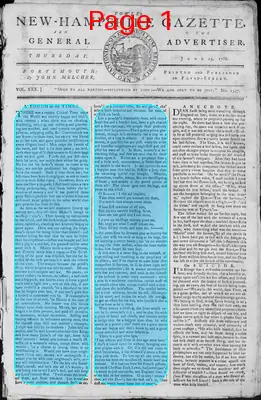
Literary
June 15, 1786
Fowle's New Hampshire Gazette And General Advertiser
Portsmouth, Rockingham County, New Hampshire
What is this article about?
A satirical essay lamenting the corrupting power of money, contrasting a mythical pre-monetary era of contentment and virtue with modern society's vices like covetousness, usury, injustice, and moral decay, illustrated by biblical and contemporary examples.
Clipping
OCR Quality
95%
Excellent
Full Text
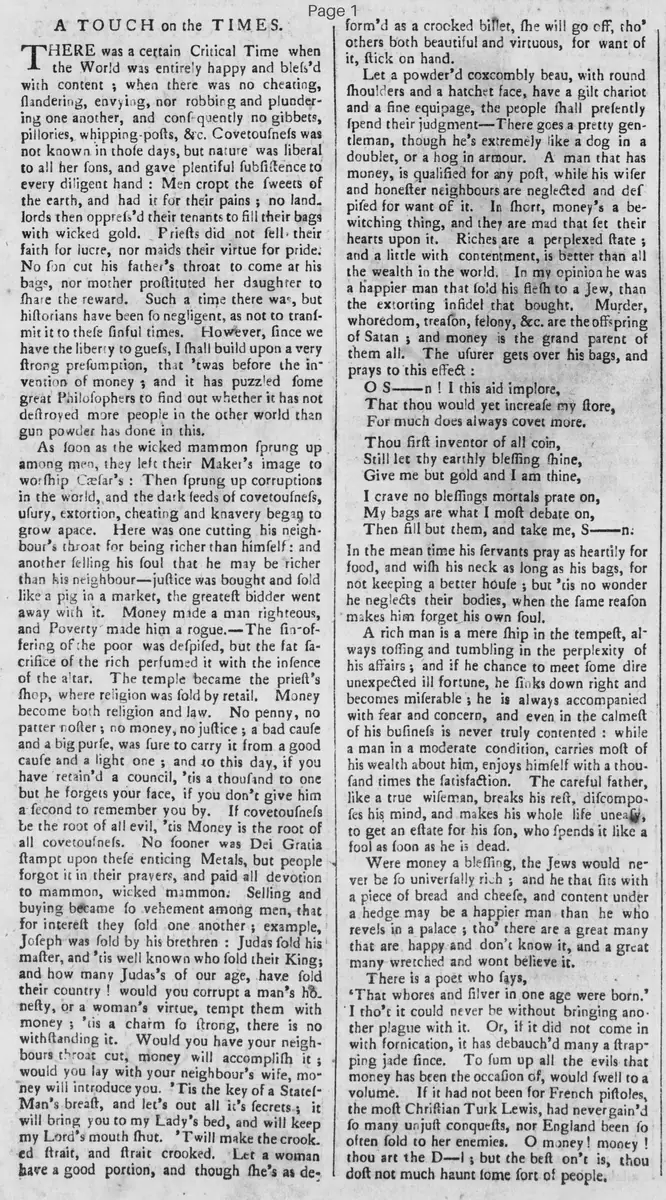
A TOUCH on the TIMES.
There was a time when the World was entirely happy and bless'd with content; when there was no cheating, slandering, envying, nor robbing and plundering one another, and consequently no gibbets, pillories, whipping-posts, &c. Covetousness was not known in those days, but nature was liberal to all her sons, and gave plentiful subsistence to every diligent hand: Men cropt the sweets of the earth, and had it for their pains; no landlords then oppress'd their tenants to fill their bags with wicked gold. Priests did not sell their faith for lucre, nor maids their virtue for pride: No one cut his father's throat to come at his bags, nor mother prostituted her daughter to share the reward. Such a time there was, but historians have been so negligent, as not to transmit it to these sinful times. However, since we have the liberty to guess, I shall build upon a very strong presumption, that twas before the invention of money; and it has puzzled some great Philosophers to find out whether it has not destroyed more people in the other world than gun powder has done in this.
As soon as the wicked mammon sprung up among men, they left their Maker's image to worship Caesar's: Then sprung up corruptions in the world, and the dark seeds of covetousness, usury, extortion, cheating and knavery began to grow apace. Here was one cutting his neighbour's throat for being richer than himself: and another selling his soul that he may be richer than his neighbour--justice was bought and sold like a pig in a market, the greatest bidder went away with it. Money made a man righteous, and Poverty made him a rogue.--The suffering of the poor was despised, but the fat sacrifice of the rich perfumed it with the incense of the altar. The temple became the priest's shop, where religion was sold by retail. Money become both religion and law. No penny, no pater noster; no money, no justice; a bad cause and a big purse, was sure to carry it from a good cause and a light one; and to this day, if you have retained a counsel, 'tis a thousand to one but he forgets your face, if you don't give him a second to remember you by. If covetousness be the root of all evil, 'tis Money is the root of all covetousness. No sooner was Dei Gratia stamped upon these enticing Metals, but people forgot it in their prayers, and paid all devotion to mammon, wicked mammon. Selling and buying became so vehement among men, that for interest they sold one another; example, Joseph was sold by his brethren: Judas sold his master, and 'tis well known who sold their King; and how many Judas's of our age, have sold their country! would you corrupt a man's honesty, or a woman's virtue, tempt them with money; 'tis a charm so strong. there is no withstanding it. Would you have your neighbour's throat cut, money will accomplish it; would you lay with your neighbour's wife, money will introduce you. 'Tis the key of a Statesman's breast, and let's out all it's secrets; it will bring you to my Lady's bed, and will keep my Lord's mouth shut. 'Twill make the crooked straight, and strait crooked. Let a woman have a good portion, and though she's as deform'd as a crooked billet, she will go off, tho' others both beautiful and virtuous, for want of it, stick on hand.
Let a powder'd coxcombly beau, with round shoulders and a hatchet face, have a gilt chariot and a fine equipage, the people shall presently spend their judgment--There goes a pretty gentleman, though he's extremely like a dog in a doublet, or a hog in armour. A man that has money, is qualified for any post, while his wiser and honester neighbours are neglected and despised for want of it. In short, money's a bewitching thing, and they are mad that set their hearts upon it. Riches are a perplexed state; and a little with contentment, is better than all the wealth in the world. - In my opinion he was a happier man that sold his flesh to a Jew, than the extorting infidel that bought. Murder, whoredom, treason, felony, &c. are the offspring of Satan; and money is the grand parent of them all. The usurer gets over his bags, and prays to this effect:
O Satan! I this aid implore,
That thou would yet increase my store,
For much does always covet more.
Thou first inventor of all coin,
Still let thy earthly blessing Shine,
Give me but gold and I am thine,
I crave no blessings mortals prate on,
My bags are what I most debate on,
Then fill but them, and take me, Satan:
In the mean time his servants pray as heartily for food, and wish his neck as long as his bags, for not keeping a better house; but 'tis no wonder he neglects their bodies, when the same reason makes him forget his own soul.
A rich man is a mere ship in the tempest, always tossing and tumbling in the perplexity of his affairs; and if he chance to meet some dire unexpected ill fortune, he sinks down right and becomes miserable; he is always accompanied with fear and concern. and even in the calmest of his business is never truly contented: while a man in a moderate condition, carries most of his wealth about him, enjoys himself with a thousand times the satisfaction. The careful father, like a true wise man, breaks his rest, discomposes his mind, and makes his whole life uneasy, to get an estate for his son, who spends it like a fool as soon as he is dead.
Were money a blessing, the Jews would never be so universally rich; and he that sits with a piece of bread and cheese, and content under a hedge may be a happier man than he who revels in a palace; tho' there are a great many that are happy and don't know it, and a great many wretched and won't believe it.
There is a poet who says,
"That whores and silver in one age were born."
I tho't it could never be without bringing another plague with it. Or, if it did not come in with fornication, it has debauch'd many a trapping jade since. To sum up all the evils that money has been the occasion of, would swell to a volume. If it had not been for French pitoles, the most Christian Turk Lewis, had never gain'd so many unjust conquests, nor England been so often sold to her enemies. O money! money! thou art the Devil; but the best on't is, thou dost not much haunt some sort of people.
There was a time when the World was entirely happy and bless'd with content; when there was no cheating, slandering, envying, nor robbing and plundering one another, and consequently no gibbets, pillories, whipping-posts, &c. Covetousness was not known in those days, but nature was liberal to all her sons, and gave plentiful subsistence to every diligent hand: Men cropt the sweets of the earth, and had it for their pains; no landlords then oppress'd their tenants to fill their bags with wicked gold. Priests did not sell their faith for lucre, nor maids their virtue for pride: No one cut his father's throat to come at his bags, nor mother prostituted her daughter to share the reward. Such a time there was, but historians have been so negligent, as not to transmit it to these sinful times. However, since we have the liberty to guess, I shall build upon a very strong presumption, that twas before the invention of money; and it has puzzled some great Philosophers to find out whether it has not destroyed more people in the other world than gun powder has done in this.
As soon as the wicked mammon sprung up among men, they left their Maker's image to worship Caesar's: Then sprung up corruptions in the world, and the dark seeds of covetousness, usury, extortion, cheating and knavery began to grow apace. Here was one cutting his neighbour's throat for being richer than himself: and another selling his soul that he may be richer than his neighbour--justice was bought and sold like a pig in a market, the greatest bidder went away with it. Money made a man righteous, and Poverty made him a rogue.--The suffering of the poor was despised, but the fat sacrifice of the rich perfumed it with the incense of the altar. The temple became the priest's shop, where religion was sold by retail. Money become both religion and law. No penny, no pater noster; no money, no justice; a bad cause and a big purse, was sure to carry it from a good cause and a light one; and to this day, if you have retained a counsel, 'tis a thousand to one but he forgets your face, if you don't give him a second to remember you by. If covetousness be the root of all evil, 'tis Money is the root of all covetousness. No sooner was Dei Gratia stamped upon these enticing Metals, but people forgot it in their prayers, and paid all devotion to mammon, wicked mammon. Selling and buying became so vehement among men, that for interest they sold one another; example, Joseph was sold by his brethren: Judas sold his master, and 'tis well known who sold their King; and how many Judas's of our age, have sold their country! would you corrupt a man's honesty, or a woman's virtue, tempt them with money; 'tis a charm so strong. there is no withstanding it. Would you have your neighbour's throat cut, money will accomplish it; would you lay with your neighbour's wife, money will introduce you. 'Tis the key of a Statesman's breast, and let's out all it's secrets; it will bring you to my Lady's bed, and will keep my Lord's mouth shut. 'Twill make the crooked straight, and strait crooked. Let a woman have a good portion, and though she's as deform'd as a crooked billet, she will go off, tho' others both beautiful and virtuous, for want of it, stick on hand.
Let a powder'd coxcombly beau, with round shoulders and a hatchet face, have a gilt chariot and a fine equipage, the people shall presently spend their judgment--There goes a pretty gentleman, though he's extremely like a dog in a doublet, or a hog in armour. A man that has money, is qualified for any post, while his wiser and honester neighbours are neglected and despised for want of it. In short, money's a bewitching thing, and they are mad that set their hearts upon it. Riches are a perplexed state; and a little with contentment, is better than all the wealth in the world. - In my opinion he was a happier man that sold his flesh to a Jew, than the extorting infidel that bought. Murder, whoredom, treason, felony, &c. are the offspring of Satan; and money is the grand parent of them all. The usurer gets over his bags, and prays to this effect:
O Satan! I this aid implore,
That thou would yet increase my store,
For much does always covet more.
Thou first inventor of all coin,
Still let thy earthly blessing Shine,
Give me but gold and I am thine,
I crave no blessings mortals prate on,
My bags are what I most debate on,
Then fill but them, and take me, Satan:
In the mean time his servants pray as heartily for food, and wish his neck as long as his bags, for not keeping a better house; but 'tis no wonder he neglects their bodies, when the same reason makes him forget his own soul.
A rich man is a mere ship in the tempest, always tossing and tumbling in the perplexity of his affairs; and if he chance to meet some dire unexpected ill fortune, he sinks down right and becomes miserable; he is always accompanied with fear and concern. and even in the calmest of his business is never truly contented: while a man in a moderate condition, carries most of his wealth about him, enjoys himself with a thousand times the satisfaction. The careful father, like a true wise man, breaks his rest, discomposes his mind, and makes his whole life uneasy, to get an estate for his son, who spends it like a fool as soon as he is dead.
Were money a blessing, the Jews would never be so universally rich; and he that sits with a piece of bread and cheese, and content under a hedge may be a happier man than he who revels in a palace; tho' there are a great many that are happy and don't know it, and a great many wretched and won't believe it.
There is a poet who says,
"That whores and silver in one age were born."
I tho't it could never be without bringing another plague with it. Or, if it did not come in with fornication, it has debauch'd many a trapping jade since. To sum up all the evils that money has been the occasion of, would swell to a volume. If it had not been for French pitoles, the most Christian Turk Lewis, had never gain'd so many unjust conquests, nor England been so often sold to her enemies. O money! money! thou art the Devil; but the best on't is, thou dost not much haunt some sort of people.
What sub-type of article is it?
Essay
Satire
What themes does it cover?
Moral Virtue
Commerce Trade
What keywords are associated?
Money Evils
Covetousness
Mammon Worship
Social Corruption
Moral Decay
Usury
Justice Bought
Literary Details
Title
A Touch On The Times.
Subject
On The Evils Of Money And Covetousness
Key Lines
If Covetousness Be The Root Of All Evil, 'Tis Money Is The Root Of All Covetousness.
Money Become Both Religion And Law. No Penny, No Pater Noster; No Money, No Justice;
O Satan! I This Aid Implore,
That Thou Would Yet Increase My Store,
For Much Does Always Covet More.
Riches Are A Perplexed State; And A Little With Contentment, Is Better Than All The Wealth In The World.
O Money! Money! Thou Art The Devil; But The Best On't Is, Thou Dost Not Much Haunt Some Sort Of People.