Thank you for visiting SNEWPapers!
Sign up free
Literary
May 28, 1842
Republican Herald
Providence, Providence County, Rhode Island
What is this article about?
In this sentimental tale, Florence gives her cherished tea-rose to a poor widow and her daughter, emphasizing the joy beauty brings to the needy. The flower later connects the family with a stranger who reunites Florence with her long-lost love from France.
Clipping
OCR Quality
98%
Excellent
Full Text
MISCELLANEOUS.
From the Lady's Book.
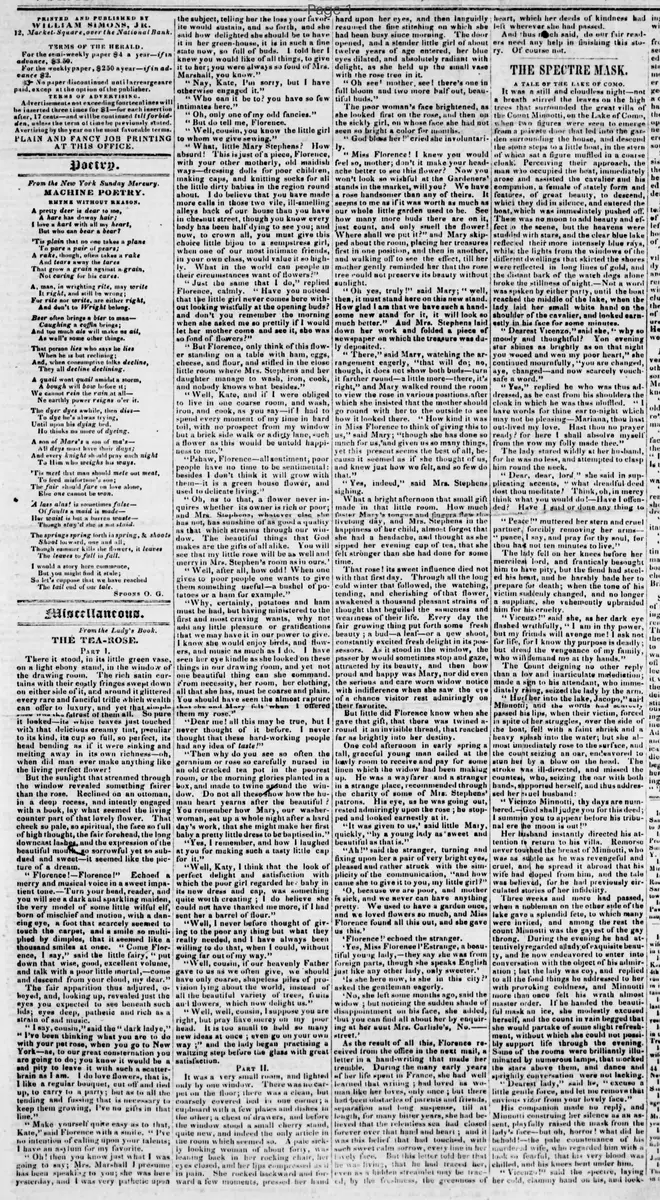
THE TEA-ROSE.
PART I.
There it stood, in its little green vase, on a light ebony stand, in the window of the drawing room. The rich satin curtains with their costly fringes swept down on either side of it, and around it glittered every rare and fanciful trifle which wealth can offer to luxury, and yet that simple vow was the fairest of them all. So pure it looked—its white leaves just touched with that delicious creamy tint, peculiar to its kind, its cup so full, so perfect, its head bending as if it were sinking and melting away in its own richness—oh, when did man ever make anything like the living perfect flower!
But the sunlight that streamed through the window revealed something fairer than the rose. Reclined on an ottoman, in a deep recess, and intently engaged with a book, lay what seemed the living counterpart of that lovely flower. That cheek so pale, so spiritual, the face so full of high thought, the fair forehead, the long downcast lashes, and the expression of the beautiful mouth, so sorrowful yet so subdued and sweet—it seemed like the picture of a dream.
"Florence!—Florence!" Echoed a merry and musical voice in a sweet impatient tone.—Turn your head, reader, and you will see a dark and sparkling maiden, the very model of some little wilful elf, born of mischief and motion, with a dancing eye, a foot that scarcely seemed to touch the carpet, and a smile so multiplied by dimples, that it seemed like a thousand smiles at once. "Come Florence, I say," said the little fairy, "put down that wise, good, excellent volume, and talk with a poor little mortal,—come and descend from your cloud, my dear."
The fair apparition thus adjured, obeyed, and, looking up, revealed just the eyes you expected to see beneath such lids; eyes deep, pathetic and rich as a strain of sad music.
"I say, cousin," said the "dark ladye," "I've been thinking what you are to do with your pet rose, when you go to New York—as, to our great consternation you are going to do; you know it would be a sad pity to leave it with such a scatter-brain as I am. I do love flowers, that is, I like a regular bouquet, cut off and tied up, to carry to a party; but as to all the tending and fussing that is necessary to keep them growing, I've no gifts in that line."
"Make yourself quite easy as to that, Kate," said Florence with a smile. "I've no intention of calling upon your talents; I have an asylum for my favorite."
"Oh! then you know just what I was going to say; Mrs. Marshall I presume has been speaking to you; she was here yesterday, and I was very pathetic upon the subject, telling her the loss your favorite would sustain, and so forth, and she said how delighted she should be to have it in her green-house, it is in such a fine state now, so full of buds. I told her I knew you would like of all things, to give it to her; you were always so fond of Mrs. Marshall, you know."
"Nay, Kate, I'm sorry, but I have otherwise engaged it."
"Who can it be to? you have so few intimates here."
"Oh, only one of my old fancies."
"But do tell me, Florence."
"Well, cousin, you know the little girl to whom we give sewing."
"What, little Mary Stephens? How absurd! This is just of a piece, Florence, with your other motherly, old-maidish ways—dressing dolls for poor children, making caps, and knitting socks for all the little dirty babies in the region round about. I do believe that you have made more calls in those two vile, ill-smelling alleys back of our house than you have in Chestnut Street, though you know everybody has been half dying to see you; and now, to crown all, you must give this choice little bijou to a sempstress girl, when one of our most intimate friends, in your own class, would value it so highly. What in the world can people in their circumstances want of flowers?"
"Just the same that I do," replied Florence, calmly. "Have you noticed that the little girl never comes here without looking wistfully at the opening buds? and don't you remember the morning when she asked me so prettily if I would let her mother come and see it, she was so fond of flowers?"
"But Florence, only think of this flower standing on a table with ham, eggs, cheese, and flour, and stifled in the close little room where Mrs. Stephens and her daughter manage to wash, iron, cook, and nobody knows what besides."
"Well, Kate, and if I were obliged to live in one coarse room, and wash, iron, and cook, as you say—if I had to spend every moment of my time in hard toil, with no prospect from my window but a brick side walk or a dirty lane, such a flower as this would be untold happiness to me."
"Pshaw, Florence—all sentiment; poor people have no time to be sentimental: besides I don't think it will grow with them—it is a green house flower, and used to delicate living."
"Oh, as to that, a flower never inquires whether its owner is rich or poor; and Mrs. Stephens, whatever else she has not, has sunshine of as good a quality as that which streams through our window. The beautiful things that God makes are the gifts of all alike. You will see that my little rose will be as well and merry in Mrs. Stephen's room as in ours."
"Well, after all, how odd! When one gives to poor people one wants to give them something useful—a bushel of potatoes or a ham for example."
"Why, certainly, potatoes and ham must be had, but having ministered to the first and most craving wants, why not add any little pleasure or gratifications that we may have it in our power to give. I know she would enjoy birds, and flowers, and music as much as I do. I have seen her eye kindle as she looked on these things in our drawing room, and yet not one beautiful thing can she command. From necessity, her room, her clothing, all that she has, must be coarse and plain. You should have seen the almost rapture that she and Mary felt when I offered them my rose."
"Dear me! all this may be true, but I never thought of it before. I never thought that these hard-working people had any idea of taste!"
"Then why do you see so often the geranium or rose so carefully nursed in an old cracked tea pot in the poorest room, or the morning glories planted in a box, and made to twine around the window. Do not all these show how the human heart yearns after the beautiful? You remember how Mary, our washer-woman, sat up a whole night after a hard day's work, that she might make her first baby a pretty little dress to be baptised in."
"Yes, I remember, and how I laughed at you for making such a tasty little cap for it."
"Well, Katy, I think that the look of perfect delight and satisfaction with which the poor girl regarded her baby in its new dress and cap, was something quite worth creating; I do believe she could not have thanked me more, if I had sent her a barrel of flour."
"Well, I never before thought of giving to the poor any thing but what they really needed, and I have always been willing to do that, when I could, without going far out of my way."
"Well, cousin, if our heavenly Father gave to us as we often give, we should have only coarse, shapeless piles of provision lying about the world, instead of all the beautiful variety of trees, fruits and flowers, which now delight us."
"Well, well, cousin, I suppose you are right, but pray have mercy on my poor head. It is too small to hold so many new ideas at once; even go on your own way;" and the lady began practising a waltzing step before the glass with great satisfaction.
PART II.
It was a very small room, and lighted only by one window. There was no carpet on the floor; there was a clean, but coarsely covered bed in one corner; a cupboard with a few plates and dishes in the other; a chest of drawers, and before the window stood a small cherry stand, quite new, and indeed the only article in the room which seemed so. A pale sickly-looking woman of about forty, was leaning back in her rocking chair, her eyes closed, and her lips compressed as if in pain. She rocked backward and forward a few moments, pressed her hand hard upon her eyes, and then languidly resumed the fine stitching on which she had been busy since morning. The door opened, and a slender little girl of about twelve years of age entered, her blue eyes dilated, and absolutely radiant with delight, as she held up the small vase with the rose tree in it.
"Oh see, mother, see! there's one in full bloom and two more half out, beautiful buds."
The poor woman's face brightened, as she looked first on the rose, and then on the sickly girl, on whose face she had not seen so bright a color for months.
"God bless her!" cried she involuntarily. "Miss Florence! I knew you would feel so, mother: don't it make your head ache better to see this flower? Now you won't look so wishful at the Gardeners' stands in the market, will you? We have a rose handsomer than any of theirs. It seems to me as if it was worth as much as our whole little garden used to be. See how many more buds there are on it, just count, and only smell the flower! Where shall we put it?" and Mary skipped about the room, placing her treasure first in one position, and then in another, and walking off to see the effect, till her mother gently reminded her that the rose tree could not preserve its beauty without sunlight.
"Oh yes, truly!" said Mary; "well, then, it must stand here on this new stand. How glad I am that we have such a handsome new stand for it, it will look so much better." And Mrs. Stephens laid down her work and folded a piece of newspaper on which the treasure was duly deposited.
"There," said Mary, watching the arrangement eagerly, "that will do; no, though, it does not show both buds—turn it farther round—a little more—there, it's right," and Mary walked round the room to view the rose in various positions, after which she insisted that the mother should go round with her to the outside to see how it looked there. "How kind it was in Miss Florence to think of giving this to us," said Mary; "though she has done so much for us, and given us so many things, yet this present seems the best of all, because it seemed as if she thought of us, and knew just how we felt, and so few do that."
"Yes, indeed," said Mrs. Stephens sighing.
What a bright afternoon that small gift made in that little room. How much faster Mary's tongue and fingers flew through the live long day, and Mrs. Stephens in the happiness of her child, almost forgot that she had a headache, and thought as she sipped her evening cup of tea, that she felt stronger than she had done for some time.
That rose! its sweet influence died not with that first day. Through all the long cold winter that followed, the watching, tending, and cherishing of that flower, awakened a thousand pleasant strains of thought that beguiled the sameness and weariness of their life. Every day the fair growing thing put forth some fresh beauty; a bud—a leaf—or a new shoot, constantly excited fresh delight in its possessors. As it stood in the window, the passer by would sometimes stop and gaze, attracted by its beauty, and then how proud and happy was Mary, nor did even the serious and care worn widow notice with indifference when she saw the eye of a chance visitor rest admiringly on their favorite.
But little did Florence know when she gave that gift, that there was twined around it an invisible thread, that reached far as brightly into her destiny.
One cold afternoon in early spring a tall, graceful young man called at the lowly room to receive and pay for some linen which the widow had been making up. He was a wayfarer and a stranger in a strange place, recommended through the charity of some of Mrs. Stephens' patrons. His eye, as he was going out, rested admiringly upon the rose; he stopped and looked earnestly at it.
"It was given to us," said little Mary, quickly, "by a young lady as sweet and beautiful as that is."
"Ah!" said the stranger, turning and fixing upon her a pair of very bright eyes, pleased and rather struck with the simplicity of the communication, "and how came she to give it to you, my little girl?"
"O, because we are poor, and mother is sick, and we never can have anything pretty. We used to have a garden once, and we loved flowers so much, and Miss Florence found all this out, and she gave us this."
"Florence!" echoed the stranger.
"Yes, Miss Florence L'Estrange, a beautiful young lady,—they say she was from foreign parts, though she speaks English just like any other lady, only sweeter."
"Is she here now, is she in this city?" asked the gentleman eagerly.
"No, she left some months ago," said the widow; but noticing the sudden shade of disappointment on his face, she added, "but you can find all about her by inquiring at her aunt Mrs. Carlisle's, No. __ street."
As the result of all this, Florence received from the post office in the next mail, a letter in a hand-writing that made her tremble. During the many early years of her life spent in France, she had well learned that writing; had loved as woman like her loves, only once; but there had been obstacles of parents and friends, separation and long suspense, till at length, for many bitter years, she had believed that the relentless sea had closed forever over that hand and heart; and it was this belief that had touched, with such sweet calm sorrow, every line in her lovely face. But this letter told her that he was living, that he had traced her, even as a hidden streamlet may be traced, by the freshness, the greenness of heart, which her deeds of kindness had left wherever she had passed.
And thus, I said, do our fair readers need any help in finishing this story. Of course not.
From the Lady's Book.
THE TEA-ROSE.
PART I.
There it stood, in its little green vase, on a light ebony stand, in the window of the drawing room. The rich satin curtains with their costly fringes swept down on either side of it, and around it glittered every rare and fanciful trifle which wealth can offer to luxury, and yet that simple vow was the fairest of them all. So pure it looked—its white leaves just touched with that delicious creamy tint, peculiar to its kind, its cup so full, so perfect, its head bending as if it were sinking and melting away in its own richness—oh, when did man ever make anything like the living perfect flower!
But the sunlight that streamed through the window revealed something fairer than the rose. Reclined on an ottoman, in a deep recess, and intently engaged with a book, lay what seemed the living counterpart of that lovely flower. That cheek so pale, so spiritual, the face so full of high thought, the fair forehead, the long downcast lashes, and the expression of the beautiful mouth, so sorrowful yet so subdued and sweet—it seemed like the picture of a dream.
"Florence!—Florence!" Echoed a merry and musical voice in a sweet impatient tone.—Turn your head, reader, and you will see a dark and sparkling maiden, the very model of some little wilful elf, born of mischief and motion, with a dancing eye, a foot that scarcely seemed to touch the carpet, and a smile so multiplied by dimples, that it seemed like a thousand smiles at once. "Come Florence, I say," said the little fairy, "put down that wise, good, excellent volume, and talk with a poor little mortal,—come and descend from your cloud, my dear."
The fair apparition thus adjured, obeyed, and, looking up, revealed just the eyes you expected to see beneath such lids; eyes deep, pathetic and rich as a strain of sad music.
"I say, cousin," said the "dark ladye," "I've been thinking what you are to do with your pet rose, when you go to New York—as, to our great consternation you are going to do; you know it would be a sad pity to leave it with such a scatter-brain as I am. I do love flowers, that is, I like a regular bouquet, cut off and tied up, to carry to a party; but as to all the tending and fussing that is necessary to keep them growing, I've no gifts in that line."
"Make yourself quite easy as to that, Kate," said Florence with a smile. "I've no intention of calling upon your talents; I have an asylum for my favorite."
"Oh! then you know just what I was going to say; Mrs. Marshall I presume has been speaking to you; she was here yesterday, and I was very pathetic upon the subject, telling her the loss your favorite would sustain, and so forth, and she said how delighted she should be to have it in her green-house, it is in such a fine state now, so full of buds. I told her I knew you would like of all things, to give it to her; you were always so fond of Mrs. Marshall, you know."
"Nay, Kate, I'm sorry, but I have otherwise engaged it."
"Who can it be to? you have so few intimates here."
"Oh, only one of my old fancies."
"But do tell me, Florence."
"Well, cousin, you know the little girl to whom we give sewing."
"What, little Mary Stephens? How absurd! This is just of a piece, Florence, with your other motherly, old-maidish ways—dressing dolls for poor children, making caps, and knitting socks for all the little dirty babies in the region round about. I do believe that you have made more calls in those two vile, ill-smelling alleys back of our house than you have in Chestnut Street, though you know everybody has been half dying to see you; and now, to crown all, you must give this choice little bijou to a sempstress girl, when one of our most intimate friends, in your own class, would value it so highly. What in the world can people in their circumstances want of flowers?"
"Just the same that I do," replied Florence, calmly. "Have you noticed that the little girl never comes here without looking wistfully at the opening buds? and don't you remember the morning when she asked me so prettily if I would let her mother come and see it, she was so fond of flowers?"
"But Florence, only think of this flower standing on a table with ham, eggs, cheese, and flour, and stifled in the close little room where Mrs. Stephens and her daughter manage to wash, iron, cook, and nobody knows what besides."
"Well, Kate, and if I were obliged to live in one coarse room, and wash, iron, and cook, as you say—if I had to spend every moment of my time in hard toil, with no prospect from my window but a brick side walk or a dirty lane, such a flower as this would be untold happiness to me."
"Pshaw, Florence—all sentiment; poor people have no time to be sentimental: besides I don't think it will grow with them—it is a green house flower, and used to delicate living."
"Oh, as to that, a flower never inquires whether its owner is rich or poor; and Mrs. Stephens, whatever else she has not, has sunshine of as good a quality as that which streams through our window. The beautiful things that God makes are the gifts of all alike. You will see that my little rose will be as well and merry in Mrs. Stephen's room as in ours."
"Well, after all, how odd! When one gives to poor people one wants to give them something useful—a bushel of potatoes or a ham for example."
"Why, certainly, potatoes and ham must be had, but having ministered to the first and most craving wants, why not add any little pleasure or gratifications that we may have it in our power to give. I know she would enjoy birds, and flowers, and music as much as I do. I have seen her eye kindle as she looked on these things in our drawing room, and yet not one beautiful thing can she command. From necessity, her room, her clothing, all that she has, must be coarse and plain. You should have seen the almost rapture that she and Mary felt when I offered them my rose."
"Dear me! all this may be true, but I never thought of it before. I never thought that these hard-working people had any idea of taste!"
"Then why do you see so often the geranium or rose so carefully nursed in an old cracked tea pot in the poorest room, or the morning glories planted in a box, and made to twine around the window. Do not all these show how the human heart yearns after the beautiful? You remember how Mary, our washer-woman, sat up a whole night after a hard day's work, that she might make her first baby a pretty little dress to be baptised in."
"Yes, I remember, and how I laughed at you for making such a tasty little cap for it."
"Well, Katy, I think that the look of perfect delight and satisfaction with which the poor girl regarded her baby in its new dress and cap, was something quite worth creating; I do believe she could not have thanked me more, if I had sent her a barrel of flour."
"Well, I never before thought of giving to the poor any thing but what they really needed, and I have always been willing to do that, when I could, without going far out of my way."
"Well, cousin, if our heavenly Father gave to us as we often give, we should have only coarse, shapeless piles of provision lying about the world, instead of all the beautiful variety of trees, fruits and flowers, which now delight us."
"Well, well, cousin, I suppose you are right, but pray have mercy on my poor head. It is too small to hold so many new ideas at once; even go on your own way;" and the lady began practising a waltzing step before the glass with great satisfaction.
PART II.
It was a very small room, and lighted only by one window. There was no carpet on the floor; there was a clean, but coarsely covered bed in one corner; a cupboard with a few plates and dishes in the other; a chest of drawers, and before the window stood a small cherry stand, quite new, and indeed the only article in the room which seemed so. A pale sickly-looking woman of about forty, was leaning back in her rocking chair, her eyes closed, and her lips compressed as if in pain. She rocked backward and forward a few moments, pressed her hand hard upon her eyes, and then languidly resumed the fine stitching on which she had been busy since morning. The door opened, and a slender little girl of about twelve years of age entered, her blue eyes dilated, and absolutely radiant with delight, as she held up the small vase with the rose tree in it.
"Oh see, mother, see! there's one in full bloom and two more half out, beautiful buds."
The poor woman's face brightened, as she looked first on the rose, and then on the sickly girl, on whose face she had not seen so bright a color for months.
"God bless her!" cried she involuntarily. "Miss Florence! I knew you would feel so, mother: don't it make your head ache better to see this flower? Now you won't look so wishful at the Gardeners' stands in the market, will you? We have a rose handsomer than any of theirs. It seems to me as if it was worth as much as our whole little garden used to be. See how many more buds there are on it, just count, and only smell the flower! Where shall we put it?" and Mary skipped about the room, placing her treasure first in one position, and then in another, and walking off to see the effect, till her mother gently reminded her that the rose tree could not preserve its beauty without sunlight.
"Oh yes, truly!" said Mary; "well, then, it must stand here on this new stand. How glad I am that we have such a handsome new stand for it, it will look so much better." And Mrs. Stephens laid down her work and folded a piece of newspaper on which the treasure was duly deposited.
"There," said Mary, watching the arrangement eagerly, "that will do; no, though, it does not show both buds—turn it farther round—a little more—there, it's right," and Mary walked round the room to view the rose in various positions, after which she insisted that the mother should go round with her to the outside to see how it looked there. "How kind it was in Miss Florence to think of giving this to us," said Mary; "though she has done so much for us, and given us so many things, yet this present seems the best of all, because it seemed as if she thought of us, and knew just how we felt, and so few do that."
"Yes, indeed," said Mrs. Stephens sighing.
What a bright afternoon that small gift made in that little room. How much faster Mary's tongue and fingers flew through the live long day, and Mrs. Stephens in the happiness of her child, almost forgot that she had a headache, and thought as she sipped her evening cup of tea, that she felt stronger than she had done for some time.
That rose! its sweet influence died not with that first day. Through all the long cold winter that followed, the watching, tending, and cherishing of that flower, awakened a thousand pleasant strains of thought that beguiled the sameness and weariness of their life. Every day the fair growing thing put forth some fresh beauty; a bud—a leaf—or a new shoot, constantly excited fresh delight in its possessors. As it stood in the window, the passer by would sometimes stop and gaze, attracted by its beauty, and then how proud and happy was Mary, nor did even the serious and care worn widow notice with indifference when she saw the eye of a chance visitor rest admiringly on their favorite.
But little did Florence know when she gave that gift, that there was twined around it an invisible thread, that reached far as brightly into her destiny.
One cold afternoon in early spring a tall, graceful young man called at the lowly room to receive and pay for some linen which the widow had been making up. He was a wayfarer and a stranger in a strange place, recommended through the charity of some of Mrs. Stephens' patrons. His eye, as he was going out, rested admiringly upon the rose; he stopped and looked earnestly at it.
"It was given to us," said little Mary, quickly, "by a young lady as sweet and beautiful as that is."
"Ah!" said the stranger, turning and fixing upon her a pair of very bright eyes, pleased and rather struck with the simplicity of the communication, "and how came she to give it to you, my little girl?"
"O, because we are poor, and mother is sick, and we never can have anything pretty. We used to have a garden once, and we loved flowers so much, and Miss Florence found all this out, and she gave us this."
"Florence!" echoed the stranger.
"Yes, Miss Florence L'Estrange, a beautiful young lady,—they say she was from foreign parts, though she speaks English just like any other lady, only sweeter."
"Is she here now, is she in this city?" asked the gentleman eagerly.
"No, she left some months ago," said the widow; but noticing the sudden shade of disappointment on his face, she added, "but you can find all about her by inquiring at her aunt Mrs. Carlisle's, No. __ street."
As the result of all this, Florence received from the post office in the next mail, a letter in a hand-writing that made her tremble. During the many early years of her life spent in France, she had well learned that writing; had loved as woman like her loves, only once; but there had been obstacles of parents and friends, separation and long suspense, till at length, for many bitter years, she had believed that the relentless sea had closed forever over that hand and heart; and it was this belief that had touched, with such sweet calm sorrow, every line in her lovely face. But this letter told her that he was living, that he had traced her, even as a hidden streamlet may be traced, by the freshness, the greenness of heart, which her deeds of kindness had left wherever she had passed.
And thus, I said, do our fair readers need any help in finishing this story. Of course not.
What sub-type of article is it?
Prose Fiction
What themes does it cover?
Moral Virtue
Social Manners
Love Romance
What keywords are associated?
Tea Rose
Charity
Poverty
Beauty
Flowers
Romance
Kindness
Reunion
What entities or persons were involved?
From The Lady's Book.
Literary Details
Title
The Tea Rose.
Author
From The Lady's Book.
Key Lines
Oh, When Did Man Ever Make Anything Like The Living Perfect Flower!
"Just The Same That I Do," Replied Florence, Calmly.
"The Beautiful Things That God Makes Are The Gifts Of All Alike.
"God Bless Her!" Cried She Involuntarily.
But This Letter Told Her That He Was Living, That He Had Traced Her, Even As A Hidden Streamlet May Be Traced, By The Freshness, The Greenness Of Heart, Which Her Deeds Of Kindness Had Left Wherever She Had Passed.