Thank you for visiting SNEWPapers!
Sign up free
Story
November 19, 1926
The Ely Miner
Ely, Saint Louis County, Minnesota
What is this article about?
Professor Gabriel Bertrand of the Pasteur Institute developed a war gas, chloropicrin, now repurposed for the silk industry to treat cocoons, making them nonperishable and easier to handle than traditional baking or steaming methods.
Clipping
OCR Quality
98%
Excellent
Full Text
War Gas Made Useful
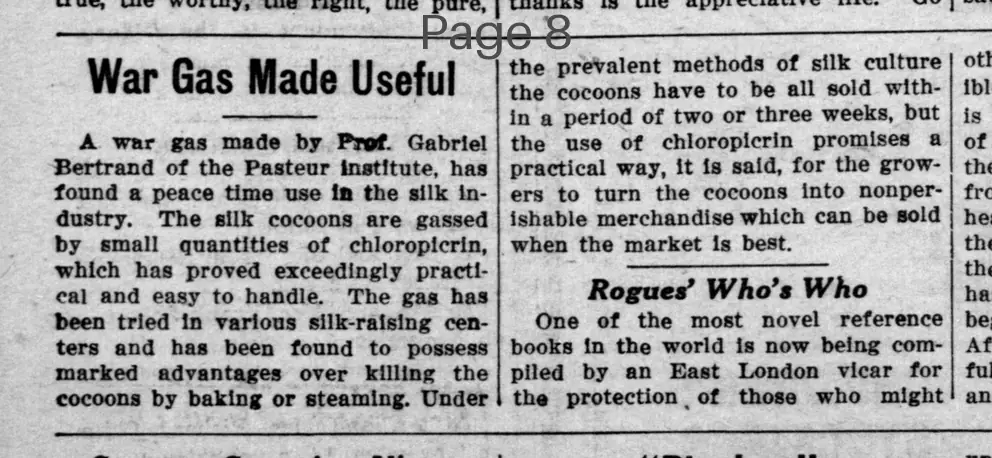
A war gas made by Prof. Gabriel Bertrand of the Pasteur institute, has found a peace time use in the silk industry. The silk cocoons are gassed by small quantities of chloropicrin, which has proved exceedingly practical and easy to handle. The gas has been tried in various silk-raising centers and has been found to possess marked advantages over killing the cocoons by baking or steaming. Under the prevalent methods of silk culture the cocoons have to be all sold within a period of two or three weeks, but the use of chloropicrin promises a practical way, it is said, for the growers to turn the cocoons into nonperishable merchandise which can be sold when the market is best.
A war gas made by Prof. Gabriel Bertrand of the Pasteur institute, has found a peace time use in the silk industry. The silk cocoons are gassed by small quantities of chloropicrin, which has proved exceedingly practical and easy to handle. The gas has been tried in various silk-raising centers and has been found to possess marked advantages over killing the cocoons by baking or steaming. Under the prevalent methods of silk culture the cocoons have to be all sold within a period of two or three weeks, but the use of chloropicrin promises a practical way, it is said, for the growers to turn the cocoons into nonperishable merchandise which can be sold when the market is best.
What sub-type of article is it?
Curiosity
What themes does it cover?
Triumph
What keywords are associated?
War Gas
Chloropicrin
Silk Industry
Cocoons
Pasteur Institute
Nonperishable Merchandise
What entities or persons were involved?
Prof. Gabriel Bertrand
Where did it happen?
Various Silk Raising Centers
Story Details
Key Persons
Prof. Gabriel Bertrand
Location
Various Silk Raising Centers
Story Details
A war gas invented by Prof. Gabriel Bertrand is repurposed for gassing silk cocoons with chloropicrin, offering advantages over baking or steaming and allowing storage as nonperishable merchandise for better market timing.