Thank you for visiting SNEWPapers!
Sign up free
Editorial
December 1, 1768
The Virginia Gazette
Williamsburg, Virginia
What is this article about?
An anonymous London writer, signing as Caius Memmius, argues against British government plans to send troops to the American colonies to enforce parliamentary taxation, warning of economic ruin, loss of trade, and potential rebellion. He defends colonial rights to representation and criticizes the Stamp Act and similar measures.
Clipping
OCR Quality
98%
Excellent
Full Text
From a late London Paper.
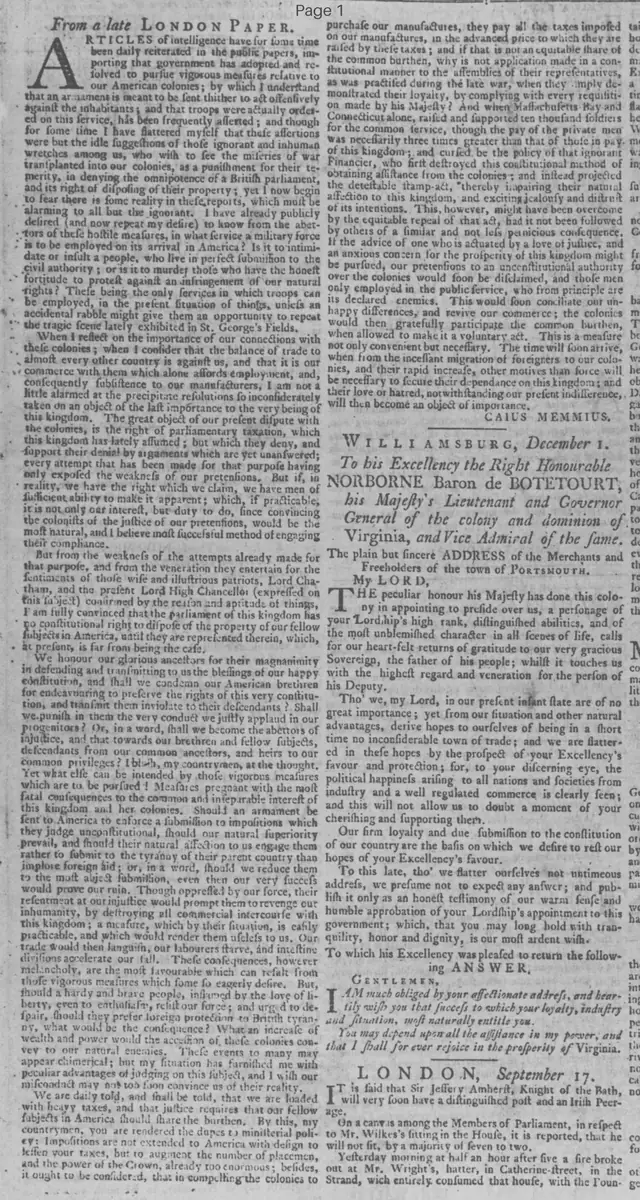
ARTICLES of intelligence have for some time been daily reiterated in the public papers, importing that government has adopted and resolved to pursue vigorous measures relative to our American colonies: by which I understand that an armament is meant to be sent thither to act offensively against the inhabitants: and that troops were actually ordered on this service, has been frequently asserted; and though for some time I have flattered myself that these assertions were but the idle suggestions of those ignorant and inhuman wretches among us, who wish to see the miseries of war transplanted into our colonies, as a punishment for their temerity, in denying the omnipotence of a British parliament, and its right of disposing of their property; yet I now begin to fear there is some reality in these reports, which must be alarming to all but those ignorant. I have already publicly desired (and now repeat my desire) to know from the abettors of these hostile measures, in what service a military force is to be employed on its arrival in America? Is it to intimidate or insult a people, who live in perfect submission to the civil authority; or is it to murder those who have the honest fortitude to protest against an infringement of our natural rights? These being the only services in which troops can be employed, in the present situation of things, unless an accidental rabble might give them an opportunity to repeat the tragic scene lately exhibited in St. George's Fields. When I reflect on the importance of our connections with these colonies; when I consider that the balance of trade to almost every other country is against us, and that it is our commerce with them which alone affords employment, and, consequently subsistence to our manufacturers, I am not a little alarmed at the precipitate resolutions so inconsiderately taken on an object of the last importance to the very being of this kingdom. The great object of our present dispute with the colonies, is the right of parliamentary taxation, which this kingdom has lately assumed: but which they deny, and support their denial by arguments which are yet unanswered; every attempt that has been made for that purpose having only exposed the weakness of our pretensions. But if, in reality, we have the right which we claim, we have men of sufficient ability to make it apparent; which, if practicable, it is not only our interest, but duty to do, since convincing the colonists of the justice of our pretensions, would be the most natural, and I believe most successful method of engaging their compliance. But from the weakness of the attempts already made for that purpose, and from the veneration they entertain for the sentiments of those wise and illustrious patriots, Lord Chatham, and the present Lord High Chancellor (expressed on this subject) confirmed by the reason and aptitude of things, I am fully convinced that the parliament of this kingdom has no constitutional right to dispose of the property of our fellow subjects in America, until they are represented therein, which, at present, is far from being the case. We honour our glorious ancestors for their magnanimity in defending and transmitting to us the blessings of our happy constitution, and shall we condemn our American brethren for endeavouring to preserve the rights of this very constitution, and transmit them inviolate to their descendants? Shall we punish in them the very conduct we justly applaud in our progenitors? Or, in a word, shall we become the abettors of injustice, and that towards our brethren and fellow subjects, descendants from our common ancestors, and heirs to our common privileges? I blush, my countrymen, at the thought. Yet what else can be intended by those vigorous measures which are to be pursued! Measures pregnant with the most fatal consequences to the common and inseparable interest of this kingdom and her colonies. Should an armament be sent to America to enforce a submission to impositions which they judge unconstitutional, should our natural superiority prevail, and should their natural affection to us engage them rather to submit to the tyranny of their parent country than implore foreign aid: or, in a word, should we reduce them to the most abject submission, even then our very success would prove our ruin. Though oppressed by our force, their resentment at our injustice would prompt them to revenge our inhumanity, by destroying all commercial intercourse with this kingdom; a measure, which by their situation, is easily practicable, and which would render them useless to us. Our trade would then languish, our labourers starve, and intestine divisions accelerate our fall. These consequences, however melancholy, are the most favourable which can result from those vigorous measures which some so eagerly desire. But, should a hardy and brave people, inspired by the love of liberty, even to enthusiasm, resist our force: and urged to despair, should they prefer foreign protection to British tyranny, what would be the consequence? What an increase of wealth and power would the accession of these colonies convey to our natural enemies. These events to many may appear chimerical; but my situation has furnished me with peculiar advantages of judging on this subject, and I wish our misconduct may not too soon convince us of their reality. We are daily told, and shall be told, that we are loaded with heavy taxes, and that justice requires that our fellow subjects in America should share the burden. By this, my countrymen, you are rendered the dupes to ministerial policy: Impositions are not extended to America with design to lessen your taxes, but to augment the number of placemen, and the power of the Crown, already too enormous; besides, it ought to be considered, that in compelling the colonies to purchase our manufactures, they pay all the taxes imposed on our manufactures, in the advanced price to which they are raised by these taxes: and if that is not an equitable share of the common burden, why is not application made in a constitutional manner to the assemblies of their representatives, as was practised during the late war, when they simply demonstrated their loyalty, by complying with every requisition made by his Majesty? And when Massachusetts Bay and Connecticut alone, raised and supported ten thousand soldiers for the common service, though the pay of the private men was necessarily three times greater than that of those in pay of this kingdom; and cursed be the policy of that ignorant Financier, who first destroyed this constitutional method of obtaining assistance from the colonies: and instead projected the detestable stamp-act, thereby impairing their natural affection to this kingdom, and exciting jealousy and distrust of its intentions. This, however, might have been overcome by the equitable repeal of that act, had it not been followed by others of a similar and not less pernicious consequence. If the advice of one who is actuated by a love of justice, and an anxious concern for the prosperity of this kingdom might be pursued, our pretensions to an unconstitutional authority over the colonies would soon be disclaimed, and those men only employed in the public service, who from principle are its declared enemies. This would soon conciliate our unhappy differences, and revive our commerce; the colonies would then gratefully participate the common burden, when allowed to make it a voluntary act. This is a measure not only convenient but necessary. The time will soon arrive, when from the incessant migration of foreigners to our colonies, and their rapid increase, other motives than force will be necessary to secure their dependence on this kingdom; and their love or hatred, notwithstanding our present indifference, will then become an object of importance.
CAIUS MEMMIUS.
ARTICLES of intelligence have for some time been daily reiterated in the public papers, importing that government has adopted and resolved to pursue vigorous measures relative to our American colonies: by which I understand that an armament is meant to be sent thither to act offensively against the inhabitants: and that troops were actually ordered on this service, has been frequently asserted; and though for some time I have flattered myself that these assertions were but the idle suggestions of those ignorant and inhuman wretches among us, who wish to see the miseries of war transplanted into our colonies, as a punishment for their temerity, in denying the omnipotence of a British parliament, and its right of disposing of their property; yet I now begin to fear there is some reality in these reports, which must be alarming to all but those ignorant. I have already publicly desired (and now repeat my desire) to know from the abettors of these hostile measures, in what service a military force is to be employed on its arrival in America? Is it to intimidate or insult a people, who live in perfect submission to the civil authority; or is it to murder those who have the honest fortitude to protest against an infringement of our natural rights? These being the only services in which troops can be employed, in the present situation of things, unless an accidental rabble might give them an opportunity to repeat the tragic scene lately exhibited in St. George's Fields. When I reflect on the importance of our connections with these colonies; when I consider that the balance of trade to almost every other country is against us, and that it is our commerce with them which alone affords employment, and, consequently subsistence to our manufacturers, I am not a little alarmed at the precipitate resolutions so inconsiderately taken on an object of the last importance to the very being of this kingdom. The great object of our present dispute with the colonies, is the right of parliamentary taxation, which this kingdom has lately assumed: but which they deny, and support their denial by arguments which are yet unanswered; every attempt that has been made for that purpose having only exposed the weakness of our pretensions. But if, in reality, we have the right which we claim, we have men of sufficient ability to make it apparent; which, if practicable, it is not only our interest, but duty to do, since convincing the colonists of the justice of our pretensions, would be the most natural, and I believe most successful method of engaging their compliance. But from the weakness of the attempts already made for that purpose, and from the veneration they entertain for the sentiments of those wise and illustrious patriots, Lord Chatham, and the present Lord High Chancellor (expressed on this subject) confirmed by the reason and aptitude of things, I am fully convinced that the parliament of this kingdom has no constitutional right to dispose of the property of our fellow subjects in America, until they are represented therein, which, at present, is far from being the case. We honour our glorious ancestors for their magnanimity in defending and transmitting to us the blessings of our happy constitution, and shall we condemn our American brethren for endeavouring to preserve the rights of this very constitution, and transmit them inviolate to their descendants? Shall we punish in them the very conduct we justly applaud in our progenitors? Or, in a word, shall we become the abettors of injustice, and that towards our brethren and fellow subjects, descendants from our common ancestors, and heirs to our common privileges? I blush, my countrymen, at the thought. Yet what else can be intended by those vigorous measures which are to be pursued! Measures pregnant with the most fatal consequences to the common and inseparable interest of this kingdom and her colonies. Should an armament be sent to America to enforce a submission to impositions which they judge unconstitutional, should our natural superiority prevail, and should their natural affection to us engage them rather to submit to the tyranny of their parent country than implore foreign aid: or, in a word, should we reduce them to the most abject submission, even then our very success would prove our ruin. Though oppressed by our force, their resentment at our injustice would prompt them to revenge our inhumanity, by destroying all commercial intercourse with this kingdom; a measure, which by their situation, is easily practicable, and which would render them useless to us. Our trade would then languish, our labourers starve, and intestine divisions accelerate our fall. These consequences, however melancholy, are the most favourable which can result from those vigorous measures which some so eagerly desire. But, should a hardy and brave people, inspired by the love of liberty, even to enthusiasm, resist our force: and urged to despair, should they prefer foreign protection to British tyranny, what would be the consequence? What an increase of wealth and power would the accession of these colonies convey to our natural enemies. These events to many may appear chimerical; but my situation has furnished me with peculiar advantages of judging on this subject, and I wish our misconduct may not too soon convince us of their reality. We are daily told, and shall be told, that we are loaded with heavy taxes, and that justice requires that our fellow subjects in America should share the burden. By this, my countrymen, you are rendered the dupes to ministerial policy: Impositions are not extended to America with design to lessen your taxes, but to augment the number of placemen, and the power of the Crown, already too enormous; besides, it ought to be considered, that in compelling the colonies to purchase our manufactures, they pay all the taxes imposed on our manufactures, in the advanced price to which they are raised by these taxes: and if that is not an equitable share of the common burden, why is not application made in a constitutional manner to the assemblies of their representatives, as was practised during the late war, when they simply demonstrated their loyalty, by complying with every requisition made by his Majesty? And when Massachusetts Bay and Connecticut alone, raised and supported ten thousand soldiers for the common service, though the pay of the private men was necessarily three times greater than that of those in pay of this kingdom; and cursed be the policy of that ignorant Financier, who first destroyed this constitutional method of obtaining assistance from the colonies: and instead projected the detestable stamp-act, thereby impairing their natural affection to this kingdom, and exciting jealousy and distrust of its intentions. This, however, might have been overcome by the equitable repeal of that act, had it not been followed by others of a similar and not less pernicious consequence. If the advice of one who is actuated by a love of justice, and an anxious concern for the prosperity of this kingdom might be pursued, our pretensions to an unconstitutional authority over the colonies would soon be disclaimed, and those men only employed in the public service, who from principle are its declared enemies. This would soon conciliate our unhappy differences, and revive our commerce; the colonies would then gratefully participate the common burden, when allowed to make it a voluntary act. This is a measure not only convenient but necessary. The time will soon arrive, when from the incessant migration of foreigners to our colonies, and their rapid increase, other motives than force will be necessary to secure their dependence on this kingdom; and their love or hatred, notwithstanding our present indifference, will then become an object of importance.
CAIUS MEMMIUS.
What sub-type of article is it?
Constitutional
Economic Policy
Foreign Affairs
What keywords are associated?
American Colonies
Parliamentary Taxation
Military Armament
Constitutional Rights
British Trade
Stamp Act
Colonial Representation
What entities or persons were involved?
British Parliament
Lord Chatham
Lord High Chancellor
American Colonies
Massachusetts Bay
Connecticut
Editorial Details
Primary Topic
Opposition To Military Force And Taxation Of American Colonies Without Representation
Stance / Tone
Strongly Against British Parliamentary Authority Over Colonies And Use Of Troops
Key Figures
British Parliament
Lord Chatham
Lord High Chancellor
American Colonies
Massachusetts Bay
Connecticut
Key Arguments
- parliament has no constitutional right to tax colonies without representation
- sending troops would destroy trade and employment in britain
- colonies already contribute voluntarily through purchases and wartime support
- stamp act and similar measures impair colonial affection
- force could drive colonies to foreign enemies
- better to convince through argument or seek voluntary aid