Thank you for visiting SNEWPapers!
Sign up free
The Liberator
Boston, Suffolk County, Massachusetts
What is this article about?
Report on a June 1840 meeting of New York's colored people where Garrison defended his abolitionist stance in a farewell speech before the London convention; a supporting resolution for select delegates was postponed to include rivals like Birney and Stanton amid movement divisions. (218 characters)
Clipping
OCR Quality
Full Text
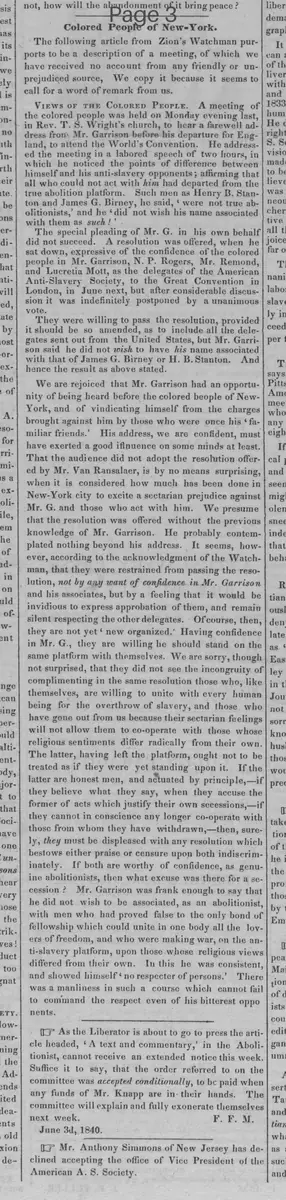
The following article from Zion's Watchman purports to be a description of a meeting, of which we have received no account from any friendly or unprejudiced source. We copy it because it seems to call for a word of remark from us.
Views of The Colored People. A meeting of the colored people was held on Monday evening last, in Rev. T. S. Wright's church, to hear a farewell address from Mr. Garrison before his departure for England, to attend the World's Convention. He addressed the meeting in a labored speech of two hours, in which he noticed the points of difference between himself and his anti-slavery opponents; affirming that all who could not act with him had departed from the true abolition platform. Such men as Henry B. Stanton and James G. Birney, he said, 'were not true abolitionists,' and he 'did not wish his name associated with them as such!'
The special pleading of Mr. G. in his own behalf did not succeed. A resolution was offered, when he sat down, expressive of the confidence of the colored people in Mr. Garrison, N. P. Rogers, Mr. Remond, and Lucretia Mott, as the delegates of the American Anti-Slavery Society, to the Great Convention in London, in June next, but after considerable discussion it was indefinitely postponed by a unanimous vote.
They were willing to pass the resolution, provided it should be so amended, as to include all the delegates sent out from the United States, but Mr. Garrison said he did not wish to have his name associated with that of James G. Birney or H. B. Stanton. And hence the result as above stated.
We are rejoiced that Mr. Garrison had an opportunity of being heard before the colored people of New-York, and of vindicating himself from the charges brought against him by those who were once his 'familiar friends.' His address, we are confident, must have exerted a good influence on some minds at least. That the audience did not adopt the resolution offered by Mr. Van Rensselaer, is by no means surprising, when it is considered how much has been done in New-York city to excite a sectarian prejudice against Mr. G. and those who act with him. We presume that the resolution was offered without the previous knowledge of Mr. Garrison. He probably contemplated nothing beyond his address. It seems, however, according to the acknowledgment of the Watchman, that they were restrained from passing the resolution, not by any want of confidence in Mr. Garrison and his associates, but by a feeling that it would be invidious to express approbation of them, and remain silent respecting the other delegates. Of course, then, they are not yet 'new organized.' Having confidence in Mr. G., they are willing he should stand on the same platform with themselves. We are sorry, though not surprised, that they did not see the incongruity of complimenting in the same resolution those who, like themselves, are willing to unite with every human being for the overthrow of slavery, and those who have gone out from us because their sectarian feelings will not allow them to co-operate with those whose religious sentiments differ radically from their own. The latter, having left the platform, ought not to be treated as if they were yet standing upon it. If the latter are honest men, and actuated by principle,—if they believe what they say, when they accuse the former of acts which justify their own secession,—if they cannot in conscience any longer co-operate with those from whom they have withdrawn,—then, surely, they must be displeased with any resolution which bestows either praise or censure upon both indiscriminately. If both are worthy of confidence, as genuine abolitionists, then what excuse was there for a secession? Mr. Garrison was frank enough to say that he did not wish to be associated, as an abolitionist, with men who had proved false to the only bond of fellowship which could unite in one body all the lovers of freedom, and who were making war, on the anti-slavery platform, upon those whose religious views differed from their own. In this he was consistent, and showed himself 'no respecter of persons.' There was a manliness in such a course which cannot fail to command the respect even of his bitterest opponents.
As the Liberator is about to go to press the article headed, 'A text and commentary,' in the Abolitionist, cannot receive an extended notice this week. Suffice it to say, that the order referred to on the committee was accepted conditionally, to be paid when any funds of Mr. Knapp are in their hands. The committee will explain and fully exonerate themselves next week.
F.F.M.
June 3d, 1840.
Mr. Anthony Simmons of New Jersey has declined accepting the office of Vice President of the American A. S. Society.
What sub-type of article is it?
What themes does it cover?
What keywords are associated?
What entities or persons were involved?
Where did it happen?
Story Details
Key Persons
Location
New York, In Rev. T. S. Wright's Church
Event Date
Monday Evening Last, June 3d, 1840
Story Details
A meeting of colored people in Rev. T. S. Wright's church heard William Lloyd Garrison's two-hour farewell address before his departure for the World's Convention in London, where he criticized opponents like Henry B. Stanton and James G. Birney as not true abolitionists. A resolution expressing confidence in specific delegates was unanimously postponed after discussion to include all U.S. delegates, despite Garrison's objection to associating with Stanton and Birney. Commentary rejoices at Garrison's opportunity to vindicate himself amid sectarian prejudices. A note mentions the Liberator's upcoming notice on another article, and Anthony Simmons of New Jersey declined the office of Vice President of the American A. S. Society.