Thank you for visiting SNEWPapers!
Sign up free
Editorial
September 14, 1819
The Portland Gazette
Portland, Cumberland County, Maine
What is this article about?
This editorial, part of a series, argues the historical and geographical necessity of Maine's separation from Massachusetts, reflecting on past benefits of union while affirming independence as inevitable and beneficial for Maine's future prosperity.
Merged-components note: Multi-part editorial on the separation of Maine from Massachusetts, continued across components and pages with seamless textual flow.
Clippings
1 of 2
OCR Quality
98%
Excellent
Full Text
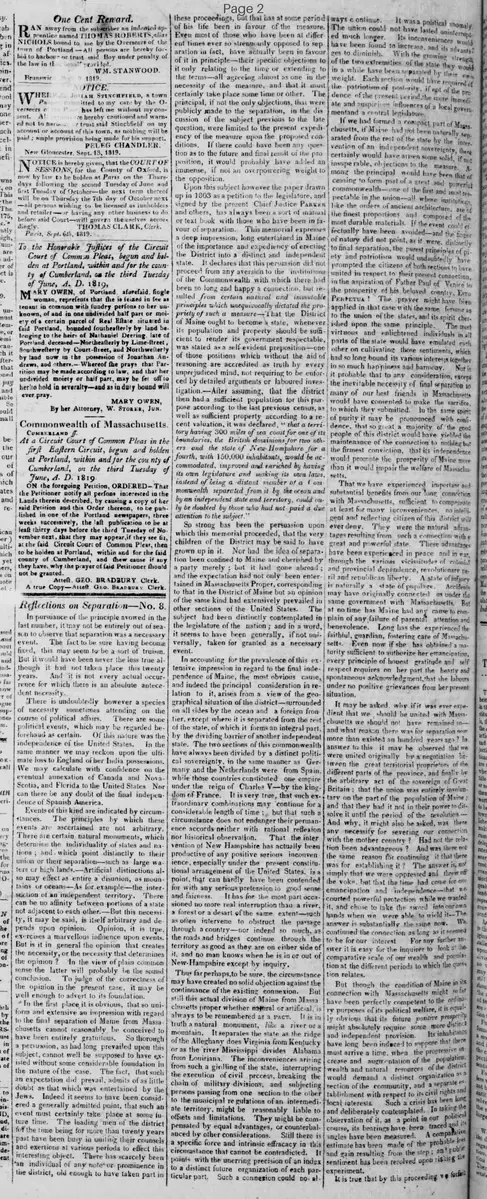
Reflections on Separation—No. 8.
In pursuance of the principle avowed in the last number, it may not be entirely out of season to observe that separation was a necessary event. The fact to be sure having become fixed, this may seem to be a sort of truism. But it would have been never the less true although it had not taken place this twenty years. And it is not every actual occurrence for which there is an absolute antecedent necessity.
There is undoubtedly however a species of necessity sometimes attending on the course of political affairs. There are some political events, which may be regarded beforehand as certain. Of this nature was the independence of the United States. In the same manner we may reckon upon the ultimate loss to England of her India possessions. We may calculate with confidence on the eventual annexation of Canada and Nova Scotia, and Florida to the United States. Nor can there be any doubt of the final independence of Spanish America.
Events of this kind are indicated by circumstances. The principles by which these events are ascertained are not arbitrary. There are certain natural monuments, which determine the individuality of states and nations; and which point distinctly to their union or their separation—such as large waters or high lands.—Artificial distinctions also may effect as entire a disunion, as mountains or oceans—As for example—the intersection of an independent territory. There can be no affinity between portions of a state not adjacent to each other.—But this necessity, it may be said, is itself arbitrary and depends upon opinion. Opinion, it is true, exercises a marvellous influence upon events. But is it in general the opinion that creates the necessity, or the necessity that determines the opinion? In the view of plain common sense the latter will probably be the sound conclusion. To judge of the correctness of the opinion in the present case, it may be well enough to advert to its foundation.
In the first place it is obvious, that so uniform and extensive an impression with regard to the final separation of Maine from Massachusetts cannot reasonably be conceived to have been entirely gratuitous. So thorough a persuasion, as had long prevailed upon this subject, cannot well be supposed to have existed without some considerable foundation in the nature of the case. The fact, that such an expectation did prevail, admits of as little doubt as that which was entertained by the Jews. Indeed it seems to have been considered a generally admitted point, that such an event must certainly take place at some future time. The leading men of the district for the time being for more than twenty years past have been busy in uniting their counsels and exertions at various periods to effect this interesting object. There has scarcely been an individual of any note or prominence in the district, old enough to have taken part in these proceedings, but that has at some period of his life been in favour of the measure.
Even most of those who have been at different times ever so strenuously opposed to separation in fact, have actually been in favour of it in principle—their specific objections to it only relating to the time or extending to the terms—all agreeing almost as one in the necessity of the measure, and that it must certainly take place some time or other. The principal, if not the only objections, that were publicly made to the separation, in the discussion of the subject previous to the late question, were limited to the present expediency of the measure upon the proposed conditions. If there could have been any question as to the future and final result of the proposition, it would probably have added an immense, if not an overpowering weight to the opposition.
Upon this subject however the paper drawn up in 1803 as a petition to the legislature, and signed by the present Chief Justice Parker and others, has always been a sort of manual or text book with those who have been in favour of separation. This memorial expresses a deep impression, long entertained in Maine of the importance and expediency of erecting the District into a distinct and independent state. It declares that this persuasion did not proceed from any aversion to the institutions of the Commonwealth with which there had been so long and happy a connection, but resulted from certain natural and immutable principles which unequivocally dictated the propriety of such a measure—That the District of Maine ought to become a state, whenever its population and property should be sufficient to render its government respectable, was stated as a self-evident proposition—one of those positions which without the aid of reasoning are accredited as truth by every unprejudiced mind, not requiring to be enforced by detailed arguments or laboured investigation.—After assuming, that the district then had a sufficient population for this purpose according to the last previous census, as well as sufficient property according to a recent valuation, it was declared, "that a territory having 300 miles of sea coast for one of its boundaries, the British dominions for two others and the state of New-Hampshire for a fourth, with 150,000 inhabitants, would be accommodated, improved and enriched by having its own legislature and making its own laws, instead of being a distant member of a commonwealth separated from it by the ocean and by an independent state and territory, could only be doubted by those who had not paid a due attention to the subject."
So strong has been the persuasion upon which this memorial proceeded, that the very children of the District may be said to have grown up in it. Nor had the idea of separation been confined to Maine and cherished by a party merely; but it had gone abroad; and the expectation had not only been entertained in Massachusetts Proper, corresponding to that in the District of Maine but an opinion of the same kind had extensively prevailed in other sections of the United States. The subject had been distinctly contemplated in the legislature of the nation; and in a word, it seems to have been generally, if not universally, taken for granted as a necessary event.
In accounting for the prevalence of this extensive impression in regard to the final independence of Maine, the most obvious cause, and indeed the principal consideration in relation to it, arises from a view of the geographical situation of the district—surrounded on all sides by the ocean and a foreign frontier, except where it is separated from the rest of the state, of which it forms an integral part, by the dividing barrier of another independent state. The two sections of this commonwealth have always been divided by a distinct political sovereignty, in the same manner as Germany and the Netherlands were from Spain, while those countries constituted one empire under the reign of Charles V by the kingdom of France. It is very true, that such extraordinary combinations may continue for a considerable length of time; but that such a circumstance does not endanger their permanence accords neither with rational reflection nor historical observation. That the intervention of New Hampshire has actually been productive of any positive serious inconvenience, especially under the present constitutional arrangement of the United States, is a point, that can hardly have been contended for with any serious pretension to good sense and fairness. It has for the most part occasioned no more real interruption than a river, a forest or a desert of the same extent—such as often intervene to obstruct the passage through a country—nor indeed so much, as the roads and bridges continue through the territory as good as they are on either side of it, and no man knows when he is in or out of New-Hampshire except by inquiry.
Thus far perhaps, to be sure, the circumstance may have created no solid objection against the continuance of the existing connexion. But still this actual division of Maine from Massachusetts proper whether natural or artificial, is always to be remembered as a fact. It is in truth a natural monument, like a river or a mountain. It separates the state as the ridge of the Alleghany does Virginia from Kentucky or as the river Mississippi divides Alabama from Louisiana. The inconveniences arising from such a girtling of the state, interrupting the execution of civil process, breaking the chain of military divisions, and subjecting persons passing from one section to the other to the municipal regulations of an intermediate territory, might be reasonably liable to offsets and limitations. They might be compensated by equal advantages, or counterbalanced by other considerations. Still there is a specific force and intrinsic efficacy in this circumstance that cannot be contradicted. It points with the unerring precision of an index to a distinct future organization of each particular part. Such a connexion could not always continue. It was a political anomaly which the union could not have lasted uninterrupted much longer. Its inconveniences would have been found to increase, and its advantages to diminish. With the growing strength of the two extremities of the state they would in a while have been separated by their own weight. Each section would have required of the patriotism of posterity, if not of the prudence of the present period, the more immediate and auspicious influences of a local government and a central legislature.
If we had formed a compact part of Massachusetts, if Maine had not been naturally separated from the rest of the state by the intervention of an independent sovereignty, there certainly would have arisen some solid, if not insuperable, objections to the measure. Among the principal would have been that of ceasing to form part of a great and powerful commonwealth—one of the first and most respectable in the union—all whose institutions, like the orders of ancient architecture, are of the finest proportions and composed of the most durable materials. If the event could effectually have been avoided—and the finger of nature did not point, as it were, distinctly to final separation, the purest principles of piety and patriotism would undoubtedly have prompted the citizens of both sections to have united in respect to their present connection, in the aspiration of Father Paul of Venice to the prosperity of his beloved country, Esto Perpetua! The prayer might have been applied in that case with the same fervour as to the union of the states, and its spirit cherished upon the same principle. The most virtuous and enlightened individuals in all parts of the state would have emulated each other on cultivating those sentiments, which had so long bound its various interests together in so much happiness and harmony. Nor is it probable that to any consideration, except the inevitable necessity of final separation so many of our best friends in Massachusetts would have consented to make the sacrifice to which they submitted. In the same spirit of purity it may be pronounced with confidence, that so great a majority of the good people of this district would have yielded the maintenance of the connection to nothing but the firmest conviction, that its independence would promote the prosperity of Maine more than it would impair the welfare of Massachusetts.
That we have experienced important and substantial benefits from our long connection with Massachusetts, sufficient to compensate at least for many inconveniences, no intelligent and reflecting citizen of this district will ever deny. They were the natural advantages resulting from such a connection with a great and powerful state. These advantages have been experienced in peace and in war, through the various vicissitudes of colonial and provincial dependence, revolutionary peril and republican liberty. A state of infancy is naturally a state of pupilage. Accidents may have originally connected us under the same government with Massachusetts. But at no time has Maine had any cause to complain of any failure of parental attention and benevolence. Long has she experienced the faithful, guardian, fostering care of Massachusetts. Even now if she has obtained a maturity sufficient to authorize her emancipation, every principle of honest gratitude and self respect requires on her part the hearty and spontaneous acknowledgment, that she labours under no positive grievances from her present situation.
It may be asked, why if it was ever expedient that we should be united with Massachusetts we should not have remained so—and what reason there was for separation now more than existed an hundred years ago? In answer to this it may be observed that we were united originally by a negotiation between the great territorial proprietors of the different parts of the province, and finally by the arbitrary act of the sovereign of Great Britain; that the union was entirely involuntary on the part of the population of Maine; and that they had it not in their power to dissolve it until the period of the revolution.—And why, it might also be asked, was there any necessity for severing our connection with the mother country? Had not the relation been advantageous? And was there not the same reason for continuing it that there was for establishing it? The answer is, not simply that we were oppressed and threw off the yoke, but that the time had come for our emancipation and independence—that we courted powerful protection while we wanted it, and chose to take the sword into our own hands when we were able to wield it—The answer is substantially the same now. We continued the connection as long as it seemed to be for our interest—for any further answer it is easy for the inquirer to look at the comparative scale of our wealth and population at the different periods to which the question relates.
But though the condition of Maine in its connection with Massachusetts might so far have been perfectly competent to the ordinary purposes of its political welfare, it is equally obvious that its future positive prosperity might absolutely require some more distinct and independent provision. Its inhabitants have long been induced to suppose that there must arrive a time, when the progressive increase and augmentation of the population, wealth and natural resources of the district would demand a distinct organization as a separate establishment with respect to its civil rights and local interests. Such a crisis has been long anticipated and deliberately contemplated. In taking the observation of it, as a point in our political course, its bearings have been traced and its angles have been measured. A comparative estimate has been made of the probable loss and gain resulting from the step; and public sentiment has been resolved upon risking the experiment.
It is true that by this proceeding we forfeit
For the benefit of our immediate union with the great and powerful state of Massachusetts, and relinquish all its peculiar privileges. But in the first place, we already form an important part of that great and powerful state. At the last census our population was about a third of the whole, and the ratio is rapidly improving in our favour; so that in half a century the balance will fall on this side of New Hampshire. Secondly, we are entitled to the protection of the United States against foreign invasion; and for this purpose we are still authorized under the federal constitution to claim the auxiliary assistance of Massachusetts herself, as a member of the union. From our peculiar frontier position also it is evident, that we ought to have the independent direction and control of our military strength and resources.
That Maine moreover is destined herself to become a great and powerful state, even separate from Massachusetts, no one at all acquainted with her local affairs and conversant with the progressive causes of our national prosperity, can on reflection for a moment hesitate to entertain a rational confidence.
There comes, it is true, have had to struggle in her case with a climate less propitious than is enjoyed by some of the Southern and Western sections of the union; and its unfavourable influences have been increased by a discouraging succession of seasons which have contributed to produce a kind of sympathetic depression between the interests of the district and the spirits of its population. These clouds are however happily passing away, and the sun has again shone with all his genial radiance animating the earth and crowning the year, so as to make it literally a year of the right hand of the most High.
In this particular view of her situation, it could not but become an object of interest to the friends of Maine to consider what aid could be administered to her welfare; what were the most effectual methods that could be adopted to develop the natural capacities of the district and increase the restricted activity of its citizens. It became a serious subject of enquiry among them what could be done to extricate the causes of her growth and greatness from their recent embarrassment and excite their latent energies. And it was a natural source of reflection how far it was incumbent on their part to contribute and employ their most efficacious exertions for these important purposes. It was obviously a most important consideration to ascertain what could effectually be done to cherish the spirit of enterprise and check that of emigration—to cultivate the rich and various resources of this portion of our country, and preserve them as funds for the encouragement of her native talents and the advancement of her useful interests—to promote internal improvement—to produce a distinguishing sentiment of patriotic self respect—and inspire a strong and concentrated local interest in the prosperity of Maine. The answer to these inquiries from the voice of her virtuous and enlightened population, by a plurality of ten thousand, was Independence.
CYNON.
In pursuance of the principle avowed in the last number, it may not be entirely out of season to observe that separation was a necessary event. The fact to be sure having become fixed, this may seem to be a sort of truism. But it would have been never the less true although it had not taken place this twenty years. And it is not every actual occurrence for which there is an absolute antecedent necessity.
There is undoubtedly however a species of necessity sometimes attending on the course of political affairs. There are some political events, which may be regarded beforehand as certain. Of this nature was the independence of the United States. In the same manner we may reckon upon the ultimate loss to England of her India possessions. We may calculate with confidence on the eventual annexation of Canada and Nova Scotia, and Florida to the United States. Nor can there be any doubt of the final independence of Spanish America.
Events of this kind are indicated by circumstances. The principles by which these events are ascertained are not arbitrary. There are certain natural monuments, which determine the individuality of states and nations; and which point distinctly to their union or their separation—such as large waters or high lands.—Artificial distinctions also may effect as entire a disunion, as mountains or oceans—As for example—the intersection of an independent territory. There can be no affinity between portions of a state not adjacent to each other.—But this necessity, it may be said, is itself arbitrary and depends upon opinion. Opinion, it is true, exercises a marvellous influence upon events. But is it in general the opinion that creates the necessity, or the necessity that determines the opinion? In the view of plain common sense the latter will probably be the sound conclusion. To judge of the correctness of the opinion in the present case, it may be well enough to advert to its foundation.
In the first place it is obvious, that so uniform and extensive an impression with regard to the final separation of Maine from Massachusetts cannot reasonably be conceived to have been entirely gratuitous. So thorough a persuasion, as had long prevailed upon this subject, cannot well be supposed to have existed without some considerable foundation in the nature of the case. The fact, that such an expectation did prevail, admits of as little doubt as that which was entertained by the Jews. Indeed it seems to have been considered a generally admitted point, that such an event must certainly take place at some future time. The leading men of the district for the time being for more than twenty years past have been busy in uniting their counsels and exertions at various periods to effect this interesting object. There has scarcely been an individual of any note or prominence in the district, old enough to have taken part in these proceedings, but that has at some period of his life been in favour of the measure.
Even most of those who have been at different times ever so strenuously opposed to separation in fact, have actually been in favour of it in principle—their specific objections to it only relating to the time or extending to the terms—all agreeing almost as one in the necessity of the measure, and that it must certainly take place some time or other. The principal, if not the only objections, that were publicly made to the separation, in the discussion of the subject previous to the late question, were limited to the present expediency of the measure upon the proposed conditions. If there could have been any question as to the future and final result of the proposition, it would probably have added an immense, if not an overpowering weight to the opposition.
Upon this subject however the paper drawn up in 1803 as a petition to the legislature, and signed by the present Chief Justice Parker and others, has always been a sort of manual or text book with those who have been in favour of separation. This memorial expresses a deep impression, long entertained in Maine of the importance and expediency of erecting the District into a distinct and independent state. It declares that this persuasion did not proceed from any aversion to the institutions of the Commonwealth with which there had been so long and happy a connection, but resulted from certain natural and immutable principles which unequivocally dictated the propriety of such a measure—That the District of Maine ought to become a state, whenever its population and property should be sufficient to render its government respectable, was stated as a self-evident proposition—one of those positions which without the aid of reasoning are accredited as truth by every unprejudiced mind, not requiring to be enforced by detailed arguments or laboured investigation.—After assuming, that the district then had a sufficient population for this purpose according to the last previous census, as well as sufficient property according to a recent valuation, it was declared, "that a territory having 300 miles of sea coast for one of its boundaries, the British dominions for two others and the state of New-Hampshire for a fourth, with 150,000 inhabitants, would be accommodated, improved and enriched by having its own legislature and making its own laws, instead of being a distant member of a commonwealth separated from it by the ocean and by an independent state and territory, could only be doubted by those who had not paid a due attention to the subject."
So strong has been the persuasion upon which this memorial proceeded, that the very children of the District may be said to have grown up in it. Nor had the idea of separation been confined to Maine and cherished by a party merely; but it had gone abroad; and the expectation had not only been entertained in Massachusetts Proper, corresponding to that in the District of Maine but an opinion of the same kind had extensively prevailed in other sections of the United States. The subject had been distinctly contemplated in the legislature of the nation; and in a word, it seems to have been generally, if not universally, taken for granted as a necessary event.
In accounting for the prevalence of this extensive impression in regard to the final independence of Maine, the most obvious cause, and indeed the principal consideration in relation to it, arises from a view of the geographical situation of the district—surrounded on all sides by the ocean and a foreign frontier, except where it is separated from the rest of the state, of which it forms an integral part, by the dividing barrier of another independent state. The two sections of this commonwealth have always been divided by a distinct political sovereignty, in the same manner as Germany and the Netherlands were from Spain, while those countries constituted one empire under the reign of Charles V by the kingdom of France. It is very true, that such extraordinary combinations may continue for a considerable length of time; but that such a circumstance does not endanger their permanence accords neither with rational reflection nor historical observation. That the intervention of New Hampshire has actually been productive of any positive serious inconvenience, especially under the present constitutional arrangement of the United States, is a point, that can hardly have been contended for with any serious pretension to good sense and fairness. It has for the most part occasioned no more real interruption than a river, a forest or a desert of the same extent—such as often intervene to obstruct the passage through a country—nor indeed so much, as the roads and bridges continue through the territory as good as they are on either side of it, and no man knows when he is in or out of New-Hampshire except by inquiry.
Thus far perhaps, to be sure, the circumstance may have created no solid objection against the continuance of the existing connexion. But still this actual division of Maine from Massachusetts proper whether natural or artificial, is always to be remembered as a fact. It is in truth a natural monument, like a river or a mountain. It separates the state as the ridge of the Alleghany does Virginia from Kentucky or as the river Mississippi divides Alabama from Louisiana. The inconveniences arising from such a girtling of the state, interrupting the execution of civil process, breaking the chain of military divisions, and subjecting persons passing from one section to the other to the municipal regulations of an intermediate territory, might be reasonably liable to offsets and limitations. They might be compensated by equal advantages, or counterbalanced by other considerations. Still there is a specific force and intrinsic efficacy in this circumstance that cannot be contradicted. It points with the unerring precision of an index to a distinct future organization of each particular part. Such a connexion could not always continue. It was a political anomaly which the union could not have lasted uninterrupted much longer. Its inconveniences would have been found to increase, and its advantages to diminish. With the growing strength of the two extremities of the state they would in a while have been separated by their own weight. Each section would have required of the patriotism of posterity, if not of the prudence of the present period, the more immediate and auspicious influences of a local government and a central legislature.
If we had formed a compact part of Massachusetts, if Maine had not been naturally separated from the rest of the state by the intervention of an independent sovereignty, there certainly would have arisen some solid, if not insuperable, objections to the measure. Among the principal would have been that of ceasing to form part of a great and powerful commonwealth—one of the first and most respectable in the union—all whose institutions, like the orders of ancient architecture, are of the finest proportions and composed of the most durable materials. If the event could effectually have been avoided—and the finger of nature did not point, as it were, distinctly to final separation, the purest principles of piety and patriotism would undoubtedly have prompted the citizens of both sections to have united in respect to their present connection, in the aspiration of Father Paul of Venice to the prosperity of his beloved country, Esto Perpetua! The prayer might have been applied in that case with the same fervour as to the union of the states, and its spirit cherished upon the same principle. The most virtuous and enlightened individuals in all parts of the state would have emulated each other on cultivating those sentiments, which had so long bound its various interests together in so much happiness and harmony. Nor is it probable that to any consideration, except the inevitable necessity of final separation so many of our best friends in Massachusetts would have consented to make the sacrifice to which they submitted. In the same spirit of purity it may be pronounced with confidence, that so great a majority of the good people of this district would have yielded the maintenance of the connection to nothing but the firmest conviction, that its independence would promote the prosperity of Maine more than it would impair the welfare of Massachusetts.
That we have experienced important and substantial benefits from our long connection with Massachusetts, sufficient to compensate at least for many inconveniences, no intelligent and reflecting citizen of this district will ever deny. They were the natural advantages resulting from such a connection with a great and powerful state. These advantages have been experienced in peace and in war, through the various vicissitudes of colonial and provincial dependence, revolutionary peril and republican liberty. A state of infancy is naturally a state of pupilage. Accidents may have originally connected us under the same government with Massachusetts. But at no time has Maine had any cause to complain of any failure of parental attention and benevolence. Long has she experienced the faithful, guardian, fostering care of Massachusetts. Even now if she has obtained a maturity sufficient to authorize her emancipation, every principle of honest gratitude and self respect requires on her part the hearty and spontaneous acknowledgment, that she labours under no positive grievances from her present situation.
It may be asked, why if it was ever expedient that we should be united with Massachusetts we should not have remained so—and what reason there was for separation now more than existed an hundred years ago? In answer to this it may be observed that we were united originally by a negotiation between the great territorial proprietors of the different parts of the province, and finally by the arbitrary act of the sovereign of Great Britain; that the union was entirely involuntary on the part of the population of Maine; and that they had it not in their power to dissolve it until the period of the revolution.—And why, it might also be asked, was there any necessity for severing our connection with the mother country? Had not the relation been advantageous? And was there not the same reason for continuing it that there was for establishing it? The answer is, not simply that we were oppressed and threw off the yoke, but that the time had come for our emancipation and independence—that we courted powerful protection while we wanted it, and chose to take the sword into our own hands when we were able to wield it—The answer is substantially the same now. We continued the connection as long as it seemed to be for our interest—for any further answer it is easy for the inquirer to look at the comparative scale of our wealth and population at the different periods to which the question relates.
But though the condition of Maine in its connection with Massachusetts might so far have been perfectly competent to the ordinary purposes of its political welfare, it is equally obvious that its future positive prosperity might absolutely require some more distinct and independent provision. Its inhabitants have long been induced to suppose that there must arrive a time, when the progressive increase and augmentation of the population, wealth and natural resources of the district would demand a distinct organization as a separate establishment with respect to its civil rights and local interests. Such a crisis has been long anticipated and deliberately contemplated. In taking the observation of it, as a point in our political course, its bearings have been traced and its angles have been measured. A comparative estimate has been made of the probable loss and gain resulting from the step; and public sentiment has been resolved upon risking the experiment.
It is true that by this proceeding we forfeit
For the benefit of our immediate union with the great and powerful state of Massachusetts, and relinquish all its peculiar privileges. But in the first place, we already form an important part of that great and powerful state. At the last census our population was about a third of the whole, and the ratio is rapidly improving in our favour; so that in half a century the balance will fall on this side of New Hampshire. Secondly, we are entitled to the protection of the United States against foreign invasion; and for this purpose we are still authorized under the federal constitution to claim the auxiliary assistance of Massachusetts herself, as a member of the union. From our peculiar frontier position also it is evident, that we ought to have the independent direction and control of our military strength and resources.
That Maine moreover is destined herself to become a great and powerful state, even separate from Massachusetts, no one at all acquainted with her local affairs and conversant with the progressive causes of our national prosperity, can on reflection for a moment hesitate to entertain a rational confidence.
There comes, it is true, have had to struggle in her case with a climate less propitious than is enjoyed by some of the Southern and Western sections of the union; and its unfavourable influences have been increased by a discouraging succession of seasons which have contributed to produce a kind of sympathetic depression between the interests of the district and the spirits of its population. These clouds are however happily passing away, and the sun has again shone with all his genial radiance animating the earth and crowning the year, so as to make it literally a year of the right hand of the most High.
In this particular view of her situation, it could not but become an object of interest to the friends of Maine to consider what aid could be administered to her welfare; what were the most effectual methods that could be adopted to develop the natural capacities of the district and increase the restricted activity of its citizens. It became a serious subject of enquiry among them what could be done to extricate the causes of her growth and greatness from their recent embarrassment and excite their latent energies. And it was a natural source of reflection how far it was incumbent on their part to contribute and employ their most efficacious exertions for these important purposes. It was obviously a most important consideration to ascertain what could effectually be done to cherish the spirit of enterprise and check that of emigration—to cultivate the rich and various resources of this portion of our country, and preserve them as funds for the encouragement of her native talents and the advancement of her useful interests—to promote internal improvement—to produce a distinguishing sentiment of patriotic self respect—and inspire a strong and concentrated local interest in the prosperity of Maine. The answer to these inquiries from the voice of her virtuous and enlightened population, by a plurality of ten thousand, was Independence.
CYNON.
What sub-type of article is it?
Constitutional
What keywords are associated?
Maine Separation
Massachusetts Union
Geographical Necessity
State Independence
Political Anomaly
Local Governance
What entities or persons were involved?
Maine
Massachusetts
New Hampshire
Chief Justice Parker
Editorial Details
Primary Topic
Necessity Of Maine's Separation From Massachusetts
Stance / Tone
Reflective Support For Separation As Inevitable And Beneficial
Key Figures
Maine
Massachusetts
New Hampshire
Chief Justice Parker
Key Arguments
Separation Of Maine From Massachusetts Was A Necessary Political Event Due To Geographical And Historical Factors.
Long Held Opinion In Maine Favored Eventual Independence, Supported By A 1803 Petition.
Geographical Barriers Like New Hampshire's Intervention Made Union Anomalous And Unsustainable.
Past Connection With Massachusetts Provided Benefits, But Maine's Growth Demands Separate Governance.
Independence Promotes Maine's Prosperity Without Significantly Impairing Massachusetts.
Maine Is Destined To Become A Great State, With Federal Protection Ensuring Security.