Thank you for visiting SNEWPapers!
Sign up free
Story
September 8, 1882
The Corvallis Gazette
Corvallis, Benton County, Oregon
What is this article about?
The Grange has exceeded expectations by educating farmers in leadership, public speaking, and farm management; fostering community through libraries, lectures, and halls; softening political divides; and gaining respect as an educational body, as reported in the Ohio Farmer.
Clipping
OCR Quality
98%
Excellent
Full Text
What the Order has Done
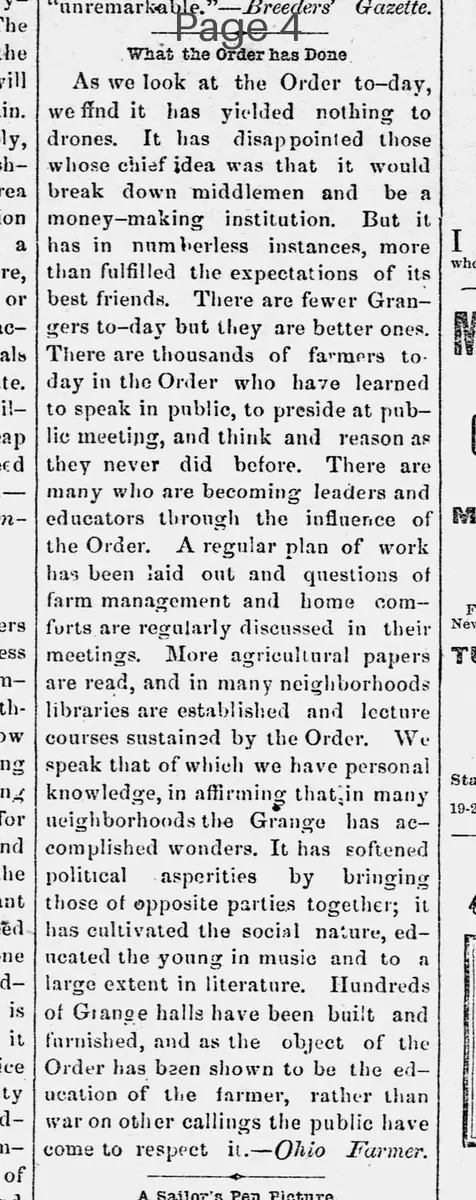
As we look at the Order to-day, we find it has yielded nothing to drones. It has disappointed those whose chief idea was that it would break down middlemen and be a money-making institution. But it has in numberless instances more than fulfilled the expectations of its best friends. There are fewer Grangers to-day but they are better ones. There are thousands of farmers to-day in the Order who have learned to speak in public, to preside at public meeting, and think and reason as they never did before. There are many who are becoming leaders and educators through the influence of the Order. A regular plan of work has been laid out and questions of farm management and home comforts are regularly discussed in their meetings. More agricultural papers are read, and in many neighborhoods libraries are established and lecture courses sustained by the Order. We speak that of which we have personal knowledge, in affirming that, in many neighborhoods the Grange has accomplished wonders. It has softened political asperities by bringing those of opposite parties together; it has cultivated the social nature, educated the young in music and to a large extent in literature. Hundreds of Grange halls have been built and furnished, and as the object of the Order has been shown to be the education of the farmer, rather than war on other callings the public have come to respect it.--Ohio Farmer
As we look at the Order to-day, we find it has yielded nothing to drones. It has disappointed those whose chief idea was that it would break down middlemen and be a money-making institution. But it has in numberless instances more than fulfilled the expectations of its best friends. There are fewer Grangers to-day but they are better ones. There are thousands of farmers to-day in the Order who have learned to speak in public, to preside at public meeting, and think and reason as they never did before. There are many who are becoming leaders and educators through the influence of the Order. A regular plan of work has been laid out and questions of farm management and home comforts are regularly discussed in their meetings. More agricultural papers are read, and in many neighborhoods libraries are established and lecture courses sustained by the Order. We speak that of which we have personal knowledge, in affirming that, in many neighborhoods the Grange has accomplished wonders. It has softened political asperities by bringing those of opposite parties together; it has cultivated the social nature, educated the young in music and to a large extent in literature. Hundreds of Grange halls have been built and furnished, and as the object of the Order has been shown to be the education of the farmer, rather than war on other callings the public have come to respect it.--Ohio Farmer
What sub-type of article is it?
Historical Event
What themes does it cover?
Triumph
Moral Virtue
What keywords are associated?
Grange Achievements
Farmers Education
Community Building
Agricultural Order
Public Respect
Where did it happen?
Many Neighborhoods
Story Details
Location
Many Neighborhoods
Event Date
To Day
Story Details
The Order (Grange) has educated farmers in public speaking, leadership, farm management, and home comforts; established libraries and lecture courses; softened political differences; cultivated social and cultural education; built hundreds of halls; and earned public respect as an educational institution rather than a money-making one.