Thank you for visiting SNEWPapers!
Sign up free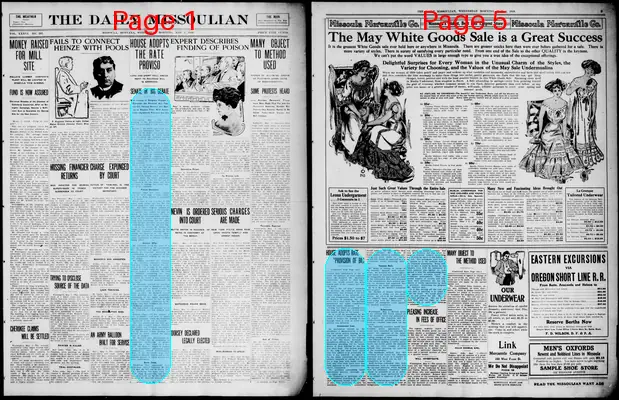
The Daily Missoulian
Missoula, Missoula County, Montana
What is this article about?
On May 3, 1906, in Washington, the Senate and House debated the railroad bill, eliminating traffic agreement and merger provisions, adopting modified long-short haul clauses, amid partisan and insurgent challenges, with the bill's final passage uncertain.
Merged-components note: This is a continuation of the railroad bill story from page 1 to page 5, as indicated by the '(Continued on Page Five.)' and '(Continued from Page One.)' markers. The overall content fits domestic_news as it covers national political developments.
Clippings

1 of 2
OCR Quality
Full Text
Both Houses of Congress Proceed to Dismantle the Proposed Act. Tearing Out Various Sections and Seeking to Replace Them With Substitutes—Agreement Provision Cut Out.
Washington, May 3.—The dismantling of the administration railroad bill proceeded in both houses today.
Section 7, the traffic agreement provision, was eliminated both by the senate and the house; the senate also struck out Section 12, which would have permitted any railroad owning 50 per cent of another to absorb it altogether.
The section prohibiting a railroad charging a higher rate for a short haul than for a long haul was adopted by the house in the form reported by the committee on interstate commerce, but with an additional provision and report to congress by the interstate commerce commission of the facts relative to the long and short haul question.
There is no section corresponding to this in the bill as it is pending in the senate; but an amendment offered by Senator Heyburn today to modify the existing law similarly precipitated an extended debate which was in progress when the senate adjourned.
Each version of the bill has yet to be passed in its own house and then will have to undergo the tender mercies of the conferees.
Future Uncertain.
Whether either will ever emerge from the final stage of joint conference is a thing nobody is prepared to prophesy.
Never since it was reported to the senate some weeks ago has the bill moved along with such celerity as today. The entire program outlined at yesterday's conference of the republican leaders was carried out and extended. In rapid succession the Cummins and the Crawford-Elkins amendments to the traffic agreement provision were withdrawn and the entire traffic merger provision stricken out.
Immediately after the bill was taken up in the senate, Mr. Elkins, in charge of it, proposed to lay on the table the Cummins' amendment requiring the approval of all agreements on rates by the interstate commerce commission in advance of their taking effect.
Another Offer.
Mr. Cummins saved the most of a vote by withdrawing his amendment. The democrats had agreed to vote against the Cummins' provision in consideration of the adoption of the Clay amendment striking out the entire section.
Mr. Elkins explained the majority of the Interstate commerce commission was willing to permit the section to go out because of the apprehension it would repeal the anti-trust law as applied to railroads. He said he intended supporting the Clay amendment, but explained that to get it before the senate it was necessary to lay the Cummins amendment on the table.
Mr. Cummins believed his provision if adopted would be beneficial to the public and said he would re-offer it in connection with a section to be taken up later. He declared himself much gratified over the prospective elimination of the entire agreement section. The motion to lay on the table was promptly withdrawn by Mr. Elkins, who then withdrew the Crawford-Elkins substitute.
The last action was acquiesced in by Mr. Crawford, but not without protest.
Senator Clapp said the purpose of that declaration had been to insure against monopoly which the Crawford amendment would not accomplish.
The Clay amendment was then presented and accepted without division. This action was followed immediately by adoption without division of a motion by Senator Nelson striking out Section 12, which covered the questions of mergers.
Mr. Heyburn then precipitated the debate of the day by presenting an amendment prohibiting a greater charge for a short than for a long haul. He spoke at length in support of his amendment, presenting many instances of alleged discrimination.
Many of his statements were challenged by Senator Aldrich and a controversy ensued, in which several senators participated.
Some Cases.
Admitting that apparently there were some cases of injustice, Mr. Aldrich said the bill was to find a remedy. Declaring that many cities such as St. Paul, Kansas City and Denver had been built up by the railroads, he asked Mr. Heyburn whether he advocated destroying them.
(Continued on Page Five.)
HOUSE ADOPTS RATE PROVISION OF BILL
(Continued from Page One.)
Advocated their annihilation in the interest, for instance, of some unknown place. He declared Mr. Heyburn's contentions carried to their legitimate end, would convert the great central part of the country into barren waste.
"That is the old song." responded Mr. Heyburn. He would not admit its applicability and declared if the terminal charges of the railroads were fair and remunerative there could be no injustice in charging the same prices for a short haul. The Heyburn amendment was under consideration when the senate adjourned.
Voting was begun on amendments to the long and short haul section after two hours' debate in the house. By 55 to 132 an amendment by Mr. Hardy of Texas to strike out the provision to permit the making of low through rates in view of water competition was defeated.
Amendment Lost.
An amendment offered by Mr. Washburn of Massachusetts to strike out the entire section relating to the long and short haul clause. leaving the law unchanged was also defeated, 48 to 172. The house accepted an amendment offered by Mr. Stevens of Minnesota providing for an investigation of facts relating to the long and short haul. The section relating to the long and short haul clause was then agreed to in practically the form it was reported. As agreed to by the house committee the section permits railroads to charge low rates for a long haul with water competition, only after such lower rates have been approved by the interstate commerce commission.
The provision authorizing traffic agreements between railroads was then taken up. Mr. Townsend of Michigan, offered an amendment providing in case any such agreement should result in higher rates than previously charged, the interstate commerce commission should approve the rates before they became effective.
Mr. Martin of South Dakota offered a substitute providing any rates made by traffic agreements should be approved by the commission before becoming effective.
Opposes Both.
Mr. Mann of Illinois, in charge of the measure, opposed both amendments. He declared the traffic agreement clause as reported contained all the safeguards for supervision of rates by the commission that were proposed in the amendments. Both political parties, he declared had approved this proposition for traffic agreements. By 83 to 59. Mr. Martin's substitute was adopted.
Mr. Madden of Illinois offered an amendment to strike out the entire section. By 110 to 91 the amendment was adopted, many regular republicans voting with the democrats. A number of insurgents voted against the Madden proposition.
Substitutes.
Washington, May 3.—Section seven of the railroad bill, which caused all of the trouble. never was perfected in the senate. The Cummins and the Elkins-Crawford provisions were offered as complete substitutes for the section. The Cummins provision would have legalized traffic agreements but would have compelled the railroads to procure the approval of the interstate commerce commission before making changes of rates. The Elkins-Crawford provision would authorize the making of traffic agreements, but would permit the railroads to put into force changes of rates without first obtaining the approval of the commission.
The insurgents claimed that this provision would repeal the Sherman anti-trust law, so far as it applied to railroads and would put an end to competition as to rates. Both factions contended that their amendments were in compliance with the national platform, which declared that the interstate commerce laws should be amended so as to permit railroads to make agreements as to rates subject to approval of the commission.
"The insurgents have reached the respectable status of being treated as belligerents," commented Mr. Dolliver, before the senate convened. Not only Mr. Dolliver, but also other insurgents believed today's proceeding would mark an epoch in the history of the bill. The insurgents were divided in opinion as to the probable fate of the Cummins amendment. Some were not so sure it could be beaten by the regulars even with the assistance of those senators who agreed to vote against it with the understanding that the agreement provision would be withdrawn subsequently. They appeared hopeful of success and indicated their preference for the regulation of traffic agreements by such a provision.
Discussing the program Mr. Dolliver said: "It is like driving off the roof the man who is patching it in order to burn the house. We would prefer to go on and perfect the bill. We are certainly getting on. We are to be dealt with and our right to make treaties and to enter into alliances is established."
What sub-type of article is it?
What keywords are associated?
What entities or persons were involved?
Where did it happen?
Domestic News Details
Primary Location
Washington
Event Date
May 3
Key Persons
Outcome
section 7 (traffic agreement provision) eliminated in both houses; section 12 (mergers) struck out in senate; long and short haul section adopted in house with amendments for icc investigation; heyburn amendment debated in senate; various amendments withdrawn or defeated; bill's future uncertain pending conference.
Event Details
Both houses of Congress dismantled the administration railroad bill on May 3. The Senate eliminated Section 7 (traffic agreements) after withdrawing Cummins and Crawford-Elkins amendments, and struck Section 12 (mergers). Senator Heyburn's amendment on long and short hauls sparked debate. In the House, the long and short haul section was adopted with additions for ICC reporting, and the traffic agreement section was struck out after amendments. Insurgents and Democrats influenced outcomes, with ongoing concerns about anti-trust implications.