Thank you for visiting SNEWPapers!
Sign up free
New York Daily Tribune
New York, New York County, New York
What is this article about?
Detailed account of the August 3, 1864, prisoner exchange in Charleston harbor between Union and Confederate forces, involving 50 officers each. Describes the proceedings, welcoming receptions, harsh Rebel treatment of prisoners, and observations on Southern Union sentiment and conditions.
Clipping
OCR Quality
Full Text
From the New South, August 13th.
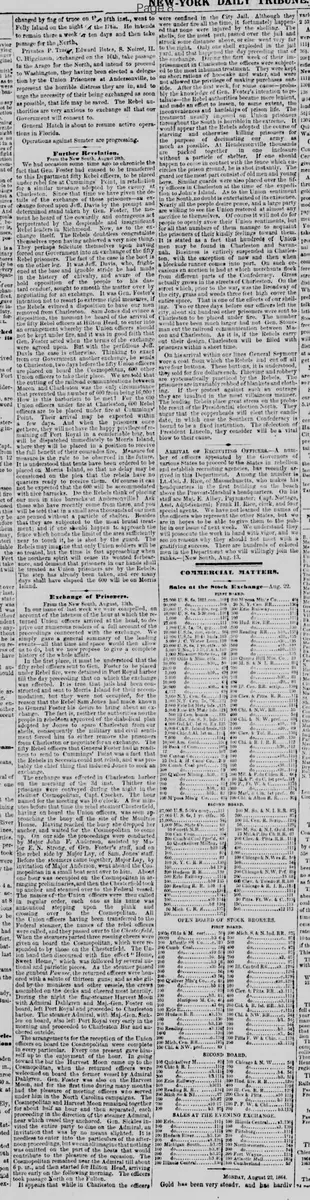
In our issue of last week we were compelled, on account of the lateness of the hour at which the returned Union officers arrived at the head, to deprive our numerous readers of a full account of the proceedings connected with the exchange. We simply gave a general summary of the leading events-all that time and space would then allow us to do, but we now propose to give a complete history of the whole affair.
In the first place, it must be understood that the fifty rebel officers sent to Gen. Foster to be placed under Rebel fire, were detained in Port Royal harbor till the day preceding that on which the exchange was effected. It is true that jails had been constructed and sent to Morris Island for their accommodation, but they were not occupied, for the reason that the Rebel Sam Jones had made known to General Foster his desire to bring about an exchange. The fact is, neither the authorities nor the people in rebeldom approved of the diabolical plan adopted by Jones to spare Charleston from shells, consequently the military and civil sentiment forced him to either remove the prisoners from Charleston or negotiate for an exchange. The fifty Rebel officers that General Foster had in readiness to send to Cummings' Point was a fact that the Rebels in Secessia could not relish, and was probably the chief thing that induced Jones to seek an exchange.
The exchange was effected in Charleston harbor on the morning of the 3d inst. Thither the prisoners were conveyed during the night in the steamer Cosmopolitan, Capt. Crocker. The hour named for the meeting was 10 o'clock. A few minutes before that time the rebel steamer Chesterfield, having on board the Union officers, was seen approaching the buoy off the site of the Moultrie House. Having reached the buoy she dropped her anchor, and waited for the Cosmopolitan to come up. On our side the proceedings were conducted by Major John F. Anderson, assisted by Major E. N. Strong, of Gen. Foster's staff, and on the rebel side by Major Lay, of Sam. Jones' staff.
Before the steamers came together, Major Lay, by invitation of Major Anderson, went aboard the Cosmopolitan in a small boat sent over to him. About one hour was occupied on the Cosmopolitan in arranging preliminaries, and then the Chesterfield took up anchor and steamed over to the Federal vessel.
The names of the Union officers were then called in regular order, each one as his name was announced stepping upon the plank and crossing over to the Cosmopolitan. All the Union officers having been transferred to the Federal steamer, the names of the rebel officers were called, and they passed over to the Chesterfield.
When the steamers parted three rousing cheers were given on board the Cosmopolitan, which were responded to by those on the Chesterfield. The Union band then discoursed with fine effect "Home, Sweet Home," which was followed by several national and patriotic pieces. As the steamer passed the gunboat Pawnee, the returned officers were honored with a salute of thirteen guns; and as she glided by the monitors and other vessels, the crews assembled on the decks and cheered most heartily.
During the night the flag-steamer Harvest Moon with Admiral Dahlgren and Maj.-Gen. Foster on board, left Port Royal and proceeded to Charleston harbor. The steamer Admiral, with Maj.-Gen. Sickles on board, also left Port Royal very early in the morning and proceeded to Charleston Bar and anchored outside.
The arrangements for the reception of the Union officers on board the Cosmopolitan were complete in every particular. Every one present gave himself up to the enjoyment of the hour. In going toward the bar the Harvest Moon came up to the Cosmopolitan, when the returned officers were welcomed on board the former vessel by Admiral Dahlgren. Gen. Foster was also on the Harvest Moon, and for the first time during many months had the pleasure of meeting officers who served under him in the North Carolina campaigns. The Cosmopolitan and Harvest Moon remained together for about half an hour and then separated, each proceeding in the direction of the steamer Admiral, near which vessel they anchored. Gen. Sickles invited the entire party to dine on the Admiral, an invitation that was by no means slighted. It is needless to enter into the particulars of the afternoon proceedings, but we can all imagine that nothing was omitted on the part of the hosts that would contribute to the pleasure of the occasion. The Cosmopolitan remained near the Admiral till about 6 p. m., and then started for Hilton Head, arriving there early on the following morning. The officers took passage North on the Fulton.
It appears that while in Charleston the officers were confined in the City Jail. Although they were under fire all the time, it fortunately happened that none were injured by the shelling. The shells, for the most part, passed over the jail and struck some distance above, or else went very far to the right. Only one shell exploded in the jail yard, and that happened the day preceding that of the exchange. During the first week of their imprisonment in Charleston the officers were subjected to the most inhuman treatment. They were kept on short rations of hoe-cake and water, and were not allowed the privilege of making purchases outside. After the first week, for some cause-probably the knowledge of Gen. Foster's intention to retaliate-the Rebel authorities became more lenient, and made an effort to lessen, to some extent, the inconveniences and hardships of prison life. The treatment usually imposed on Union prisoners throughout the South is horrible in the extreme. It would appear that the Rebels adopted the course of starving and otherwise killing prisoners for the purpose of decimating our army as much as possible. At Andersonville thousands are packed together in one inclosure without a particle of shelter. If one should happen to come in contact with the fence which encircles the prison ground, he is shot instantly. The guard for the most part consist of old men and young boys. Similar guards were also placed over the fifty officers in Charleston at the time of the expedition to John's Island. As to the Union sentiment in the South, no doubt is entertained of its existence. Nearly all the people desire peace, and a large party are willing to see the Union restored at almost any sacrifice to themselves. Of course it will not do for people to openly avow their Union sentiments, but for all that numbers of them manage to acquaint the prisoners of their kindly feelings toward them. It is stated as a fact that hundreds of Union men may be found in Charleston and Savannah. Business is entirely suspended in Charleston, with the exception of now and then when a blockade runner comes into port. On such occasions an auction is had at which merchants flock from different parts of the Confederacy. Grass actually grows in the streets of Charleston. On the street which, prior to the war, was the Broadway of the city, grass and weeds three feet high cover the entire space. That is one of the effects of our shelling. Two or three days before our officers left the city, about six hundred other prisoners were sent to Charleston to be placed under fire. The number would have been much larger had not Gen. Stoneman cut the railroad communication between Macon and Charleston. As it is, if the Rebels carry out their design, Charleston will be filled with prisoners within a short time.
On his arrival within our lines General Seymour wore a coat from which the Rebels had cut off all save four buttons. These buttons, it is understood, they sold for five dollars each. Thieving and robbery are systematically practiced by the Rebels. The prisoners are invariably robbed of blankets and clothing. If they protest against such an outrage they are insulted in the most villainous manner.
The leading Rebels place great stress on the probable result of the Presidential election North. They augur that the copperheads will elect their candidate, in which case the Southern Confederacy is bound to be a fixed institution. The re-election of President Lincoln, they consider will be a vital blow to their cause.
What sub-type of article is it?
What themes does it cover?
What keywords are associated?
What entities or persons were involved?
Where did it happen?
Story Details
Key Persons
Location
Charleston Harbor
Event Date
Morning Of The 3d Inst.
Story Details
The exchange of 50 Union and 50 Rebel officers occurred in Charleston harbor on August 3, facilitated by threats of retaliation. Proceedings involved steamers Cosmopolitan and Chesterfield, with officers crossing via plank. Returned Union officers received warm welcomes, salutes, and a dinner. Details include harsh Rebel prison conditions, theft from prisoners, Union sentiment in the South, and economic decline in Charleston.