Thank you for visiting SNEWPapers!
Sign up free
Editorial
December 9, 1948
Twin City Observer
Minneapolis, Saint Paul, Hennepin County, Ramsey County, Minnesota
What is this article about?
Editorial critiques the decisive defeat of a new Minneapolis city charter proposal (42% yes vs. 58% no, needing 60%) and similar rejections in St. Paul. Urges proponents to examine their sales techniques and avoid condescending attitudes that provoke voter resentment rather than blaming public ignorance.
Clipping
OCR Quality
75%
Good
Full Text
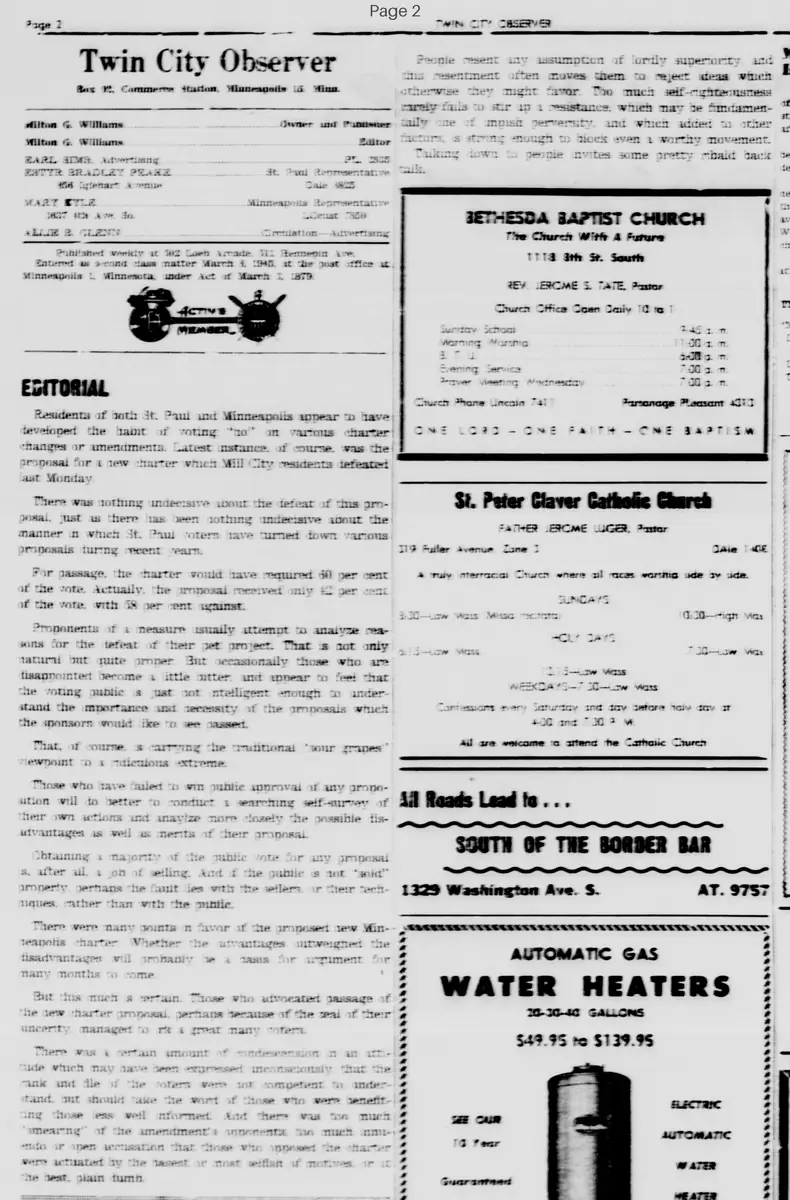
EDITORIAL
Residents of both St. Paul and Minneapolis appear to have developed the habit of voting "no" on various charter changes or amendments. Latest instance, of course, was the proposal for a new charter when Mill City residents defeated it last Monday.
There was nothing indecisive about the defeat of this proposal, just as there has been nothing indecisive about the manner in which St. Paul voters have turned down various proposals during recent years.
For passage, the charter would have required 60 per cent of the vote. Actually, the proposal received only 42 per cent of the vote, with 58 per cent against.
Proponents of any measure usually attempt to analyze reasons for the defeat of their pet project. That is not only natural but quite proper. But occasionally those who are disappointed become a little bitter and appear to feel that the voting public is just not intelligent enough to understand the importance and necessity of the proposals which the sponsors would like to see passed.
That, of course, is carrying the traditional "sour grapes" viewpoint to a ridiculous extreme.
Those who have failed to win public approval of any proposition will do better to conduct a searching self-survey of their own actions and analyze more closely the possible disadvantages as well as merits of their proposal.
Obtaining a majority of the public vote for any proposal is, after all, one of selling. And if the public is not "sold" properly, perhaps the fault lies with the sellers, or their techniques, rather than with the public.
There were many points in favor of the proposed new Minneapolis charter. Whether the advantages outweighed the disadvantages will probably be a subject for argument for many months to come.
But this much is certain. Those who advocated passage of the new charter proposal, perhaps because of the pall of their uncertainty managed to raise a great many cat's.
There is a certain amount of condescension in it.
Such which may have been expressed unconsciously that the rank and file of the voters were in no competent to understand, or should take the word of those who were sentient and those as well informed, that there was no much smearing of the amendment opponents in most int- made or open accusation that those who opposed the charter were motivated by the basest or most selfish of motives or at he best. Plain dumb.
People resent any assumption of moral superiority and this resentment often moves them to reject ideas which otherwise they might favor.
Too much self-righteousness rarely fails to stir up a resistance, which may be fundamentally one of moral perversity, and which added to other factors, is strong enough to block even a worthy movement.
Taking tool with people invites some pretty ribald back calk.
Residents of both St. Paul and Minneapolis appear to have developed the habit of voting "no" on various charter changes or amendments. Latest instance, of course, was the proposal for a new charter when Mill City residents defeated it last Monday.
There was nothing indecisive about the defeat of this proposal, just as there has been nothing indecisive about the manner in which St. Paul voters have turned down various proposals during recent years.
For passage, the charter would have required 60 per cent of the vote. Actually, the proposal received only 42 per cent of the vote, with 58 per cent against.
Proponents of any measure usually attempt to analyze reasons for the defeat of their pet project. That is not only natural but quite proper. But occasionally those who are disappointed become a little bitter and appear to feel that the voting public is just not intelligent enough to understand the importance and necessity of the proposals which the sponsors would like to see passed.
That, of course, is carrying the traditional "sour grapes" viewpoint to a ridiculous extreme.
Those who have failed to win public approval of any proposition will do better to conduct a searching self-survey of their own actions and analyze more closely the possible disadvantages as well as merits of their proposal.
Obtaining a majority of the public vote for any proposal is, after all, one of selling. And if the public is not "sold" properly, perhaps the fault lies with the sellers, or their techniques, rather than with the public.
There were many points in favor of the proposed new Minneapolis charter. Whether the advantages outweighed the disadvantages will probably be a subject for argument for many months to come.
But this much is certain. Those who advocated passage of the new charter proposal, perhaps because of the pall of their uncertainty managed to raise a great many cat's.
There is a certain amount of condescension in it.
Such which may have been expressed unconsciously that the rank and file of the voters were in no competent to understand, or should take the word of those who were sentient and those as well informed, that there was no much smearing of the amendment opponents in most int- made or open accusation that those who opposed the charter were motivated by the basest or most selfish of motives or at he best. Plain dumb.
People resent any assumption of moral superiority and this resentment often moves them to reject ideas which otherwise they might favor.
Too much self-righteousness rarely fails to stir up a resistance, which may be fundamentally one of moral perversity, and which added to other factors, is strong enough to block even a worthy movement.
Taking tool with people invites some pretty ribald back calk.
What sub-type of article is it?
Constitutional
Partisan Politics
What keywords are associated?
Minneapolis Charter
Voter Rejection
Proposal Defeat
Public Approval
Voter Resentment
Charter Amendments
St Paul Voting
Sour Grapes
Self Righteousness
Selling Proposals
What entities or persons were involved?
St. Paul Voters
Minneapolis Voters
Charter Proponents
Editorial Details
Primary Topic
Defeat Of Minneapolis Charter Proposal
Stance / Tone
Critical Of Proponents' Attitudes Toward Voters
Key Figures
St. Paul Voters
Minneapolis Voters
Charter Proponents
Key Arguments
Voters In St. Paul And Minneapolis Habitually Reject Charter Changes Decisively
New Minneapolis Charter Received Only 42% Approval, Needing 60%
Proponents Should Self Analyze Rather Than Blame Voters' Intelligence
Condescension And Accusations Of Selfishness Alienate Voters
Excessive Self Righteousness Stirs Resistance To Worthy Ideas