Thank you for visiting SNEWPapers!
Sign up free
Story
March 20, 1858
Staunton Vindicator And General Advertiser
Staunton, Virginia
What is this article about?
The Richmond Enquirer critiques the taxation of Virginia state bonds, noting that combined taxes reduce the net yield to 4.60% on bonds quoted at 94, effectively making them trade above par and harming state credit by forcing sales below par or reliance on foreign markets.
Clipping
OCR Quality
98%
Excellent
Full Text
Taxing State Bonds.
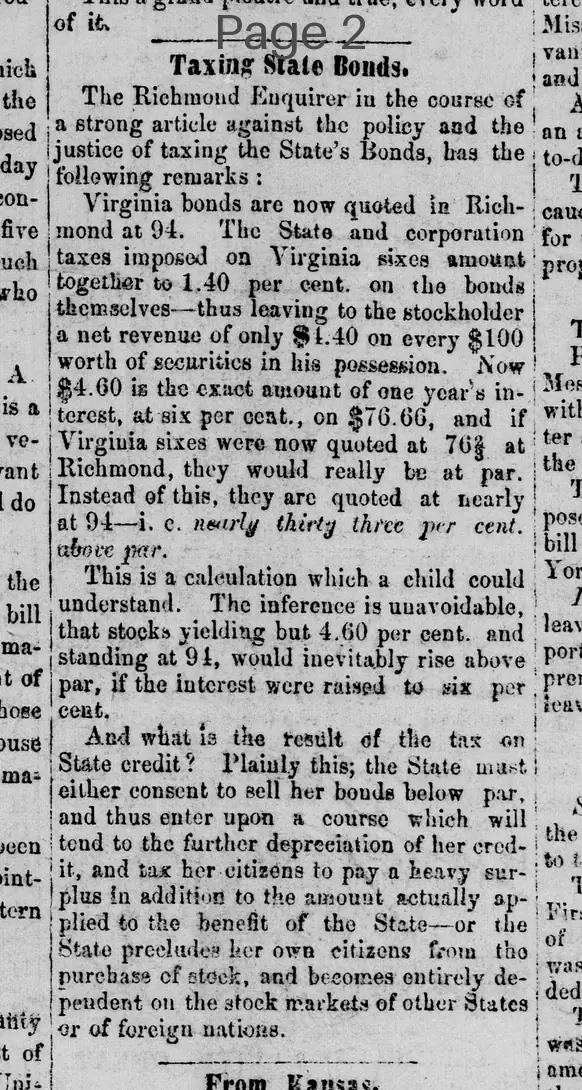
The Richmond Enquirer in the course of a strong article against the policy and the justice of taxing the State's Bonds, has the following remarks:
Virginia bonds are now quoted in Richmond at 94. The State and corporation taxes imposed on Virginia sixes amount together to 1.40 per cent. on the bonds themselves—thus leaving to the stockholder a net revenue of only $4.60 on every $100 worth of securities in his possession. Now $4.60 is the exact amount of one year's interest, at six per cent., on $76.66, and if Virginia sixes were now quoted at 76 at Richmond, they would really be at par. Instead of this, they are quoted at nearly 94—i. e. nearly thirty three per cent. above par.
This is a calculation which a child could understand. The inference is unavoidable. that stocks yielding but 4.60 per cent. and standing at 94, would inevitably rise above par, if the interest were raised to six per cent.
And what is the result of the tax on State credit? Plainly this: the State must either consent to sell her bonds below par, and thus enter upon a course which will tend to the further depreciation of her credit, and tax her citizens to pay a heavy surplus in addition to the amount actually applied to the benefit of the State—or the State precludes her own citizens from the purchase of stock, and becomes entirely dependent on the stock markets of other States or of foreign nations.
The Richmond Enquirer in the course of a strong article against the policy and the justice of taxing the State's Bonds, has the following remarks:
Virginia bonds are now quoted in Richmond at 94. The State and corporation taxes imposed on Virginia sixes amount together to 1.40 per cent. on the bonds themselves—thus leaving to the stockholder a net revenue of only $4.60 on every $100 worth of securities in his possession. Now $4.60 is the exact amount of one year's interest, at six per cent., on $76.66, and if Virginia sixes were now quoted at 76 at Richmond, they would really be at par. Instead of this, they are quoted at nearly 94—i. e. nearly thirty three per cent. above par.
This is a calculation which a child could understand. The inference is unavoidable. that stocks yielding but 4.60 per cent. and standing at 94, would inevitably rise above par, if the interest were raised to six per cent.
And what is the result of the tax on State credit? Plainly this: the State must either consent to sell her bonds below par, and thus enter upon a course which will tend to the further depreciation of her credit, and tax her citizens to pay a heavy surplus in addition to the amount actually applied to the benefit of the State—or the State precludes her own citizens from the purchase of stock, and becomes entirely dependent on the stock markets of other States or of foreign nations.
What sub-type of article is it?
Economic Commentary
Policy Critique
What themes does it cover?
Justice
Misfortune
What keywords are associated?
Virginia Bonds
State Taxation
Bond Yields
State Credit
Economic Policy
Where did it happen?
Richmond, Virginia
Story Details
Location
Richmond, Virginia
Story Details
Critique of taxing Virginia state bonds, showing taxes reduce net yield to 4.60% on bonds at 94, implying they trade above par; warns of credit depreciation, forced below-par sales, or dependence on foreign markets.