Thank you for visiting SNEWPapers!
Sign up free
Poem
September 20, 1770
The Virginia Gazette
Richmond, Williamsburg, Richmond County, Virginia
What is this article about?
A maid, alone with Milton's Paradise Lost, contemplates marriage through a soliloquy. She quotes Milton's praise of wedded love, reflects on natural instincts, fears of spinsterhood, and the joys and duties of matrimony, resolving to wed for lasting happiness and legacy.
Clipping
OCR Quality
98%
Excellent
Full Text
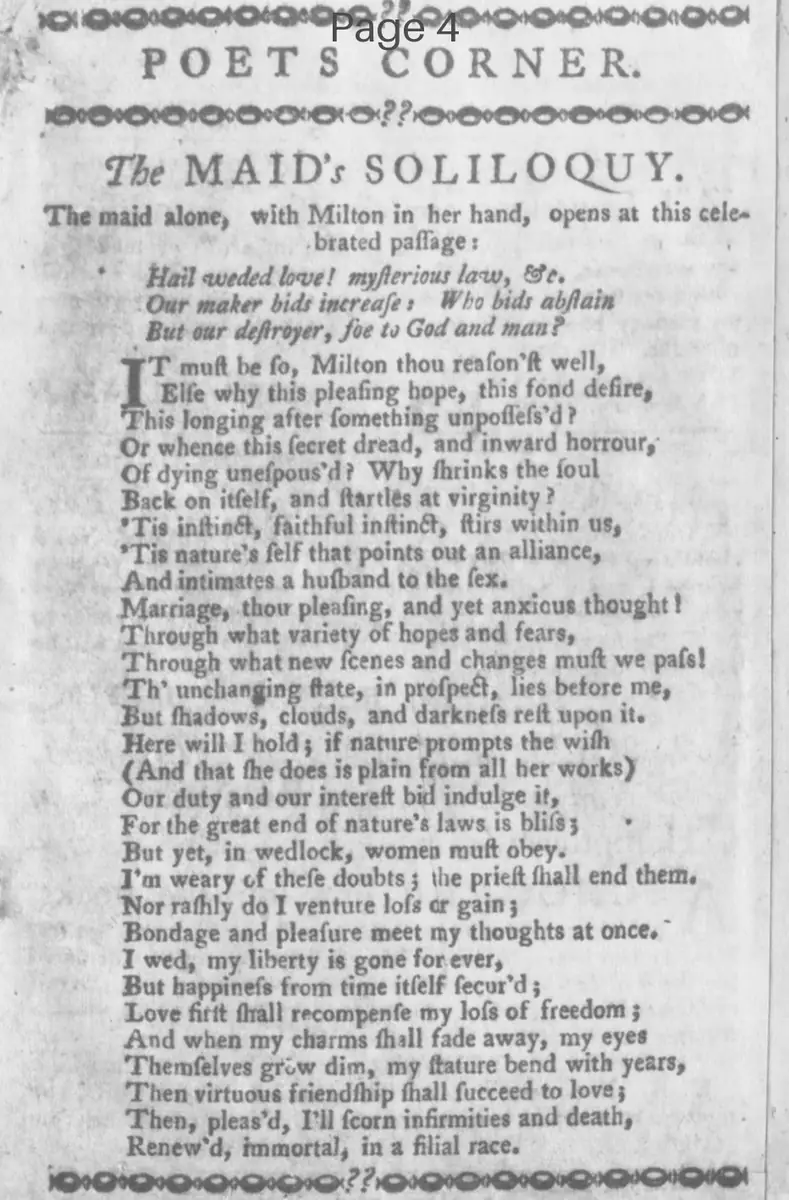
POET'S CORNER.
The Maid's Soliloquy.
The maid alone with Milton in her hand, opens at this celebrated page:
Hail wedded love! mysterious law, &c.
Our maker bids increase: Who bids abstain
But our destroyer, foe to God and man?
'T must be so, Milton thou reason'st well,
Else why this pleasing hope, this fond desire,
This longing after something unpossess't?
Or whence this secret dread, and inward horror,
Of dying unespoused? Why shrinks the soul
Back on itself, and startles at virginity?
'Tis instinct, faithful instinct, stirs within us,
'Tis nature's self that points out an alliance,
And intimates a husband to the sex.
Marriage, thou pleasing, and yet anxious thought!
Through what variety of hopes and fears,
Through what new scenes and changes must we pass!
Th' unchanging state, in prospect, lies before me,
But shadows, clouds, and darkness rest upon it.
Here will I hold; if nature prompts the wish
(And that she does is plain from all her works)
Our duty and our interest bid indulge it,
For the great end of nature's laws is bliss
But yet, in wedlock, women must obey.
I'm weary of these doubts; the priest shall end them.
Nor rashly do I venture loss or gain;
Bondage and pleasure meet my thoughts at once.
I wed, my liberty is gone for ever,
But happiness from time itself secured;
Love first shall recompense my loss of freedom;
And when my charms shall fade away, my eyes
Themselves grow dim, my stature bend with years,
Then virtuous friendship shall succeed to love;
Then, pleased, I'll scorn infirmities and death,
Renew'd, immortal, in a filial race.
The Maid's Soliloquy.
The maid alone with Milton in her hand, opens at this celebrated page:
Hail wedded love! mysterious law, &c.
Our maker bids increase: Who bids abstain
But our destroyer, foe to God and man?
'T must be so, Milton thou reason'st well,
Else why this pleasing hope, this fond desire,
This longing after something unpossess't?
Or whence this secret dread, and inward horror,
Of dying unespoused? Why shrinks the soul
Back on itself, and startles at virginity?
'Tis instinct, faithful instinct, stirs within us,
'Tis nature's self that points out an alliance,
And intimates a husband to the sex.
Marriage, thou pleasing, and yet anxious thought!
Through what variety of hopes and fears,
Through what new scenes and changes must we pass!
Th' unchanging state, in prospect, lies before me,
But shadows, clouds, and darkness rest upon it.
Here will I hold; if nature prompts the wish
(And that she does is plain from all her works)
Our duty and our interest bid indulge it,
For the great end of nature's laws is bliss
But yet, in wedlock, women must obey.
I'm weary of these doubts; the priest shall end them.
Nor rashly do I venture loss or gain;
Bondage and pleasure meet my thoughts at once.
I wed, my liberty is gone for ever,
But happiness from time itself secured;
Love first shall recompense my loss of freedom;
And when my charms shall fade away, my eyes
Themselves grow dim, my stature bend with years,
Then virtuous friendship shall succeed to love;
Then, pleased, I'll scorn infirmities and death,
Renew'd, immortal, in a filial race.
What sub-type of article is it?
Ode
What themes does it cover?
Love Courtship
Marriage Celebration
Moral Virtue
What keywords are associated?
Maids Soliloquy
Wedded Love
Milton Paradise Lost
Marriage Instincts
Matrimonial Bliss
Virtuous Friendship
Poem Details
Title
The Maid's Soliloquy
Subject
On Marriage Inspired By Milton
Key Lines
Hail Wedded Love! Mysterious Law, &C.
Our Maker Bids Increase: Who Bids Abstain / But Our Destroyer, Foe To God And Man?
'T Must Be So, Milton Thou Reason'st Well,
Marriage, Thou Pleasing, And Yet Anxious Thought!
I Wed, My Liberty Is Gone For Ever, / But Happiness From Time Itself Secured;