Thank you for visiting SNEWPapers!
Sign up free
Story
August 26, 1890
The Wichita Daily Eagle
Wichita, Sedgwick County, Kansas
What is this article about?
Article explains construction and use of tactile, dissected wooden maps for blind students to learn geography, with raised features for terrain, boundaries, and city sizes indicated by tack heads; demonstrates student proficiency in tracing states like Missouri and comparing sizes of Ohio and Texas.
Clipping
OCR Quality
98%
Excellent
Full Text
MAPS FOR THE BLIND.
Interesting Facts About Their Construction and Their Use.
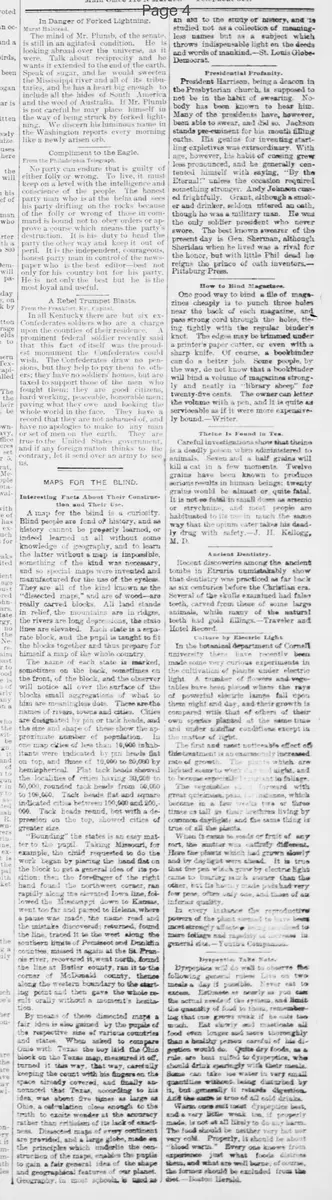
A map for the blind is a curiosity. Blind people are fond of history, and as history cannot be properly learned, or indeed learned at all without some knowledge of geography, and to learn the latter without a map is impossible, something of the kind was necessary, and so special maps were invented and manufactured for the use of the eyeless. They are all of the kind known as the "dissected maps," and are of wood—really carved blocks. All land stands in relief, the mountains are in ridges, the rivers are long depressions, the state lines are elevated. Each state is a separate block, and the pupil is taught to fit the blocks together and thus prepare for himself a map of the whole country. The name of each state is marked, sometimes on the back, sometimes on the front, of the block, and the observer will notice all over the surface of the blocks small aggregations of what to him are meaningless dots. These are the names of rivers, towns and cities. Cities are designated by pin or tack heads, and the size and shape of these show the approximate number of population. In one map cities of less than 10,000 inhabitants were indicated by pin heads flat on top, and those of 10,000 to 20,000 by hemispherical. Flat tack heads showed the localities of cities having 20,000 to 50,000, rounded tack heads from 50,000 to 100,000. Tack heads flat and square indicated cities between 100,000 and 200,000. One tack heads round, but with a depression on the top, showed cities of greater size.
"Bounding" the states is an easy matter to the pupil. Taking Missouri, for example, the child requested to do the work began by placing the hand flat on the block to get a general idea of its position, then the forefinger of the right hand formed the northwest corner, ran rapidly along the elevated Iowa line, followed the Mississippi down to Kansas, went too far and passed to Helena, where a pause was made, the name read and the mistake discovered; returned, found the line, traced it to the west along the southern border of Pemiscot and Dunklin counties, missed it again at the St. Francis river, recovered it, went north, found the line at Butler county, ran it to the corner of McDonald county, thence along the western boundary to the starting point and then gave the whole result orally without a moment's hesitation.
By means of these dissected maps a fair idea is also gained by the pupils of the respective size of various countries and states. When asked to compare Ohio with Texas the boy laid the Ohio block on the Texas map, measured it off, turned it this way, that way, carefully keeping the count with his fingers on the space already covered, and finally announced that Texas, according to his idea, was about five times as large as Ohio, a calculation close enough to the truth to excite wonder at the accuracy rather than criticism of its lack of exactness. Dissected maps of every continent are provided, and a large globe, made on the principles which underlie the construction of the maps, enables the pupils to gain a fair general idea of the shape and geographical features of our planet.
Geography, in most schools, is used as an aid to the study of history, and is studied not as a collection of meaningless names but as a subject which throws indispensable light on the deeds and words of mankind.—St. Louis Globe-Democrat.
Interesting Facts About Their Construction and Their Use.
A map for the blind is a curiosity. Blind people are fond of history, and as history cannot be properly learned, or indeed learned at all without some knowledge of geography, and to learn the latter without a map is impossible, something of the kind was necessary, and so special maps were invented and manufactured for the use of the eyeless. They are all of the kind known as the "dissected maps," and are of wood—really carved blocks. All land stands in relief, the mountains are in ridges, the rivers are long depressions, the state lines are elevated. Each state is a separate block, and the pupil is taught to fit the blocks together and thus prepare for himself a map of the whole country. The name of each state is marked, sometimes on the back, sometimes on the front, of the block, and the observer will notice all over the surface of the blocks small aggregations of what to him are meaningless dots. These are the names of rivers, towns and cities. Cities are designated by pin or tack heads, and the size and shape of these show the approximate number of population. In one map cities of less than 10,000 inhabitants were indicated by pin heads flat on top, and those of 10,000 to 20,000 by hemispherical. Flat tack heads showed the localities of cities having 20,000 to 50,000, rounded tack heads from 50,000 to 100,000. Tack heads flat and square indicated cities between 100,000 and 200,000. One tack heads round, but with a depression on the top, showed cities of greater size.
"Bounding" the states is an easy matter to the pupil. Taking Missouri, for example, the child requested to do the work began by placing the hand flat on the block to get a general idea of its position, then the forefinger of the right hand formed the northwest corner, ran rapidly along the elevated Iowa line, followed the Mississippi down to Kansas, went too far and passed to Helena, where a pause was made, the name read and the mistake discovered; returned, found the line, traced it to the west along the southern border of Pemiscot and Dunklin counties, missed it again at the St. Francis river, recovered it, went north, found the line at Butler county, ran it to the corner of McDonald county, thence along the western boundary to the starting point and then gave the whole result orally without a moment's hesitation.
By means of these dissected maps a fair idea is also gained by the pupils of the respective size of various countries and states. When asked to compare Ohio with Texas the boy laid the Ohio block on the Texas map, measured it off, turned it this way, that way, carefully keeping the count with his fingers on the space already covered, and finally announced that Texas, according to his idea, was about five times as large as Ohio, a calculation close enough to the truth to excite wonder at the accuracy rather than criticism of its lack of exactness. Dissected maps of every continent are provided, and a large globe, made on the principles which underlie the construction of the maps, enables the pupils to gain a fair general idea of the shape and geographical features of our planet.
Geography, in most schools, is used as an aid to the study of history, and is studied not as a collection of meaningless names but as a subject which throws indispensable light on the deeds and words of mankind.—St. Louis Globe-Democrat.
What sub-type of article is it?
Curiosity
What themes does it cover?
Triumph
What keywords are associated?
Maps For Blind
Tactile Geography
Dissected Maps
Blind Education
Geographical Learning
Where did it happen?
United States
Story Details
Location
United States
Story Details
Description of dissected wooden maps designed for blind students to learn geography, featuring raised relief for land, depressions for rivers, and tactile markers for cities; examples of students using them to trace boundaries and compare sizes accurately.