Thank you for visiting SNEWPapers!
Sign up free
Editorial
May 2, 1797
The New Hampshire Gazette
Portsmouth, Rockingham County, New Hampshire
What is this article about?
In Letter I, Fabius reflects on post-Revolutionary US dangers of internal discord and foreign jealousy, praising the 1787 Constitution and France's path to liberty amid European wars, defending her endurance of tyranny and ultimate rejection of it, while affirming US sympathy for French freedom.
Clipping
OCR Quality
98%
Excellent
Full Text
From the NEW WORLD.
REMARKS ON THE PRESENT SITUATION OF PUBLIC AFFAIRS.
LETTER I.
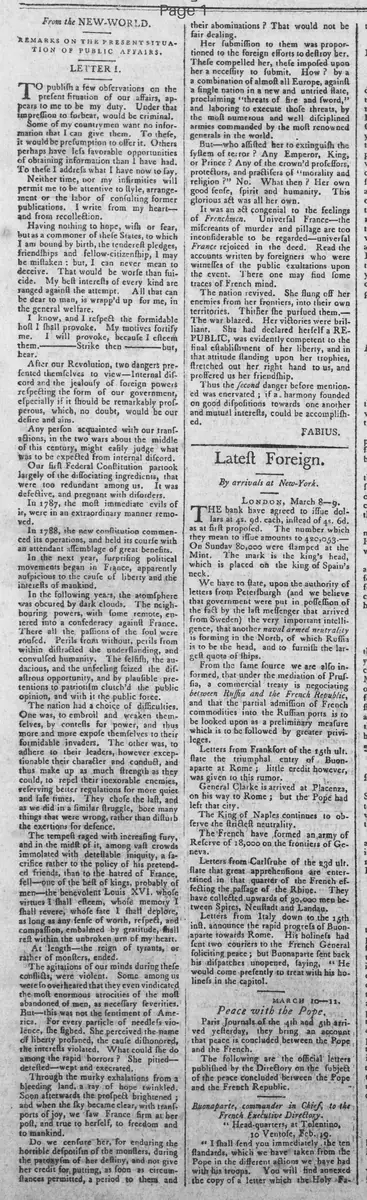
To publish a few observations on the present situation of our affairs, appears to me to be my duty. Under that impression to forbear, would be criminal. Some of my countrymen want no information that I can give them. To these it would be presumption to offer it. Others perhaps have less favorable opportunities of obtaining information than I have had. To these I address what I have now to say. Neither time, nor my infirmities will permit me to be attentive to style, arrangement or the labor of consulting former publications. I write from my heart--and from recollection. Having nothing to hope, wish or fear, but as a commoner of these States, to which I am bound by birth, the tenderest pledges, friendships and fellow-citizenship, I may be mistaken: but, I can never mean to deceive. That would be worse than suicide. My best interests of every kind are ranged against the attempt. All that can be dear to man, is wrapt up for me, in the general welfare. I know, and I repeat the formidable host I shall provoke. My motives fortify me. I will provoke, because I esteem them.-- Strike then-- but, hear.
After our Revolution, two dangers presented themselves to view--Internal discord and the jealousy of foreign powers respecting the form of our government, especially if it should be remarkably prosperous, which, no doubt, would be our desire and aim. Any person acquainted with our transactions, in the two wars about the middle of this century, might easily judge what was to be expected from internal discord. Our first Federal Constitution partook largely of the disociating ingredients, that were too redundant among us. It was defective, and pregnant with disorders. In 1787, the most immediate evils of it, were in an extraordinary manner removed. In 1788, the new constitution commenced its operations, and held its course with an attendant assemblage of great benefits. In the next year, surprising political movements began in France, apparently auspicious to the cause of liberty and the interests of mankind. In the following years, the atmosphere was obscured by dark clouds. The neighbouring powers, with some remote, entered into a confederacy against France. There all the passions of the soul were roused. Perils from without, perils from within distracted the understanding, and convulsed humanity. The selfish, the audacious, and the unfeeling seized the disastrous opportunity, and by plausible pretensions to patriotism clutch'd the public opinion, and with it the public force. The nation had a choice of difficulties. One was, to embroil and weaken themselves, by contests for power, and thus more and more expose themselves to their formidable invaders, The other was, to adhere to their leaders, however exceptionable their character and conduct, and thus make up as much strength as they could, to repel their inexorable enemies, reserving better regulations for more quiet and safe times. They chose the last, and as we did in a similar struggle, bore many things that were wrong, rather than disturb the exertions for defence. The tempest raged with increasing fury, and in the midst of it, among vast crowds immolated with detestable iniquity, a sacrifice rather to the policy of his pretended friends, than to the hatred of France, fell--one of the best of kings, probably of men--the benevolent Louis XVI. whose virtues I shall esteem, whose memory I shall revere, whose fate I shall deplore, as long as any sense of worth, respect, and compassion, embalmed by gratitude, shall rest within the unbroken urn of my heart. At length--the reign of tyrants, or rather of monsters, ended. The agitations of our minds during these conflicts, were violent. Some among us were so overheated that they even vindicated the most enormous atrocities of the most abandoned of men, as necessary severities. But--this was not the sentiment of America. For every particle of needless violence, she sighed. She perceived the name of liberty profaned, the cause dishonored, the interests violated. What could she do among the rapid horrors? She pitied-- detested--wept and execrated. Through the murky exhalations from a bleeding land, a ray of hope twinkled. Soon afterwards the prospect brightened; and when the sky became clear, with transports of joy, we saw France firm at her post, and true to herself, to freedom and to mankind. Do we censure her, for enduring the horrible despotism of the monsters, during the paroxysm of her destiny, and not give her credit for putting, as soon as circumstances permitted, a period to them and their abominations? That would not be fair dealing. Her submission to them was proportioned to the foreign efforts to destroy her. These compelled her, these imposed upon her a necessity to submit. How? by a combination of almost all Europe, against a single nation in a new and untried state, proclaiming "threats of fire and sword," and laboring to execute those threats, by the most numerous and well disciplined armies commanded by the most renowned generals in the world. But--who aided her to extinguish the system of terror? Any Emperor, King, or Prince? Any of the crown'd professors, protectors, and practisers of "morality and religion?" No. What then? Her own good sense, spirit and humanity. This glorious act was all her own. It was an act congenial to the feelings of Frenchmen. Universal France--the miscreants of murder and pillage are too inconsiderable to be regarded--universal France rejoiced in the deed. Read the accounts written by foreigners who were witnesses of the public exultations upon the event. There one may find some traces of French mind. The nation revived. She flung off her enemies from her frontiers, into their own territories. Thither she pursued them. The war blazed. Her victories were brilliant. She had declared herself a REPUBLIC, was evidently competent to the final establishment of her liberty, and in that attitude standing upon her trophies, stretched out her right hand to us, and proffered us her friendship. Thus the second danger before mentioned was enervated; if as, harmony founded on good dispositions towards one another and mutual interests, could be accomplished.
FABIUS.
REMARKS ON THE PRESENT SITUATION OF PUBLIC AFFAIRS.
LETTER I.
To publish a few observations on the present situation of our affairs, appears to me to be my duty. Under that impression to forbear, would be criminal. Some of my countrymen want no information that I can give them. To these it would be presumption to offer it. Others perhaps have less favorable opportunities of obtaining information than I have had. To these I address what I have now to say. Neither time, nor my infirmities will permit me to be attentive to style, arrangement or the labor of consulting former publications. I write from my heart--and from recollection. Having nothing to hope, wish or fear, but as a commoner of these States, to which I am bound by birth, the tenderest pledges, friendships and fellow-citizenship, I may be mistaken: but, I can never mean to deceive. That would be worse than suicide. My best interests of every kind are ranged against the attempt. All that can be dear to man, is wrapt up for me, in the general welfare. I know, and I repeat the formidable host I shall provoke. My motives fortify me. I will provoke, because I esteem them.-- Strike then-- but, hear.
After our Revolution, two dangers presented themselves to view--Internal discord and the jealousy of foreign powers respecting the form of our government, especially if it should be remarkably prosperous, which, no doubt, would be our desire and aim. Any person acquainted with our transactions, in the two wars about the middle of this century, might easily judge what was to be expected from internal discord. Our first Federal Constitution partook largely of the disociating ingredients, that were too redundant among us. It was defective, and pregnant with disorders. In 1787, the most immediate evils of it, were in an extraordinary manner removed. In 1788, the new constitution commenced its operations, and held its course with an attendant assemblage of great benefits. In the next year, surprising political movements began in France, apparently auspicious to the cause of liberty and the interests of mankind. In the following years, the atmosphere was obscured by dark clouds. The neighbouring powers, with some remote, entered into a confederacy against France. There all the passions of the soul were roused. Perils from without, perils from within distracted the understanding, and convulsed humanity. The selfish, the audacious, and the unfeeling seized the disastrous opportunity, and by plausible pretensions to patriotism clutch'd the public opinion, and with it the public force. The nation had a choice of difficulties. One was, to embroil and weaken themselves, by contests for power, and thus more and more expose themselves to their formidable invaders, The other was, to adhere to their leaders, however exceptionable their character and conduct, and thus make up as much strength as they could, to repel their inexorable enemies, reserving better regulations for more quiet and safe times. They chose the last, and as we did in a similar struggle, bore many things that were wrong, rather than disturb the exertions for defence. The tempest raged with increasing fury, and in the midst of it, among vast crowds immolated with detestable iniquity, a sacrifice rather to the policy of his pretended friends, than to the hatred of France, fell--one of the best of kings, probably of men--the benevolent Louis XVI. whose virtues I shall esteem, whose memory I shall revere, whose fate I shall deplore, as long as any sense of worth, respect, and compassion, embalmed by gratitude, shall rest within the unbroken urn of my heart. At length--the reign of tyrants, or rather of monsters, ended. The agitations of our minds during these conflicts, were violent. Some among us were so overheated that they even vindicated the most enormous atrocities of the most abandoned of men, as necessary severities. But--this was not the sentiment of America. For every particle of needless violence, she sighed. She perceived the name of liberty profaned, the cause dishonored, the interests violated. What could she do among the rapid horrors? She pitied-- detested--wept and execrated. Through the murky exhalations from a bleeding land, a ray of hope twinkled. Soon afterwards the prospect brightened; and when the sky became clear, with transports of joy, we saw France firm at her post, and true to herself, to freedom and to mankind. Do we censure her, for enduring the horrible despotism of the monsters, during the paroxysm of her destiny, and not give her credit for putting, as soon as circumstances permitted, a period to them and their abominations? That would not be fair dealing. Her submission to them was proportioned to the foreign efforts to destroy her. These compelled her, these imposed upon her a necessity to submit. How? by a combination of almost all Europe, against a single nation in a new and untried state, proclaiming "threats of fire and sword," and laboring to execute those threats, by the most numerous and well disciplined armies commanded by the most renowned generals in the world. But--who aided her to extinguish the system of terror? Any Emperor, King, or Prince? Any of the crown'd professors, protectors, and practisers of "morality and religion?" No. What then? Her own good sense, spirit and humanity. This glorious act was all her own. It was an act congenial to the feelings of Frenchmen. Universal France--the miscreants of murder and pillage are too inconsiderable to be regarded--universal France rejoiced in the deed. Read the accounts written by foreigners who were witnesses of the public exultations upon the event. There one may find some traces of French mind. The nation revived. She flung off her enemies from her frontiers, into their own territories. Thither she pursued them. The war blazed. Her victories were brilliant. She had declared herself a REPUBLIC, was evidently competent to the final establishment of her liberty, and in that attitude standing upon her trophies, stretched out her right hand to us, and proffered us her friendship. Thus the second danger before mentioned was enervated; if as, harmony founded on good dispositions towards one another and mutual interests, could be accomplished.
FABIUS.
What sub-type of article is it?
Foreign Affairs
War Or Peace
Constitutional
What keywords are associated?
French Revolution
Us Constitution
Foreign Powers
Liberty
Internal Discord
Louis Xvi
Republic
European Confederacy
What entities or persons were involved?
Louis Xvi
France
America
Federal Constitution
European Powers
Editorial Details
Primary Topic
Reflections On Post Revolutionary Us Dangers And French Revolution's Impact On Liberty
Stance / Tone
Supportive Of French Liberty And Us Constitutional Stability, Critical Of European Monarchies
Key Figures
Louis Xvi
France
America
Federal Constitution
European Powers
Key Arguments
Post Revolution Us Faced Internal Discord And Foreign Jealousy
1787 Constitution Resolved Defects Of First Federal Constitution
France's Revolution Initially Auspicious For Liberty But Led To Tyranny Due To Foreign Invasion
America Sympathized With France's Struggles And Rejected Needless Violence
France's Rejection Of Terror Was Her Own Act, Leading To Republic And Offer Of Friendship To Us