Thank you for visiting SNEWPapers!
Sign up free
Rhode Island Republican
Newport, Newport County, Rhode Island
What is this article about?
A rebuttal to 'A. Mechanic''s letter in the Newport Mercury, arguing that the Jefferson administration has not ruined Newport's economy or trade; instead, business remains stable, manufactures are encouraged, and the critic's complaints stem from personal disappointment over lost office or British-era profiteering. Signed 'CORRECTOR QUIZ' from Newport, Aug. 29.
Clipping
OCR Quality
Full Text
Mr. Farnsworth,
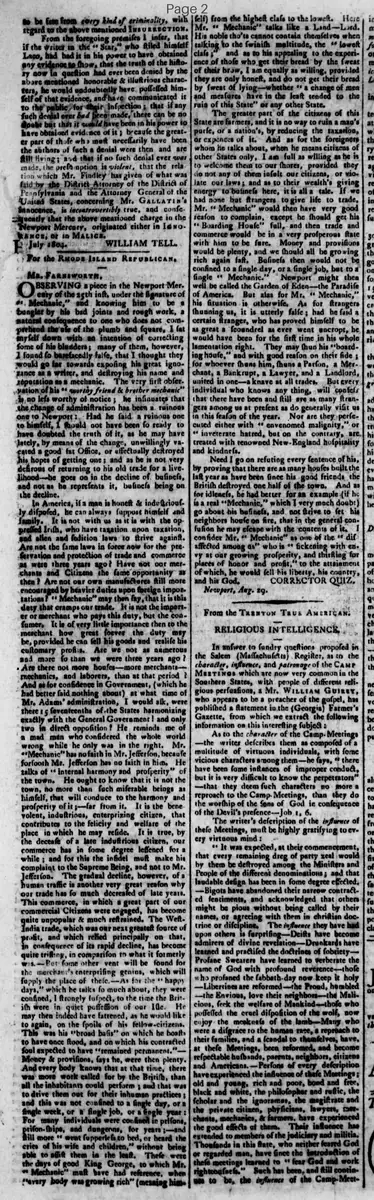
OBSERVING a piece in the Newport-Mercury of the 25th inst. under the signature of "A. Mechanic," and knowing him to be a bungler by his bad joints and rough work, a natural consequence to one who does not comprehend the use of the plumb and square, I sat me down with an intention of correcting some of his blunders; many of them, however, I found so barefacedly false, that I thought they would go far towards exposing his great ignorance as a writer, and destroying his name and reputation as a mechanic. The very first observation of his "worthy friend & brother mechanic" does no less worthy of notice; he insinuates that the change of administration has been a ruinous one to Newport. Had he said a ruinous one to himself, I should not have been so ready to have doubted the truth of it, as he may have lately, by means of the change, unwillingly vacated a good fat Office, or effectually destroyed his hopes of getting one; and as he is not very desirous of returning to his old trade for a livelihood—he goes on in the decline of business, and not as he represents it, business being on the decline.
In America, if a man is honest & industriously disposed, he can always support himself and family. It is not with us as it is with the oppressed Irish, who have taxation upon taxation, and alien and sedition laws to strive against. Are not the same laws in force now for the preservation and protection of trade and commerce as were three years ago? Have not our merchants and citizens the same opportunity as then? Are not our own manufactures still more encouraged by heavier duties upon foreign importations? "Mechanic" may then say, that it is this duty that cramps our trade. It is not the importer or merchant who pays this duty, but the consumer. It is of very little importance then to the merchant how great soever the duty may be, provided he can sell his goods and realize his customary profits. Are we not as numerous and more so than we were three years ago? Are there not more houses—more merchants—mechanics, and laborers, than at that period? And as for confidence in Government, (which he had better said nothing about) at what time of Mr. Adams' administration, I would ask, were there 17/18ths of the States harmonizing exactly with the General Government? and only two in direct opposition? He reminds me of a mad man who considered the whole world wrong while he only was in the right. Mr. "Mechanic" has no faith in Mr. Jefferson, because forsooth Mr. Jefferson has no faith in him. He talks of "internal harmony and prosperity" of the town. He ought to know that it is not the town, no more than such miserable beings as himself, that will conduce to the harmony and prosperity of it;—far from it. It is the benevolent, industrious, enterprising citizen, that contributes to the felicity and welfare of the place in which he may reside. It is true, by the decease of a late industrious citizen, our commerce has in some degree lessened for a while; and for this the infidel must make his complaint to the Supreme Being, and not to Mr. Jefferson. The gradual decline, however, of a human traffic is another very great reason why our trade has so much decreased of late years. This commerce, in which a great part of our commercial citizens were engaged, has become quite unpopular & much restrained. The West-India trade, which was our next greatest source of profit, and which relied principally on that, in consequence of its rapid decline, has become quite trifling, in comparison to what it formerly was.—But some other vent will be found for the merchant's enterprising genius, which will supply the place of these.—As for the "happy days," which he talks so much about, they were confined, I strongly suspect, to the time the British were in quiet possession of our Isle. He may then indeed have fattened, as he would like to again, on the spoils of his fellow-citizens. This was his "broad basis" on which he boasts to have once stood, and on which his contracted soul expected to have "remained permanent."
Money & provisions, says he, were then plenty. And every body knows that at that time, there was more work called for by the British, than all the inhabitants could perform; and that was to drive them out for their inhuman practices; and this was not confined to a single day, or a single week, or a single job, or a single year: For many individuals were confined in prison, prison-ships, and dungeons, for years;—and still more "went supperless to bed, or heard the cries of his wife and children," without being able to assist them in the least. These were the days of good King George, to which Mr. "Mechanic" must have had reference, when "every body was growing rich" (meaning himself) from the highest class to the lowest. Here Mr. "Mechanic" talks like a Land-Lord. His noble thoughts cannot contain themselves when talking to the swinish multitude, the "lowest class" and as to his appealing to the experience of those who get their bread by the sweat of their brow, I am equally as willing, provided they are only honest, and do not get their bread by sweat of lying whether "a change of men and measures have in the least tended to the ruin of this State" or any other State.
The greater part of the citizens of this State are farmers, and it is no way to ruin a man's purse, or a nation's, by reducing the taxation, or expenses of it.— And as for the foreigners whom he talks about, when he means citizens of other States only, I am full as willing as he is to welcome them to our shores, provided they do not any of them insult our citizens, or violate our laws; and as to their wealth's giving energy to business here, it is all a tale. If we had none but strangers to give life to trade, Mr. "Mechanic" would then have very good reason to complain, except he should get his "Boarding House" full,—and then trade and commerce would be in a very prosperous state with him to be sure. Money and provisions would be plenty, and we should all be growing rich again fast. Business then would not be confined to a single day, or a single job, but to a single "Mechanic." Newport might then well be called the Garden of Eden—the Paradise of America. But alas for Mr. "Mechanic," his situation is otherwise. As for strangers shunning us, it is utterly false; had he said a certain stranger, who has proved himself to be as great a scoundrel as ever went unwhipt, he would have been for the first time in his whole lamentation right. They may shun his "boarding house," and with good reason on their side; for whoever shuns him, shuns a Parson, a Merchant, a Bankrupt, a Lawyer, and a Landlord, united in one—a knave at all trades. But every individual who knows any thing, will confess that there have been and still are as many travellers among us at present as do generally visit us in this season of the year. Nor are they persecuted either with "envenomed malignity," or "inveterate hatred," but on the contrary, are treated with renowned New-England hospitality and kindness.
Need I go on refuting every sentence of his, by proving that there are as many houses built the last year as have been since his good friends the British destroyed one half of the town. And as for idleness, he had better for an example (if he is a real "Mechanic" which I very much doubt) go about his business, and not strive to set his neighbor's house on fire, that in the general conflagration he may scoop with the contents of it. I consider Mr. "Mechanic" as one of the "disaffected among us" who is "sickening with envy at our growing prosperity, and thirsting for places of honor and profit," to the attainment of which, he would sell his liberty, his country, and his God.
CORRECTOR QUIZ.
Newport, Aug. 29.
What sub-type of article is it?
What themes does it cover?
What keywords are associated?
What entities or persons were involved?
Letter to Editor Details
Author
Corrector Quiz
Recipient
Mr. Farnsworth
Main Argument
the change to jefferson's administration has not ruined newport's economy or trade; conditions for business and prosperity remain favorable, and 'a. mechanic''s criticisms arise from personal envy, lost opportunities, or nostalgia for british occupation profiteering.
Notable Details