Thank you for visiting SNEWPapers!
Sign up free
The North Carolinian
Fayetteville, Cumberland County, North Carolina
What is this article about?
A military court in Washington City tried Brevet Brig. Gen. George Talcott, Colonel of Ordnance, on charges of violating regulations, disobeying orders, and unbecoming conduct related to an unauthorized cannon balls contract. He was found guilty and dismissed from service, with the President approving the decision and criticizing Brevet Col. Huger.
Clipping
OCR Quality
Full Text
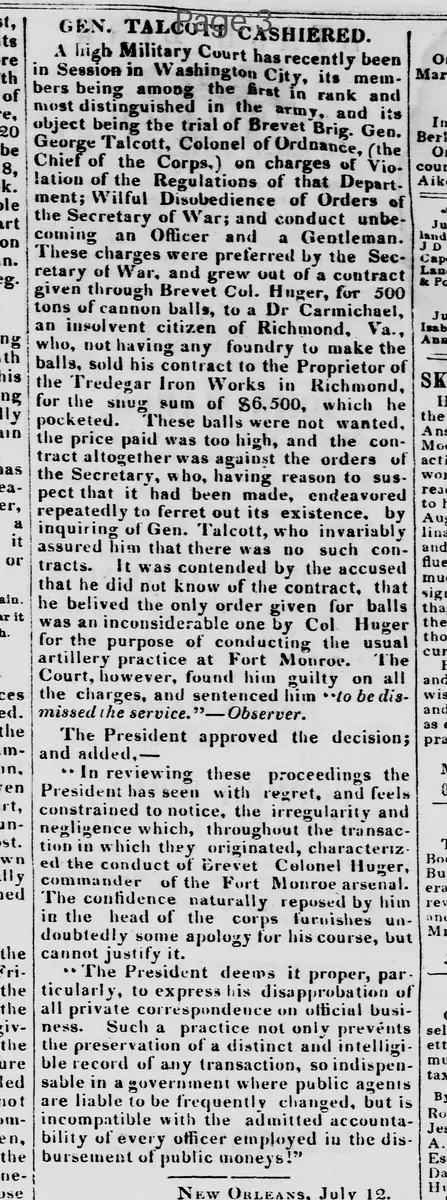
A High Military Court has recently been in Session in Washington City, its members being among the first in rank and most distinguished in the army, and its object being the trial of Brevet Brig. Gen. George Talcott, Colonel of Ordnance, (the Chief of the Corps,) on charges of Violation of the Regulations of that Department; Wilful Disobedience of Orders of the Secretary of War; and conduct unbecoming an Officer and a Gentleman.
These charges were preferred by the Secretary of War, and grew out of a contract given through Brevet Col. Huger, for 500 tons of cannon balls, to a Dr. Carmichael, an insolvent citizen of Richmond, Va., who, not having any foundry to make the balls, sold his contract to the Proprietor of the Tredegar Iron Works in Richmond, for the snug sum of $6,500, which he pocketed. These balls were not wanted, the price paid was too high, and the contract altogether was against the orders of the Secretary, who, having reason to suspect that it had been made, endeavored repeatedly to ferret out its existence, by inquiring of Gen. Talcott, who invariably assured him that there was no such contract. It was contended by the accused that he did not know of the contract, that he believed the only order given for balls was an inconsiderable one by Col. Huger for the purpose of conducting the usual artillery practice at Fort Monroe. The Court, however, found him guilty on all the charges, and sentenced him to be dismissed the service.—Observer.
The President approved the decision; and added,
In reviewing these proceedings the President has seen with regret, and feels constrained to notice, the irregularity and negligence which, throughout the transaction in which they originated, characterized the conduct of Brevet Colonel Huger, commander of the Fort Monroe arsenal.
The confidence naturally reposed by him in the head of the corps furnishes undoubtedly some apology for his course, but cannot justify it.
The President deems it proper, particularly, to express his disapprobation of all private correspondence on official business. Such a practice not only prevents the preservation of a distinct and intelligible record of any transaction, so indispensable in a government where public agents are liable to be frequently changed, but is incompatible with the admitted accountability of every officer employed in the disbursement of public moneys!
What sub-type of article is it?
What keywords are associated?
What entities or persons were involved?
Where did it happen?
Domestic News Details
Primary Location
Washington City
Event Date
Recently
Key Persons
Outcome
found guilty on all charges and sentenced to be dismissed the service. president approved the decision and noted irregularity in brevet col. huger's conduct.
Event Details
A High Military Court tried Brevet Brig. Gen. George Talcott on charges preferred by the Secretary of War arising from an unauthorized contract for 500 tons of cannon balls given through Brevet Col. Huger to Dr. Carmichael, who sold it to the Tredegar Iron Works. Talcott denied knowledge of the contract. The court found him guilty.