Thank you for visiting SNEWPapers!
Sign up free
The Colfax Chronicle
Colfax, Grant County, Louisiana
What is this article about?
The Philadelphia Record reports vast amounts of meat, fish, fruits, eggs, butter, and other foods stored in 558 U.S. cold storage plants, totaling $3 billion annually, enough to supply each family with two carcasses. Commentary suggests much is held long-term to maintain high prices, potentially unfit for consumption, calling for federal and state regulations including time limits and inspections.
Clipping
OCR Quality
Full Text
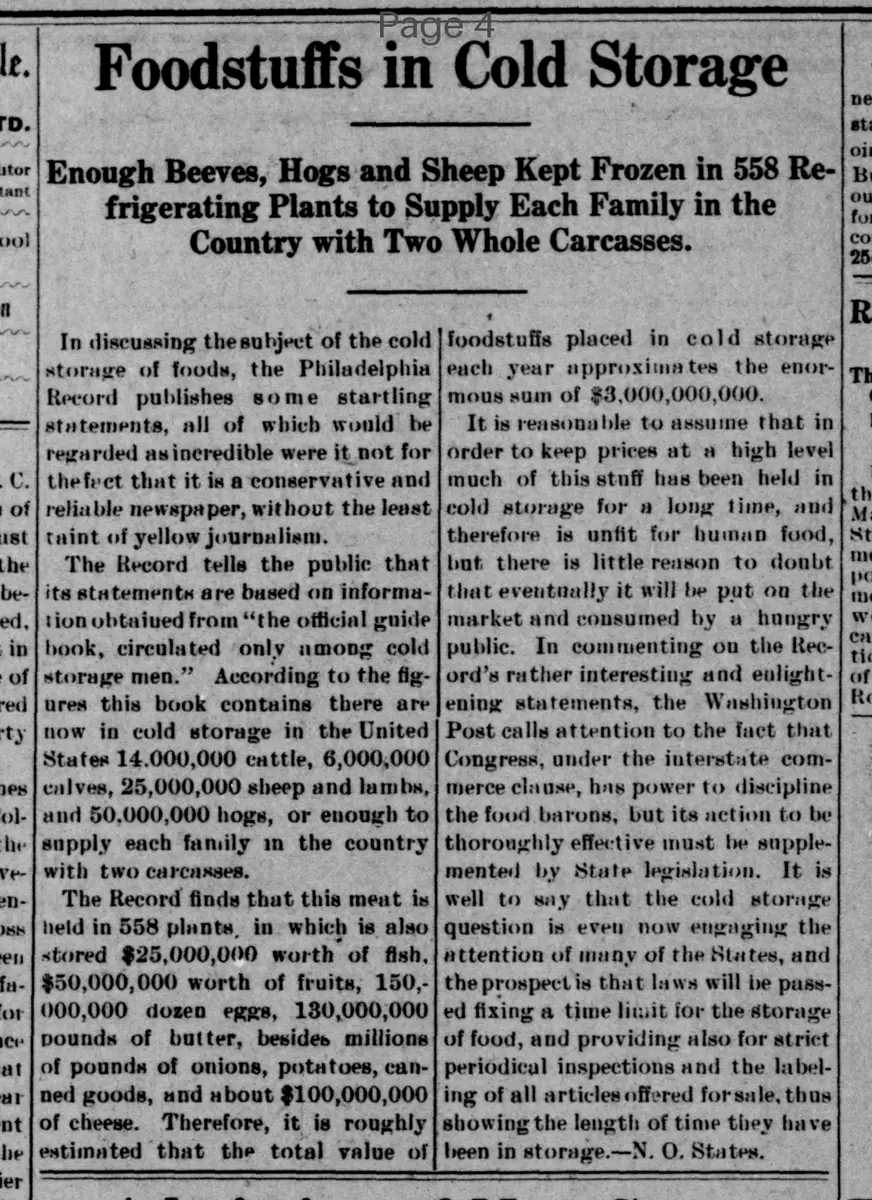
Enough Beeves, Hogs and Sheep Kept Frozen in 558 Refrigerating Plants to Supply Each Family in the Country with Two Whole Carcasses.
In discussing the subject of the cold storage of foods, the Philadelphia Record publishes some startling statements, all of which would be regarded as incredible were it not for the fact that it is a conservative and reliable newspaper, without the least taint of yellow journalism.
The Record tells the public that its statements are based on information obtained from the official guide book, circulated only among cold storage men. According to the figures this book contains there are now in cold storage in the United States 14,000,000 cattle, 6,000,000 calves, 25,000,000 sheep and lambs, and 50,000,000 hogs, or enough to supply each family in the country with two carcasses.
The Record finds that this meat is held in 558 plants, in which is also stored $25,000,000 worth of fish, $50,000,000 worth of fruits, 150,000,000 dozen eggs, 130,000,000 pounds of butter, besides millions of pounds of onions, potatoes, canned goods, and about 100,000,000 of cheese. Therefore, it is roughly estimated that the total value of foodstuffs placed in cold storage each year approximates the enormous sum of $3,000,000,000.
It is reasonable to assume that in order to keep prices at a high level much of this stuff has been held in cold storage for a long time, and therefore is unfit for human food. But there is little reason to doubt that eventually it will be put on the market and consumed by a hungry public. In commenting on the Record's rather interesting and enlightening statements, the Washington Post calls attention to the fact that Congress, under the interstate commerce clause, has power to discipline the food barons, but its action to be thoroughly effective must be supplemented by State legislation. It is well to say that the cold storage question is even now engaging the attention of many of the States, and the prospect is that laws will be passed fixing a time limit for the storage of food, and providing also for strict periodical inspections and the labeling of all articles offered for sale, thus showing the length of time they have been in storage.—N. O. States.
What sub-type of article is it?
What themes does it cover?
What keywords are associated?
Where did it happen?
Story Details
Location
United States
Story Details
Reports on enormous quantities of meat and other foodstuffs stored in 558 U.S. cold storage plants, valued at $3 billion annually, sufficient to supply each family with two carcasses; suggests prolonged storage maintains high prices and renders food unfit, urging federal and state laws for time limits, inspections, and labeling.