Thank you for visiting SNEWPapers!
Sign up free
Gazette Of The United States, & Philadelphia Daily Advertiser
Philadelphia, Philadelphia County, Pennsylvania
What is this article about?
On December 27, the U.S. House of Representatives recommitted a Stamp Act amendment bill, passed census and state balances bills, postponed the Bankrupt bill, and debated a resolution to penalize unauthorized foreign negotiations, adjourning without decision. Key speakers included Otis, Griswold, and Nicholas.
Clipping
OCR Quality
Full Text
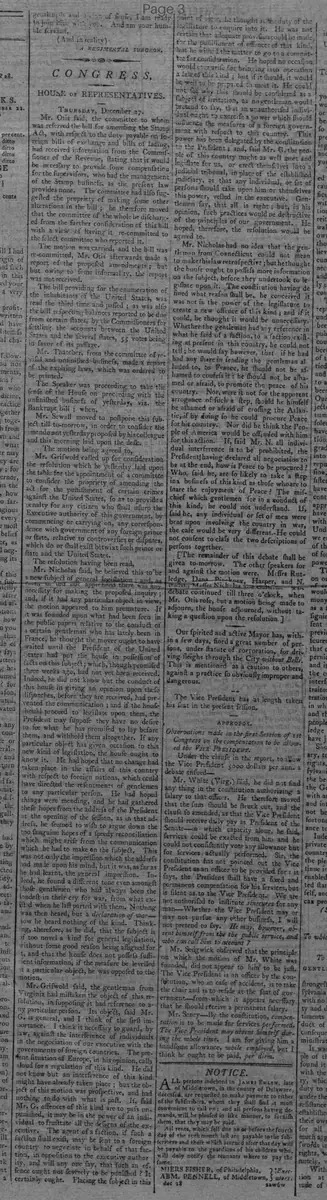
HOUSE OF REPRESENTATIVES.
Thursday, December 27
Mr. Otis said, the committee to whom was referred the bill for amending the Stamp Act, with respect to the duty payable on foreign bills of exchange and bills of lading, had received information from the Commissioner of the Revenue, stating that it would be necessary to provide some compensation for the supervisors, who had the management of the Stamp business, as the present law provides none. The committee had also suggested the propriety of making some other alterations in the bill; he therefore moved that the committee of the whole be discharged from the farther consideration of this bill with a view of having it re-committed to the select committee who reported it.
The motion was carried, and the bill was re-committed, Mr. Otis afterwards made a report of the proposed amendments; but owing to some informality, the report was not received.
The bill providing for the enumeration of the inhabitants of the United States, was read the third time and passed; as was also the bill respecting balances reported to be due from certain states, by the Commissioners for settling the accounts between the United States and the several states, 5s votes being in favor of its passage.
Mr. Thatcher, from the committee of revisal and unfinished business, made a report of the expiring laws, which was ordered to be printed.
The Speaker was proceeding to take the sense of the House on proceeding with the unfinished business of yesterday, viz. the Bankrupt bill; when,
Mr. Sewall moved to postpone this subject till to-morrow, in order to consider the amendment yesterday proposed by his colleague and this morning laid upon the desk.
The motion being agreed to,
Mr. Griswold called up for consideration the resolution which he yesterday laid upon the table for the appointment of a committee to consider the propriety of amending the act for the punishment of certain crimes against the United States, so as to provide a penalty for any citizen who shall usurp the Executive authority of this government, by commencing or carrying on, any correspondence with government of any foreign prince or state, relative to controversies or disputes, which do or shall exist betwixt such prince or state and the United States.
The resolution having been read,
Mr. Nicholas said, he believed this to be a new subject of general legislation: and as he did not apprehend there was any necessity for making the proposed inquiry; and, if it had any particular object in view, the motion appeared to him premature. If it was founded upon what had been seen in the public papers relative to the conduct of a certain gentleman who has lately been in France, he thought the mover ought to have waited until the President of the United States had put the house in possession of facts on this subject; which, though promised three weeks ago, had not yet been received. Indeed, he did not know but the conduct of this house in giving an opinion upon these dispatches, before they are received, had prevented the communication; and if the house should proceed to legislate upon them, the President may suppose they have no desire to see what he has promised to lay before them, and withhold them altogether. If any particular object has given occasion to this new kind of legislation, the house ought to know it. He had hoped that no change had taken place in the affairs of this country with respect to foreign nations, which could have directed the resentments of gentlemen to any particular person, He had hoped things were mending, and he had gathered these hopes from the address of the President at the opening of the session, as in that address, he seemed to wish to argue down the too sanguine hopes of a speedy reconciliation which might arise from the communication which he had to make on the subject. This was not only the impression which the address had made upon his mind, but it was, as far as he had learnt, the general impression. Indeed, he found a different tone even amongst those gentlemen who had always been the loudest in their cry for war, from what existed when he last parted with them. Nothing was then heard, but a declaration of war--now he heard nothing of the kind. Thinking, therefore, as he did, that the subject is of too novel a kind for general legislation, without some good reason being assigned for it, and that the house does not possess sufficient information, if the measure be levelled at a particular object, he was opposed to the motion.
Mr. Griswold said, the gentleman from Virginia had mistaken the object of this resolution, in supposing it had reference to any particular person. Its object, said Mr. G. is general, and I think of the first importance. I think it necessary to guard, by law, against the interference of individuals in the negociation of our executive with the governments of foreign countries. The present situation of Europe, in his opinion, calls aloud for a regulation of this kind.He did not know but an interference of this kind might have already taken place; but the object of this motion was prospective, and had nothing to do with what is past. If, said Mr. G. offences of this kind are to pass unpunished, it may be in the power of an individual to frustrate all the designs of the executive. The agent of a faction, if such a faction shall exist, may be sent to a foreign country to negotiate in behalf of that faction, in opposition to the executive authority, and will any one say, that such an offence ought not severely to be punished? It certainly ought. Placing the subject in this point of view, he thought it the duty of the legislature to enquire into it. He was not certain that adequate provision could be made for the punishment of offences of this kind, but he wished the matter to go to a committee for consideration. He hoped no occasion would arise for bringing into operation a law of this kind; but if it should, it would be well to be prepared to meet it. He could not see why this should be considered as a subject of irritation, as no gentleman would pretend to say, that an unauthorized individual ought to exercise a power which should influence the measures of a foreign government with respect to this country. This power has been delegated by the constitution to the President; and, said Mr. G. the people of this country might as well meet and legislate for us, or erect themselves into a judicial tribunal, in place of the established judiciary, as that any individual, or set of persons should take upon him or themselves this power, vested in the executive. Gentlemen say, this all is right; but, in his opinion, such practices would be destructive of the principles of our government. He hoped, therefore, the resolution would be agreed to.
Mr. Nicholas-had no idea that the gentleman from Connecticut could not mean to make this law retrospective; but he thought the house ought to possess more information on the subject, before they undertook to legislate upon it. The constitution having defined what treason shall be, he conceived it was not in the power of the legislature to create a new offence of this kind; and if it could, he thought it would be unnecessary. Whether the gentleman had any reference in what he said of a faction, to a faction existing at present in this country, he could not tell; he would say however, 'that if he had had any share in sending the gentleman alluded to, to France, he should not be ashamed to confess it : he should not be ashamed or afraid, to promote the peace of his country. Nor, were it not for the apparent arrogance of such a step, should he himself be ashamed or afraid of crossing the Atlantic, if by doing so he could procure Peace for his country. Nor did he think the People of America would be offended with him for this action. If, said Mr. N. all individual interference is to be prohibited, the President having declared all negociation to be at an end, how is Peace to be procured? Who, said he, are so likely to take a step in a business of this kind as those who are to share the enjoyment of Peace? The mischief which gentlemen see in a conduct of this kind, he could not understand. If, said he, any individual or set of men were bent upon involving the country in war, the case would be very different.-He could not consent to class the two descriptions of persons together.
The remainder of this debate shall be given to-morrow. The other speakers for and against the motion were. Mess. Rutledge, Dana. Pinckney, Harper, and N. Smith, Messrs Nicholas and Claiborne.
Debate continued till three o'clock, when Mr. Otis rose, but a motion being made to adjourn, the house adjourned, without taking a question upon the resolution.
What sub-type of article is it?
What keywords are associated?
What entities or persons were involved?
Where did it happen?
Domestic News Details
Primary Location
United States House Of Representatives
Event Date
Thursday, December 27
Key Persons
Outcome
bill amending stamp act recommitted with proposed amendments; bill for enumeration of inhabitants passed; bill respecting balances due from states passed; report of expiring laws ordered printed; bankrupt bill postponed; debate on resolution for committee to consider amending act on crimes against united states adjourned without decision.
Event Details
In the House of Representatives, the committee on the Stamp Act amendment bill received information on compensating supervisors and suggested alterations, leading to its recommittal. The census bill and balances due bill passed. A report on expiring laws was printed. The Bankrupt bill was postponed. Debate ensued on Mr. Griswold's resolution to appoint a committee for amending the crimes act to penalize citizens usurping executive authority via foreign correspondence, with arguments from Mr. Nicholas and Mr. Griswold; adjourned without vote.