Thank you for visiting SNEWPapers!
Sign up free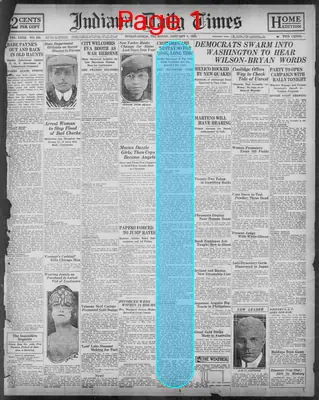
Story
January 8, 1920
Indiana Daily Times
Indianapolis, Marion County, Indiana
What is this article about?
Indianapolis street cars remain severely overcrowded due to a 40% traffic increase since 1918, while facilities have only improved 2%. Past financial disputes blocked new car purchases, and current management prioritizes dividends over expansion, delaying relief until mid-summer at earliest.
Clipping

OCR Quality
98%
Excellent
Full Text
CROWDED CARS TO STAY SO FOR LONG, LONG TIME
Traffic Increases 40 Per Cent. While Facilities Are Improved 2 Per Cent.
YET, DIVIDENDS COME
The resident of Indianapolis who is frequently one of the 125 to 190 passengers who attempt to ride either to or from work on one street car might as well make up his mind to grin and bear it, for the rest of this winter, at least.
There is no immediate relief in sight from the congestion that has resulted from the lack of proper facilities on the part of the Indianapolis Street Railway Company. Indianapolis street cars are overcrowded simply because there are not enough street cars in Indianapolis to haul the crowds that want to ride.
How utterly inadequate is the rolling stock of the company at the present moment is well illustrated by the fact that, although the traffic increased 25 per cent in 1918 over the previous year there were no new cars added to the service. And although it increased nearly 25 per cent in 1919 over 1918 the only new cars added were less than a half dozen borrowed from Terre Haute.
The street car company isn't giving out any figures on the subject, but it is not necessary to have access to its records to know that the street car traffic in Indianapolis has increased approximately 40 per cent since the public service commission shook up the operating department, and that the facilities for hauling passengers have increased not more than 2 per cent in that same time.
The result is that street cars which used to be crowded are no longer merely crowded. They are jammed to the last inch of available space before they complete the downtown loops and they go sailing by hundreds of perfectly good passengers with their nickels in their hands, who would gladly donate to the dividend fund of the Indianapolis Street Railway Company if they get close enough to a conductor to hand him their fares.
It isn't the intent here to define whose fault that is. Fixing the responsibility for the errors of the past will not get any one a foothold on a street car. But it might be well to say that the present inadequacy of the rolling stock of the Indianapolis street car system has not come unsuspected or without due warning.
NEED FOR NEW CARS LONG EVIDENT.
Long before the local interests that were intent on making foreign capital wish it had never come into Indianapolis succeeded in freezing the "Philadelphia crowd" out of the control of the local company, the need for new cars was apparent. Orders had been placed for cars. The price was particularly advantageous and the prospects of getting rolling stock sufficient to relieve what was then a desperate situation were bright.
Then the stock-jobbing began. Every effort of the traction and terminal company to get the money necessary to pay for these new cars was blocked. Men who willingly paid doubled prices for their cigars loudly howled against the "injustice" of paying 25 per cent more for their street car rides. The story is a long one. It is sufficient to say that in the interval when the street car company was waiting for the community to become sane enough to realize that 5-cent fares were just and reasonable, it lost its new cars from sheer inability to raise the money with which to pay for them.
So today, Indianapolis has the 5-cent fare, but it hasn't the street cars. And what is worse it will not have the street cars this winter.
The traction company has an order on file for new street cars with the Cincinnati Car Company. It will be filled when the car builders get good and ready to fill it. If the Indianapolis company does not like it the Indianapolis company can go somewhere else after its cars. The Cincinnati builders have all the work they desire anyhow.
The traction company also has some cars coming from the Barney Smith shops at Dayton. These are summer cars that are being rebuilt into the standardized type for this city. They were rolled to the Barney Smith company some time ago. They have been there long enough to be rebuilt several times. But there were reasons, financial, labor and otherwise why the Barney Smith company did not hurry.
When all these cars on order are running in Indianapolis, which will probably be along about the middle of the summer, and not much before, there will not be enough cars in service to give a reasonably good service to the people of Indianapolis.
Combining the cars that are ordered with about 100 more that are needed and not ordered, the system in Indianapolis would be in a position to care for the people who would ride. Therefore, when the new cars are in service the system will not be more than 100 cars short of having enough to give proper transportation facilities in Indianapolis.
Indianapolis will get more cars eventually, but it will not be before the rigors of next winter call attention to their absence, if then.
AND THEN THERE'S THOSE DIVIDENDS.
Under the terms of that delightful merger which the public service commission approved last summer the local street car company must pay dividends on the stock in the hands of those who formerly held street railway stock or the traction and terminal stock holders will obtain a voice in the management of the company. The old street railway stockholders control the company as it now stands. They propose to retain that control. Therefore they will continue to pay themselves their dividends. When money is required for dividends it can not be spent for new cars. Without money new cars can not be obtained. Without new cars greater revenue will not be derived from the present rate of fare. Consequently about the only chance that the people of Indianapolis have of obtaining more cars is to buy them out of their own pockets. And while the public-spirited gentlemen who are now operating the street car system are getting their dividends regularly it is not conceivable that the public of Indianapolis will pay for more cars in the form of increased fare. These said public-spirited gentlemen know that. That is why they are not today beseeching the public service commission for authority to increase fares.
Indianapolis street cars will be crowded for at least two years and probably much longer. They will be crowded because they are few in number and will be too few in number when all the promised cars are in operation.
This condition will continue very active until summer. Then it will be partly relieved. By next winter the increase in the population of extensions promised last year will have made the crowded car conditions acute again.
There is only one remedy for the situation and that remedy is more cars. No one has heard Dr. Jameson express any intention of buying any more cars soon.
Traffic Increases 40 Per Cent. While Facilities Are Improved 2 Per Cent.
YET, DIVIDENDS COME
The resident of Indianapolis who is frequently one of the 125 to 190 passengers who attempt to ride either to or from work on one street car might as well make up his mind to grin and bear it, for the rest of this winter, at least.
There is no immediate relief in sight from the congestion that has resulted from the lack of proper facilities on the part of the Indianapolis Street Railway Company. Indianapolis street cars are overcrowded simply because there are not enough street cars in Indianapolis to haul the crowds that want to ride.
How utterly inadequate is the rolling stock of the company at the present moment is well illustrated by the fact that, although the traffic increased 25 per cent in 1918 over the previous year there were no new cars added to the service. And although it increased nearly 25 per cent in 1919 over 1918 the only new cars added were less than a half dozen borrowed from Terre Haute.
The street car company isn't giving out any figures on the subject, but it is not necessary to have access to its records to know that the street car traffic in Indianapolis has increased approximately 40 per cent since the public service commission shook up the operating department, and that the facilities for hauling passengers have increased not more than 2 per cent in that same time.
The result is that street cars which used to be crowded are no longer merely crowded. They are jammed to the last inch of available space before they complete the downtown loops and they go sailing by hundreds of perfectly good passengers with their nickels in their hands, who would gladly donate to the dividend fund of the Indianapolis Street Railway Company if they get close enough to a conductor to hand him their fares.
It isn't the intent here to define whose fault that is. Fixing the responsibility for the errors of the past will not get any one a foothold on a street car. But it might be well to say that the present inadequacy of the rolling stock of the Indianapolis street car system has not come unsuspected or without due warning.
NEED FOR NEW CARS LONG EVIDENT.
Long before the local interests that were intent on making foreign capital wish it had never come into Indianapolis succeeded in freezing the "Philadelphia crowd" out of the control of the local company, the need for new cars was apparent. Orders had been placed for cars. The price was particularly advantageous and the prospects of getting rolling stock sufficient to relieve what was then a desperate situation were bright.
Then the stock-jobbing began. Every effort of the traction and terminal company to get the money necessary to pay for these new cars was blocked. Men who willingly paid doubled prices for their cigars loudly howled against the "injustice" of paying 25 per cent more for their street car rides. The story is a long one. It is sufficient to say that in the interval when the street car company was waiting for the community to become sane enough to realize that 5-cent fares were just and reasonable, it lost its new cars from sheer inability to raise the money with which to pay for them.
So today, Indianapolis has the 5-cent fare, but it hasn't the street cars. And what is worse it will not have the street cars this winter.
The traction company has an order on file for new street cars with the Cincinnati Car Company. It will be filled when the car builders get good and ready to fill it. If the Indianapolis company does not like it the Indianapolis company can go somewhere else after its cars. The Cincinnati builders have all the work they desire anyhow.
The traction company also has some cars coming from the Barney Smith shops at Dayton. These are summer cars that are being rebuilt into the standardized type for this city. They were rolled to the Barney Smith company some time ago. They have been there long enough to be rebuilt several times. But there were reasons, financial, labor and otherwise why the Barney Smith company did not hurry.
When all these cars on order are running in Indianapolis, which will probably be along about the middle of the summer, and not much before, there will not be enough cars in service to give a reasonably good service to the people of Indianapolis.
Combining the cars that are ordered with about 100 more that are needed and not ordered, the system in Indianapolis would be in a position to care for the people who would ride. Therefore, when the new cars are in service the system will not be more than 100 cars short of having enough to give proper transportation facilities in Indianapolis.
Indianapolis will get more cars eventually, but it will not be before the rigors of next winter call attention to their absence, if then.
AND THEN THERE'S THOSE DIVIDENDS.
Under the terms of that delightful merger which the public service commission approved last summer the local street car company must pay dividends on the stock in the hands of those who formerly held street railway stock or the traction and terminal stock holders will obtain a voice in the management of the company. The old street railway stockholders control the company as it now stands. They propose to retain that control. Therefore they will continue to pay themselves their dividends. When money is required for dividends it can not be spent for new cars. Without money new cars can not be obtained. Without new cars greater revenue will not be derived from the present rate of fare. Consequently about the only chance that the people of Indianapolis have of obtaining more cars is to buy them out of their own pockets. And while the public-spirited gentlemen who are now operating the street car system are getting their dividends regularly it is not conceivable that the public of Indianapolis will pay for more cars in the form of increased fare. These said public-spirited gentlemen know that. That is why they are not today beseeching the public service commission for authority to increase fares.
Indianapolis street cars will be crowded for at least two years and probably much longer. They will be crowded because they are few in number and will be too few in number when all the promised cars are in operation.
This condition will continue very active until summer. Then it will be partly relieved. By next winter the increase in the population of extensions promised last year will have made the crowded car conditions acute again.
There is only one remedy for the situation and that remedy is more cars. No one has heard Dr. Jameson express any intention of buying any more cars soon.
What sub-type of article is it?
Editorial
Social Critique
What themes does it cover?
Misfortune
Justice
What keywords are associated?
Streetcar Overcrowding
Indianapolis Transportation
Traffic Increase
New Cars Delay
Dividends Priority
What entities or persons were involved?
Dr. Jameson
Indianapolis Street Railway Company
Where did it happen?
Indianapolis
Story Details
Key Persons
Dr. Jameson
Indianapolis Street Railway Company
Location
Indianapolis
Event Date
1919
Story Details
Street cars in Indianapolis are overcrowded due to traffic growth outpacing vehicle additions, past blocks on funding for new cars from financial disputes and opposition to fare increases, and current prioritization of dividends over expansion, ensuring continued congestion for years.