Thank you for visiting SNEWPapers!
Sign up free
The Massachusetts Spy, And Worcester County Advertiser
Worcester, Worcester County, Massachusetts
What is this article about?
Proceedings of the Massachusetts General Court from January 8 to 14, covering Senate and House sessions with committee instructions on education, finance, ecclesiastical witnesses, manufactures, tariff resolutions on woollen industry protection, boundary documents, petitions, and debates resulting in passage of resolutions 150-94.
Clipping
OCR Quality
Full Text
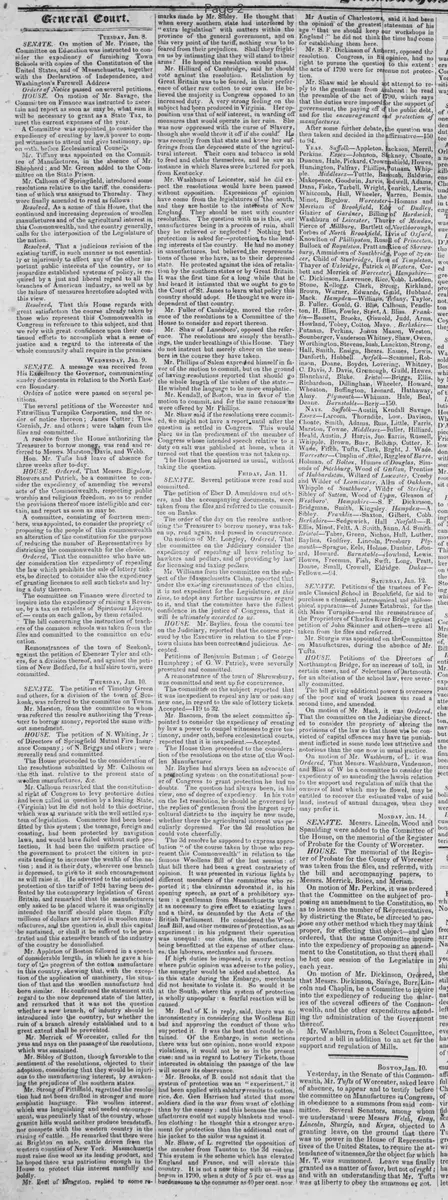
Tuesday, Jan. 8.
SENATE. On motion of Mr. Prince, the Committee on Education was instructed to consider the expediency of furnishing Town Schools with copies of the Constitution of the United States, and of Massachusetts, together with the Declaration of Independence, and Washington's Farewell Address.
Orders of Notice passed on several petitions.
HOUSE. On motion of Mr. Savage, the Committee on Finance was instructed to ascertain and report as soon as may be, what sum it will be necessary to grant as a State Tax, to meet the current expenses of the year.
A Committee was appointed to consider the expediency of creating by law, a power to compel witnesses to attend and give testimony, upon oath, before Ecclesiastical Councils.
Mr. Tiffany was appointed on the Committee of Manufactures, in the absence of Mr. Shepherd; and Mr. Green added to the Committee on the State Prison.
Mr. Calhoun of Springfield, introduced some resolutions relative to the tariff, the consideration of which was assigned to Thursday. They were finally amended to read as follows:
Resolved, As the sense of this House, that the continued and increasing depression of woollen manufactures and of the agricultural interest in this Commonwealth, and the country generally, calls for the interposition of the Legislature of the nation.
Resolved, That a judicious revision of the existing tariff, in such manner as not essentially or injuriously to affect any of the other important public interests of the country, or to jeopardize established systems of policy, is required by a just and liberal regard to all the branches of American industry, as well as by the failure of measures heretofore adopted with this view.
Resolved, That this House regards with great satisfaction the course already taken by those who represent this Commonwealth in Congress in reference to this subject, and that we rely with great confidence upon their continued efforts to accomplish what a sense of justice and a regard to the interests of the whole community shall require in the premises.
Wednesday, Jan. 9.
SENATE. A message was received from His Excellency the Governor, communicating sundry documents in relation to the North Eastern Boundary.
Orders of notice were passed on several petitions.
The several petitions of the Worcester and Fitzwilliam Turnpike Corporation, and the order of notice thereon; James Cutter; Thos. Cornish, Jr. and others; were taken from the files and committed.
A resolve from the House authorizing the Treasurer to borrow money, was read and referred to Messrs. Marston, Davis, and Webb.
Hon. Mr. Tufts had leave of absence for three weeks after to-day.
HOUSE. Ordered, That Messrs. Bigelow, Stowers and Patrick, be a committee to consider the expediency of amending the several acts of the Commonwealth, respecting public worship and religious freedom, so as to render the provisions thereof more intelligible and certain, and report as soon as may be.
A committee, consisting of fourteen members, was appointed, to consider the propriety of proposing to the people of this commonwealth an alteration of the constitution for the purpose of reducing the number of Representatives by districting the commonwealth for the choice.
Ordered, That the committee who have under consideration the expediency of repealing the law which prohibits the sale of lottery tickets, be directed to consider also the expediency of granting licenses to sell such tickets and laying a duty thereon.
The committee on Finance were directed to inquire into the expediency of raising a Revenue, by a tax on retailers of Spirituous Liquors, of 5 cents on each gallon, by them retailed.
The bill concerning the instruction of teachers of the common schools was taken from the files and committed to the committee on education.
Remonstrances of the town of Seekonk, against the petition of Ebenezer Tyler and others, for a division thereof, and against the petition of New Bedford, for a half shire town, were committed.
Thursday, Jan. 10.
SENATE. The petition of Timothy Green and others, for a division of the town of Seekonk, was referred to the committee on Towns.
Mr. Marston, from the committee to whom was referred the resolve authorizing the Treasurer to borrow money, reported the same without amendment.
HOUSE. The petition of N. Whiting, Jr.; of Directors of Springfield Mutual Fire Insurance Company; of N. Briggs and others; were severally read and committed.
The House proceeded to the consideration of the resolutions submitted by Mr. Calhoun on the 8th inst. relative to the present state of woollen manufactures, &c.
Mr. Calhoun remarked that the constitutional right of Congress to levy protective duties had been called in question by a leading State (Virginia) but he did not hold to this doctrine, which was at variance with the well settled system of legislation. Commerce had been benefited by this system; the tonnage, foreign and coasting, had been protected by navigation laws, and would have failed without such protection. It had been the uniform practice of the government to protect the citizen in pursuits tending to increase the wealth of the nation; and it is their duty, wherever one branch is depressed, to give to it such encouragement as will raise it. He adverted to the anticipated protection of the tariff of 1824 having been defeated by the cotemporary legislation of Great Britain, and remarked that the manufacturers only asked to be placed where it was originally intended the tariff should place them. Fifty millions of dollars are invested in woollen manufactures, and the question is, shall this capital be sustained, or shall it be suffered to be prostrated and this extensive branch of the industry of the country be demolished.
Mr. Appleton of Boston followed in a speech of considerable length, in which he gave a history of the progress of the cotton manufacture in this country, shewing that, with the exception of the application of machinery, the situation of that and the woollen manufacture had been similar. He confirmed the statement with regard to the now depressed state of the latter, and remarked that it was not the question whether a new branch of industry should be introduced into the country, but whether the ruin of a branch already established and to a great extent shall be prevented.
Mr. Merrick of Worcester, called for the yeas and nays on the passage of the resolutions, which was sustained.
Mr. Sibley of Sutton, though favorable to the sentiment of the resolutions, objected to their adoption, considering that they would be injurious to the manufacturing interest, by awakening the prejudices of the southern states.
Mr. Strong of Pittsfield, regretted the resolution had not been drafted in stronger and more emphatic language. The woollen interest, which was languishing and needed encouragement, was peculiarly that of the country, whose granite hills would neither produce breadstuffs nor compete with the western country in the raising of cattle. He remarked that there were at Brighton on sale, cattle driven from the western counties of New York. Massachusetts must raise fine wool as its leading product, and he hoped there was patriotism enough in the House to protect this interest manfully and boldly.
Mr. Beal of Kingston, replied to some remarks made by Mr. Sibley. He thought that when every southern state had interfered by 'extra legislation' with matters within the province of the general government, and on this very point of the tariff, nothing was to be feared from their prejudices. Shall they frighten us by intimating that they will stand to their arms? He hoped the resolution would pass.
Mr. Hilliard of Cambridge, said he should vote against the resolution. Retaliation by Great Britain was to be feared, in their preference of other raw cotton to our own. He believed the majority in Congress opposed to an increased duty. A very strong feeling on the subject had been produced in Virginia. Her opposition was that of self interest, in warding off measures that would operate in her ruin. She was now oppressed with the curse of Slavery, though she would throw it off if she could. He was recently from that state and knew her sufferings from the depressed state of the agricultural interest. Their corn and tobacco is sold to feed and clothe themselves, and he saw an instance in which Slaves were bartered for pork from Kentucky.
Mr. Washburn of Leicester, said he did expect the resolutions would have been passed without opposition. Expressions of opinion have come from the legislatures of the south, and they are hostile to the interests of New England. They should be met with counter resolutions. The question with us is this, our manufactures being in a process of ruin, shall they be relieved or neglected? Nothing but protection is asked for—protection to the leading interests of the country. He had no money in manufactures, but believed the representations of those who have, as to their depressed state. He protested against the idea of retaliation by the southern states or by Great Britain. It was the first time for a long while that he had heard it intimated that we ought to go to the Court of St. James to learn what policy this country should adopt. He thought we were independent of that country.
Mr. Fuller of Cambridge, moved the reference of the resolutions to a Committee of the House to consider and report thereon.
Mr. Shaw of Lanesboro', opposed the reference. The resolutions are simply the breathings, the under breathings of this House. They do not instruct but merely cheer on the members in the course they have taken.
Mr. Phillips of Salem expressed himself in favor of the motion to commit, but on the ground of having resolutions reported that should go the whole length of the wishes of the state. He wished the language to be more emphatic.
Mr. Kendall, of Boston, was in favor of the motion to commit, and for the same reasons as were offered by Mr Phillips.
Mr. Shaw said if the resolutions were committed, we might not have a report until after the question is settled in Congress. This would place us in the predicament of the member of Congress whose intended speech relative to a duty on salt was published at home, when it turned out that the question was not taken up.
The House then adjourned as usual, without taking the question.
FRIDAY, Jan. 11.
SENATE. Several petitions were read and committed.
The petition of Eber D. Ammidown and others, and the accompanying documents, were taken from the files and referred to the committee on Banks.
The order of the day on the resolve authorizing the Treasurer to borrow money, was taken up, read again, and passed in concurrence.
On motion of Mr. Longley, Ordered, That the committee on the Judiciary consider the expediency of repealing all laws relating to hawkers and pedlars, and of providing by law for licensing and taxing pedlars.
Mr. Williams from the committee on the subject of the Massachusetts Claim, reported that under the existing circumstances of the claim, it is not expedient for the Legislature, at this time, to adopt any further measures in regard to it, and that the committee have the fullest confidence in the justice of Congress, that it will be ultimately accorded to us.
HOUSE. Mr. Baylies, from the committee on the Judiciary, reported that the course pursued by the Executive in relation to the Freetown claims has been correct and judicious. Accepted.
Petitions of Benjamin Butman; of George Humphrey; of G. W. Patrick, were severally presented and committed.
A remonstrance of the town of Shrewsbury, was committed and sent up for concurrence.
The committee on the subject reported that it was inexpedient to repeal any law or pass any new one, in regard to the sale of lottery tickets. Accepted—119 to 32.
Mr. Bascom, from the select committee appointed to consider the expediency of creating by law a power to compel witnesses to give testimony, under oath, before ecclesiastical courts, reported that it is inexpedient.—Accepted.
The House then proceeded to the consideration of the resolutions on the state of the Woollen Manufactures.
Mr. Baylies had always been an advocate of a protecting system: on the constitutional power of Congress to grant protection he had no doubts. The question had always been, in his view, one of degree of expediency. In his vote on the 1st resolution, he should be governed by the replies of gentlemen from the largest agricultural districts to the inquiry he now made, whether there the agricultural interest was peculiarly depressed. For the 2d resolution he could vote cheerfully.
The 3d resolve he supposed to express approbation of the course taken by those who represent this Commonwealth in relation to the famous Woollens Bill of the last session: of that bill there had been a great contrariety of opinion. It was presented in various lights by different members of the committee who reported it; the chairman advocated it, in his opening speech, as part of a prohibitory system: a gentleman from Massachusetts urged it as necessary to give effect to existing laws: and a third, as demanded by the Acts of the British Parliament. He considered the Woollens Bill, and other measures of protection, as an experiment: in his judgment their operation was unequal: one class, the manufacturers, being benefitted at the expense of other classes, the laborers, mechanics and farmers.
If high duties be imposed, in every section where public opinion was adverse to the policy, the smuggler would be aided and abetted. As in this state during the Embargo, merchants did not hesitate to violate it. So would it be at the South, where this system of protection is wholly unpopular: a fearful reaction will be caused.
Mr. Beal of K. in reply, said, there was no inconsistency in considering the Woollens Bill bad and approving the conduct of those who supported it. It was the best that could be obtained. Of the Embargo, in some sections there was but one opinion, none would expose violations, it would not be so in the present case: and as in regard to Lottery Tickets, those interested in obtaining the passage of the law will secure its observance.
Mr. Brooks, of B. could not admit that the system of protection was an 'experiment.' it had been applied with salutary results to cotton, rice, &c. Gen Harrison had stated that more soldiers died in the war from want of clothing than by the enemy: and this because the manufacturers could not supply blankets and woollen clothing: he thought this a stronger argument for protection than the additional cost of his jacket to the sailor was against it.
Mr. Shaw, of L. regretted the opposition of the member from Taunton to the 3d resolve. This system is the scheme which has elevated England and France, and will elevate this country. It is not a new thing with us—it was begun in 1790, when a duty of 5 per ct. was as burdensome to the consumer as 40 per cent. now.
Mr Austin of Charlestown, said it had been the opinion of the greatest statesman of his age 'that we should keep our workshops in England:' he did not think the time had come for establishing them here.
Mr. S. F. Dickinson of Amherst, opposed the resolution. Congress, in his opinion, had no right to pursue the question to this extent: the acts of 1790 were for revenue not protection.
Mr. Shaw said he should not attempt to reply to the gentleman from Amherst: he read the preamble of the act of 1790, which says that the duties were imposed for the support of government, the paying off of the public debt, and for the encouragement and protection of manufactures.
After some further debate, the question was then taken and decided in the affirmative—150 to 94.
YEAS. Suffolk—Appleton, Jackson, Merrill, Perkins. Essex—Johnson, Stickney, Choate, Duncan, Hale, Pickard, Crowninshield, Howes, Huntington, Palfray, Phillips, Putnam, Whipple. Middlesex—Tuttle, Bascom, Baldwin, Makepeace, Goodwin, Jarvis, Lodwell, Adams, Dana, Fiske, Tarbell, Wright, Henrick, Lewis, Whitcomb, Hall, Wheeler, Warren, Bemis, Minot, Bigelow. Worcester—Homans and Merriam of Brookfield, Edg of Dudley, Glazier of Gardner, Billing of Hardwick, Washburn of Leicester, Thayer of Mendon, Pierce of Millbury, Bartlett of Northborough, Forbes of North Brookfield, Lewis of Oxford, Knowlton of Phillipston, Russell of Princeton, Bullock of Royalston, Pratt and Rice of Shrewsbury, Ammidown of Southbridge, Pope of Spencer, Child of Sturbridge, Howe of Templeton, Thayer of Uxbridge, Patrick of Western, Corbett and Merrick of Worcester. Hampshire—C. Dickinson, Lawrence, Rice, Cobb, Ludden, Stone, Kellogg, Clark, Strong, Kirkland, Brown, Warner, Edwards, Gould, Hubbard, Mack. Hampden—Williams, Tiffany, Taylor, B. Fuller, Gould, G. Bliss, Calhoun, Pendleton, H. Bliss, Fowler, Street, A. Bliss. Franklin—Bassett, Brooks, Griswold, Judd, Arms, Howland, Tobey, Cottle, Mayo. Berkshire—Putnam, Perkins, Jonah Mason, Weston, Souberger, Vanderson, Whitney, Shaw, Owen, Worthington, Stevens, Bush, Lanckton, Strong, Hall, Smith, Ensign, Shears, Eames, Lewis, Danforth, Hubbeli. Norfolk—Scammel, Robinson, Doane, Boyden, Lovering, Whitney, C. Davis, J. Davis, Grenough, Guild, Hawes, Blanchard, Blake. Bristol—Briggs, Ellis, Richardson, Dillingham, Wheeler, Howard, Wheaton, Buffington, Leonard, Hathaway, Almy. Plymouth—Whitman, Hale, Beal, Deane. Barnstable—Berry—150.
NAYS. Suffolk—Austin, Kendall, Savage. Essex—Larcom, Thorndike, Low, Davison, Choate, Smith, Adams, Russ, Little, Farris, Marston, Towne. Middlesex—Fuller, Hilliard, Heald, Austin, J. Harris, Jno. Harris, Russell, Whipple, Brown, Burr, Belknap, Cutter, E. Wade, Fitch, Tufts, Clark, Bright, J. Wade. Worcester—Chaplin of Athol, Riggs of Barre, Holman of Bolton, Humes of Douglas, Simonds of Fitchburg, Wood of Grafton, Prentiss of Hubbardston, Willard of Lancaster, Crosby and Wilder of Leominster, Allen of Oakham, Whipple of Southboro', Wilder of Sterling, Sibley of Sutton, Wood of Upton, Gleason of Westboro'. Hampshire—S. F. Dickinson, Bridgman, Smith, Kingsley. Hampden—A. Sibley. Franklin—Saxton, Gilbert, Cobb. Berkshire—Sedgwick, Hall. Norfolk—R. Ellis, Minot, Felt, A. Smith, Mann, Ad. Smith. Bristol—Taber, Green, Nichols, Hall, Luther, Baylies, Godfrey, Lincoln, Presbury. Plymouth—Sprague, Eels, Holmes, Dunbar, Leonard, Howard. Barnstable—Howland, Lewis, Howes, Freeman, Fish, Swift, Long, Pratt, Doane, Small, Crowell, Eldridge. Dukes—Fellows.—94.
SATURDAY, Jan. 12.
SENATE. Petitions of the trustees of Female Classical School in Brookfield, for aid to purchase a chemical, astronomical and philosophical apparatus—of James Estabrook, for the 6th Mass Turnpike—and the remonstrance of the Proprietors of Charles River Bridge against petition of John Skinner and others—were all taken from the files and referred.
Mr. Sturgis was appointed on the Committee on Manufactures, during the absence of Mr. Tufts.
HOUSE. Petitions of the Directors of Northampton Bridge, for an increase of toll, in certain cases, and of Selectmen of Dartmouth, for an alteration of the school law, were severally committed.
The bill giving additional power to overseers of the poor and of work houses was read a second time, and amended.
On motion of Mr. Mack, it was Ordered, That the committee on the Judiciary be directed to consider the propriety of altering the provisions of the law so that those who be convicted of capital offences may have the punishment inflicted in some mode less attractive and notorious than the one now in usual practice.
On motion of Mr. Washburn, of L. it was Ordered, That Messrs. Washburn, Vanderson, and Bliss of W. be a committee to consider the expediency of so amending the laws in relation to the support and regulation of mills that the owners of land which may be flowed, may be entitled to recover the estimated value of said land, instead of annual damages, when they may prefer it.
Monday, Jan. 14.
SENATE. Messrs. Lincoln, Wood and Spaulding were added to the Committee of the House, on the memorial of the Register of Probate for the County of Worcester.
HOUSE. The memorial of the Register of Probate for the County of Worcester was taken from the files, and referred, with the bill and accompanying papers, to Messrs. Merrick, Boies, and Merriam.
On motion of Mr. Perkins, it was ordered that the Committee on the subject of proposing an amendment to the Constitution, so as to lessen the number of Representatives, by districting the State, be directed to propose any other method which they may think proper, for effecting that object—and also ordered, that the same Committee inquire into the expediency of proposing an amendment to the Constitution, so that there shall be but one session of the Legislature in each year.
On motion of Mr. Dickinson, Ordered, that Messrs. Dickinson, Savage, Burr, Lincoln and Chaplin, be a Committee to inquire into the expediency of reducing the salaries of the several officers of the Commonwealth, and the other expenditures attending the administration of the Government thereof.
Mr. Washburn, from a Select Committee, reported a bill in addition to an act for the support and regulation of Mills.
Boston, Jan. 10.
Yesterday, in the Senate of this Commonwealth, Mr. Tufts of Worcester, asked leave of absence, to appear and to testify before the committee on Manufactures in Congress, in obedience to a summons from said committee. Several Senators, among whom we understand were Messrs Welsh, Gray, Lincoln, Sturgis, and Keyes, objected to granting leave, on the ground that there was no power in the House of Representatives of the United States, to require the attendance of witnesses, for the object for which Mr. T. was summoned. Leave was finally granted as a matter of favor, but not of right; and with an understanding that Mr. Tufts was at liberty to obey the summons or not.
What sub-type of article is it?
What keywords are associated?
What entities or persons were involved?
Where did it happen?
Domestic News Details
Primary Location
Massachusetts
Event Date
January 8 To 14
Key Persons
Outcome
tariff resolutions on woollen manufactures passed in house 150 to 94; various petitions committed; committees appointed on education, finance, constitution amendments, lottery tickets, spirituous liquors tax; resolve to borrow money passed; reports accepted on freetown claims, lottery repeal, ecclesiastical witnesses, massachusetts claim.
Event Details
Daily proceedings of Massachusetts General Court Senate and House included instructions to committees on providing constitutional documents to schools, state tax needs, compelling witnesses before ecclesiastical councils, tariff revisions for depressed woollen and agricultural interests, North Eastern Boundary documents, public worship amendments, constitutional changes to reduce representatives and sessions, lottery and liquor taxes, school teacher instruction, town divisions, manufactures committee appointments, and debates on protective tariff system with yeas and nays recorded.