Thank you for visiting SNEWPapers!
Sign up free
Story
October 9, 1926
The Watchman And Southron
Sumter, Sumter County, South Carolina
What is this article about?
Henry Ford announces a five-day workweek for Ford Motor Company workers in Detroit on Sept. 26, maintaining eight-hour days and merit-based wages, thanks to improved efficiency that sustains production.
Clipping
OCR Quality
100%
Excellent
Full Text
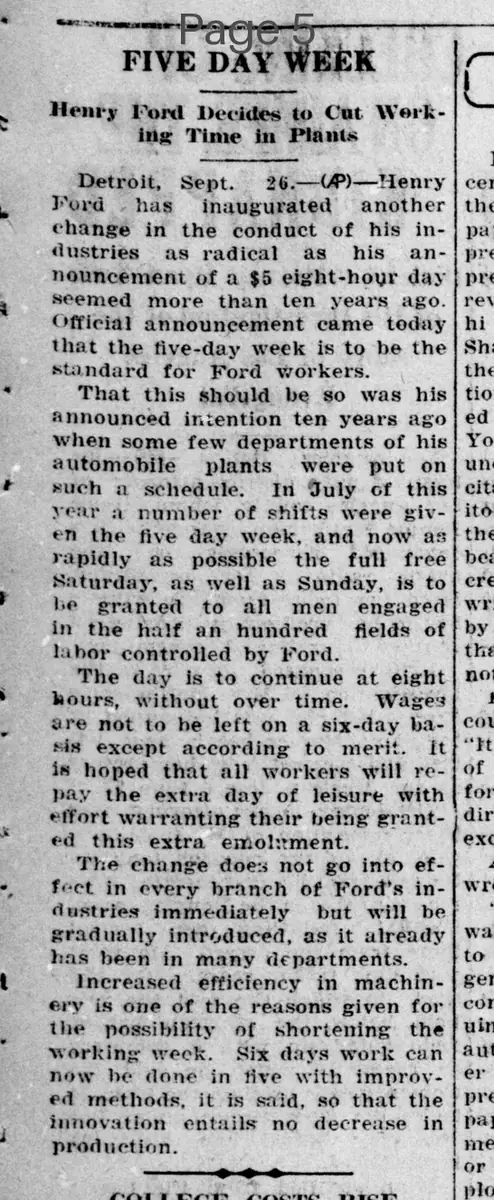
FIVE DAY WEEK
Henry Ford Decides to Cut Working Time in Plants
Detroit, Sept. 26.—Henry Ford has inaugurated another change in the conduct of his industries as radical as his announcement of a $5 eight-hour day seemed more than ten years ago.
Official announcement came today that the five-day week is to be the standard for Ford workers.
That this should be so was his announced intention ten years ago when some few departments of his automobile plants were put on such a schedule. In July of this year a number of shifts were given the five day week, and now as rapidly as possible the full free Saturday, as well as Sunday, is to be granted to all men engaged in the half an hundred fields of labor controlled by Ford.
The day is to continue at eight hours, without over time. Wages are not to be left on a six-day basis except according to merit. It is hoped that all workers will repay the extra day of leisure with effort warranting their being granted this extra emolument.
The change does not go into effect in every branch of Ford's industries immediately but will be gradually introduced, as it already has been in many departments.
Increased efficiency in machinery is one of the reasons given for the possibility of shortening the working week. Six days work can now be done in five with improved methods, it is said, so that the innovation entails no decrease in production.
Henry Ford Decides to Cut Working Time in Plants
Detroit, Sept. 26.—Henry Ford has inaugurated another change in the conduct of his industries as radical as his announcement of a $5 eight-hour day seemed more than ten years ago.
Official announcement came today that the five-day week is to be the standard for Ford workers.
That this should be so was his announced intention ten years ago when some few departments of his automobile plants were put on such a schedule. In July of this year a number of shifts were given the five day week, and now as rapidly as possible the full free Saturday, as well as Sunday, is to be granted to all men engaged in the half an hundred fields of labor controlled by Ford.
The day is to continue at eight hours, without over time. Wages are not to be left on a six-day basis except according to merit. It is hoped that all workers will repay the extra day of leisure with effort warranting their being granted this extra emolument.
The change does not go into effect in every branch of Ford's industries immediately but will be gradually introduced, as it already has been in many departments.
Increased efficiency in machinery is one of the reasons given for the possibility of shortening the working week. Six days work can now be done in five with improved methods, it is said, so that the innovation entails no decrease in production.
What sub-type of article is it?
Historical Event
Biography
What themes does it cover?
Moral Virtue
Triumph
What keywords are associated?
Five Day Week
Henry Ford
Labor Reform
Industrial Efficiency
Worker Leisure
What entities or persons were involved?
Henry Ford
Where did it happen?
Detroit
Story Details
Key Persons
Henry Ford
Location
Detroit
Event Date
Sept. 26
Story Details
Henry Ford inaugurates a five-day workweek for his workers, continuing eight-hour days without overtime, with wages based on merit. The change, intended since ten years ago, is enabled by increased machinery efficiency allowing six days' work in five, without decreasing production.