Thank you for visiting SNEWPapers!
Sign up free
Kentucky Gazette
Lexington, Fayette County, Kentucky
What is this article about?
Extract from a May speech by Percival Butler, Jr. Esq., critiquing financial ruin caused by luxury, banks, and speculation in an inland agricultural region. Advocates returning to farming, opposing bank expansions, paper money, and relief laws, favoring labor-based wealth and constitutional adherence.
Merged-components note: Continuation of the extracted speech by Percival Butler, Jr., across pages 2 and 3; merged for coherence as a single opinion piece.
Clippings
1 of 2
OCR Quality
Full Text
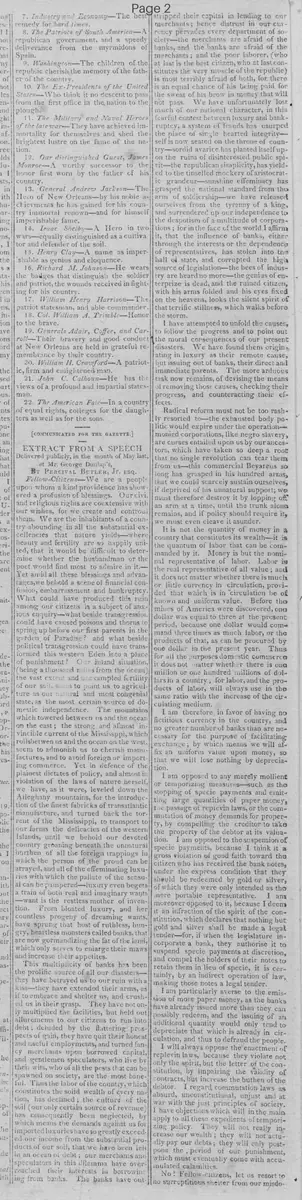
EXTRACT FROM A SPEECH Delivered publicly, in the month of May last. at Mr. George Dunlap's, By Percival Butler, Jr. Esq.
Fellow-Citizens—We are a people upon whom a kind providence has showered a profusion of blessings. Our civil and religious rights are coextensive with our wishes, for we create and controul them. We are the inhabitants of a country abounding in all the substantial excellencies that nature yields—where beauty and fertility are so happily united, that it would be difficult to determine whether the husbandman or the poet would find most to admire in it.— Yet amid all these blessings and advantages, we behold a scene of financial confusion, embarrassment and bankruptcy. What could have produced this ruin among our citizens is a subject of anxious enquiry—what beside transgression could have caused poisons and thorns to spring up before our first parents in the garden of Paradise? and what beside political transgression could have transformed this western Eden into a place of punishment? Our inland situation, (being a thousand miles from the ocean) the vast extent and unexampled fertility of our soil, seem to point us to agriculture as our natural and most congenial state, as the most certain source of domestic independence. The mountains which towered between us and the ocean on the east; the strong and almost invincible current of the Mississippi, which rolls between us and the ocean on the west, seem to admonish us to cherish manufactures, and to avoid foreign or importing commerce. Yet in defence of the plainest dictates of policy, and almost in violation of the laws of nature herself, we have, as it were, leveled down the Alleghany mountains, for the introduction of the finest fabricks of transatlantic manufacture, and turned back the torrent of the Mississippi, to transport to our farms the delicacies of the western Islands, until we behold our devoted country groaning beneath the unnatural burthen of all the foreign trappings in which the person of the proud can be arrayed, and all of the effeminating luxuries with which the pallate of the sensual can be pampered—luxury even begets a train of both real and imaginary wants—want is the restless mother of invention. From bloated luxury, and her countless progeny of dreaming wants, have sprung that host of ruthless, hungry, heartless monsters called banks, that are now gormandizing the fat of the land, which only serves to enlarge their maws and increase their appetites.
This multiplicity of banks has been the prolific source of all our disasters— they have betrayed us to our ruin with a kiss—they have extended their arms, as if to embrace and shelter us, and crushed us in their grasp. They have not only multiplied the facilities, but held out allurements to our citizens to run into debt; deluded by the flattering prospects of gain, they have quit their honest and useful employments, and turned fancy merchants upon borrowed capital. and gentlemen speculators, who live by their wits, who of all the pests that can be spawned on society, are the most baneful. Thus the labor of the country, which constitutes the solid wealth of every nation, has declined; the culture of the soil (our only certain source of revenue) has consequently been neglected, by which means the demands against us for imported luxuries have so greatly exceeded our income from the substantial products of our soil, that we have been left in an ocean of debt; our merchants and speculators in this dilemma have overreached their interests in borrowing from banks. The banks have outstripped their capital in lending to our merchants; hence distrust in our currency pervades every department of society—the merchants are afraid of the banks, and the banks are afraid of the merchants; and the poor laborer, (who at last is the best citizen, who at last constitutes the very muscle of the republic) is most terribly afraid of both, for there is an equal chance of his being paid for the sweat of his brow in money that will not pass. We have unfortunately lost much of our national character, in this fearful contest between luxury and bankruptcy, a system of frauds has usurped the place of single hearted integrity— self is now seated on the throne of country—sordid avarice has planted itself upon the ruins of disinterested public spirit—the republican simplicity, has yielded to the tinselled mockery of aristocratic grandeur—sunshine effeminacy has grasped the national standard from the arm of soldiership—we have released ourselves from the tyranny of a king, and surrendered up our independence to the despotism of a multitude of corporations ; for in the face of the world I affirm it, that the influence of banks, either through the interests or the dependence of representatives, has stolen into the hall of state, and corrupted the high source of legislation—the bees of industry are heard no more—the genius of enterprize is dead, and the ruined citizen, with his arms folded and his eyes fixed on the heavens, looks the silent spirit of that terrific stillness, which walks before the storm.
I have attempted to unfold the causes, to follow the progress and to point out the moral consequences of our present disasters. We have found them originating in luxury as their remote cause, but issuing out of banks, their direct and immediate parents. The more arduous task now remains, of devising the means of removing those causes, checking their progress, and counteracting their effects.
Radical reform must not be too rashly resorted to—the exhausted body politic would expire under the operation— monied corporations, like negro slavery, are curses entailed upon us by our ancestors, which have taken so deep a root that no single revolution can tear them from us—this commercial Briareus so long has grasped in his hundred arms, that we could scarcely sustain ourselves, if deprived of his unnatural support; we must therefore destroy it by lopping off an arm at a time, until the trunk alone remains, and if policy should require it, we must even cleave it asunder.
It is not the quantity of money in a country that constitutes its wealth—it is the quantum of labor that can be commanded by it. Money is but the nominal representative of labor. Labor is the real representative of all value; and it does not matter whether there is much or little currency in circulation, provided that which is in circulation be of known and uniform value. Before the mines of America were discovered, one dollar was equal to three at the present period, because one dollar would command three times as much labor, or the products of that, as can be procured by one dollar in the present year. Thus for all the purposes domestic commerce it does not matter whether there is one million or one hundred millions of dollars in a country; for labor, and the products of labor, will always rise in the same ratio with the increase of the circulating medium.
I am therefore in favor of having no fictitious currency in the country, and no greater number of banks than are necessary for the purpose of facilitating exchange; by which means we will affix an uniform value upon money, so that we will lose nothing by depreciation.
I am opposed to any merely pallient or temporizing measures—such as the stopping of specie payments and emitting large quantities of paper money, the passage of replevin laws, or the commutation of money demands for property, by compelling the creditor to take the property of the debtor at its valuation. I am opposed to the suspension of specie payments, because I think it a gross violation of good faith toward the citizen who has received the bank notes, under the express condition that they should be redeemed by gold or silver, of which they were only intended as the mere portable representative. I am moreover opposed to it, because I deem it an infraction of the spirit of the constitution, which declares that nothing but gold and silver shall be made a legal tender—for, if when the legislature incorporate a bank, they authorise it to suspend specie payments at discretion, and compel the holders of their notes to retain them in lieu of specie, it is certainly, by an indirect operation of law, making those notes a legal tender.
I am particularly averse to the emission of more paper money, as the banks have already issued more than they can possibly redeem, and the issuing of an additional quantity would only tend to depreciate that which is already in circulation, and thus to defraud the people.
I will always oppose the enactment of replevin laws, because they violate not only the spirit, but the letter of the constitution, by impairing the validity of contracts, but increase the burthen of the debtor. I regard commutation laws as absurd, unconstitutional, unjust and at war with the just principles of society.
I have objections which will in the main apply to all these expedients of temporizing policy. They will not really increase our wealth; they will not actually pay our debts; they will only postpone the period of our punishment, which must eventually come with accumulated calamities.
No! Fellow-citizens, let us resort to no surreptitious shelter from our misdoings.
ings. There is no danger of starving, and we cannot be hanged for debt. Let us therefore pass no laws on the subject, but stand to our posts and take the consequences of our errors. We may then regard our present difficulties as the harbinger of happier times. Luxury will be abridged; that banks will starve for want of customers; speculators, idlers and merchants without means, will be constrained to cultivate the soil for a subsistence. Industry will restore our citizens to their primitive manliness and virtue. Independence will crown every man's board: the balance of trade will turn in favour of exporting commerce, and the surplus will be brought back to beautify the face of our country. We may then look back upon our present difficulties, as upon a storm that is overpast—we may set under our own vine, and our own fig-tree, and there shall be none to make us afraid.
What sub-type of article is it?
What keywords are associated?
What entities or persons were involved?
Editorial Details
Primary Topic
Critique Of Banks Luxury And Speculation Advocating Agricultural Reform
Stance / Tone
Strongly Anti Bank And Pro Agricultural Simplicity
Key Figures
Key Arguments