Thank you for visiting SNEWPapers!
Sign up free
Daily Ohio Statesman
Columbus, Franklin County, Ohio
What is this article about?
Gen. John C. Fremont's acceptance letter for the 1864 presidential nomination from the Cleveland Convention, criticizing Lincoln's administration for constitutional violations, war mismanagement for personal ends, and rejecting broad confiscation, while supporting slavery's end via constitutional amendment.
Clipping
OCR Quality
Full Text
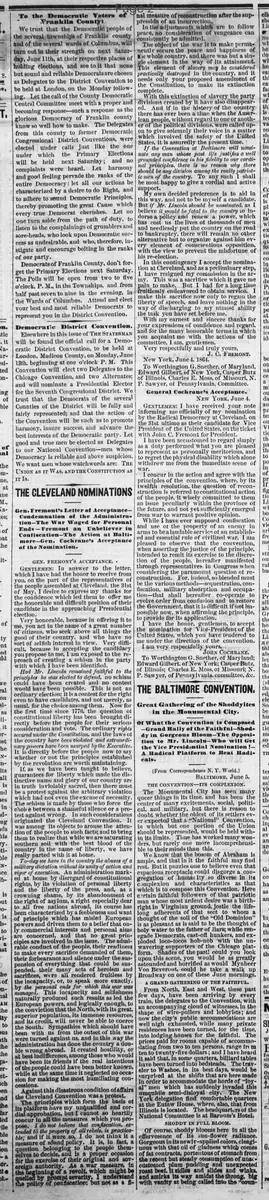
Gen. Fremont's Letter of Acceptance-
Condemnation of the Administra-
tion-The War Waged for Personal
Ends-Fremont an Unbeliever in
Confiscation-The Action at Balti-
more-Gen. Cochrane's Acceptance
of the Nomination.
GEN. FREMONT'S ACCEPTANCE.
GENTLEMEN: In answer to the letter
which I have had the honor to receive from
you, on the part of the representatives of
the people assembled at Cleveland, the 31st
of May, I desire to express my thanks for
the confidence which led them to offer me
the honorable and difficult position of their
candidate in the approaching Presidential
election.
Very honorable, because in offering it to
me, you act in the name of a great number
of citizens, who seek above all things the
good of their country, and who have no
sort of selfish interest in view. Very diffi-
cult, because in accepting the candidacy
you propose to me, I am exposed to the re-
proach of creating a schism in the party
with which I have been identified.
Had Mr. Lincoln remained faithful to the
principles he was elected to defend, no schism
could have been created and no contest
would have been possible. This is not an
ordinary election; it is a contest for the right
even to have candidates, and not merely, as
usual, for the choice among them. Now for
the first time since 1776, the question of
constitutional liberty has been brought di-
rectly before the people for their serious
consideration and vote. The ordinary rights
secured under the Constitution, and the laws of
the country have been violated and extraordi-
nary powers have been usurped by the Executive.
It is directly before the people now to say
whether or not the principles established
by the revolution are worth maintaining.
If, as we have been taught to believe,
guarantees for liberty which made the dis-
tinctive name and glory of our country are
in truth inviolably sacred, then there must
be a protest against the arbitrary violation
which had not even the excuse of necessity.
The schism is made by those who force the
choice between a shameful silence or a pro-
test against wrong. In such considerations
originated the Cleveland Convention. It
was among its objects to arouse the atten-
tion of the people to such facts; and to bring
them to realize that while we are saturating
southern soil with the best blood of the
country in the name of liberty, we have
really parted with it at home.
To-day we have in the country the abuses of a
military dictation without its unity of action and
vigor of execution. An administration marked
at home by disregard of constitutional
rights, by its violation of personal liberty
and the liberty of the press, and, as a
crowning shame, by its abandonment of
the right of asylum, a right especially dear
to all free nations abroad, its course has
been characterized by a feebleness and want
of principle which has misled European
powers and driven them to a belief that only commercial interests and personal aims
are concerned, and that no great principles are involved in the issue. The admirable conduct of the people, their readiness
to make every sacrifice demanded of them,
their forbearance and silence under the suspension of everything that could be suspended, their many acts of heroism and
sacrifices, were all rendered fruitless by
the incapacity, or, to speak more exactly,
by the personal ends for which this war was
managed
naturally produced such results as led the
European powers, and logically enough, to
the conviction that the North, with its great,
superior population, its immense resources,
and its credit, will never be able to coerce
the South. Sympathies which should have
been with us from the outset of this war
were turned against us, and in this way the
administration has done the country a dou-
ble wrong abroad. It created hostility, or
at best indifference, among those who would
have been its friends if the real intentions
of the people could have been better known,
while at the same time it neglected no occa-
sion for making the most humiliating con-
cessions.
Against this disastrous condition of affairs
the Cleveland Convention was a protest.
The principles which form the basis of
its platform have my unqualified and cor-
dial approbation, but I cannot so heartily
concur in all the measures which you pro-
pose. I do not believe that confiscation, ex-
tended to the property of all rebels, is practica-
ble; and if it were so, I do not think it a
measure of sound policy. It is, in fact, a
question belonging to the people them-
themselves to decide, and is a proper occasion
for the exercise of their original and sov-
ereign authority. As a war measure, in
the beginning of a revolt, which might be
quelled by prompt severity, I understand
the policy of confiscation; but not as a final measure of reconstruction after the sup-
pression of an insurrection.
In the adjustments which are to follow
peace, no consideration of vengeance can
consistently be admitted.
The object of the war is to make perma-
nently secure the peace and happiness of
the whole country, and there was but a sin-
gle element in the way of its attainment.
This element of slavery may be considered
practically destroyed in the country, and it
needs only your proposed amendment of
the Constitution, to make its extinction
complete.
With this extinction of slavery the party
divisions created by it have also disappeared. And if in the history of the country
there has ever been a time when the American people, without regard to one or another of the political divisions, were called upon to give solemnly their voice in a matter
which involved the safety of the United
States, it is assuredly the present time.
If the Convention at Baltimore will nomi-
nate any man whose past life justifies a well
grounded confidence in his fidelity to our cardinal principles, there is no reason why there
should be any division among the really patriotic men of the country. To any such I shall
be most happy to give a cordial and active
support.
My own decided preference is to aid in
this way, and not to be myself a candidate.
But if Mr. Lincoln should be nominated, as I
believe it would be fatal to the country to in-
dorse a policy and renew a power, which
has cost us the lives of thousands of men
and needlessly put the country on the road
to bankruptcy, there will remain no other
alternative but to organize against him every element of conscientious opposition,
with the view to prevent the misfortune of
his re-election.
In this contingency I accept the nomination at Cleveland, and as a preliminary step,
I have resigned my commission in the army. This was a sacrifice which it gave me
pain to make. But I had for a long time
fruitlessly endeavored to obtain service. I
make this sacrifice now only to regain the
liberty of speech, and leave nothing in the
way of discharging to my utmost ability
the task you have set before me.
With my earnest and sincere thanks for
your expressions of confidence and regard.
and for the many honorable terms in which
you acquaint me with the actions of the
committee, I am, gentlemen,
Very respectfully and truly yours,
J. C. FREMONT.
New York, June 4, 1864.
To Worthington G. Snethen, of Maryland
Edward Gilbert, of New York, Casper Butz
of Illinois, Charles E. Moss, of Missouri, N.
P. Sawyer, of Pennsylvania, Committee.
What sub-type of article is it?
What themes does it cover?
What keywords are associated?
What entities or persons were involved?
Where did it happen?
Story Details
Key Persons
Location
Cleveland; New York
Event Date
June 4, 1864
Story Details
Gen. Fremont accepts the presidential nomination from the Cleveland Convention, condemning the Lincoln administration's violations of constitutional rights, mismanagement of the Civil War for personal ends, and rejection of broad confiscation of rebel property, while endorsing the end of slavery via constitutional amendment and offering support to a suitable Baltimore nominee over Lincoln.