Thank you for visiting SNEWPapers!
Sign up free
Delaware Journal
Wilmington, New Castle County, Delaware
What is this article about?
The Judiciary Committee of the House of Representatives reports on the resolution to require concurrence of more than a majority of the Supreme Court to declare state constitutions or laws invalid, recommending five judges' agreement and submitting a bill.
Clipping
OCR Quality
Full Text
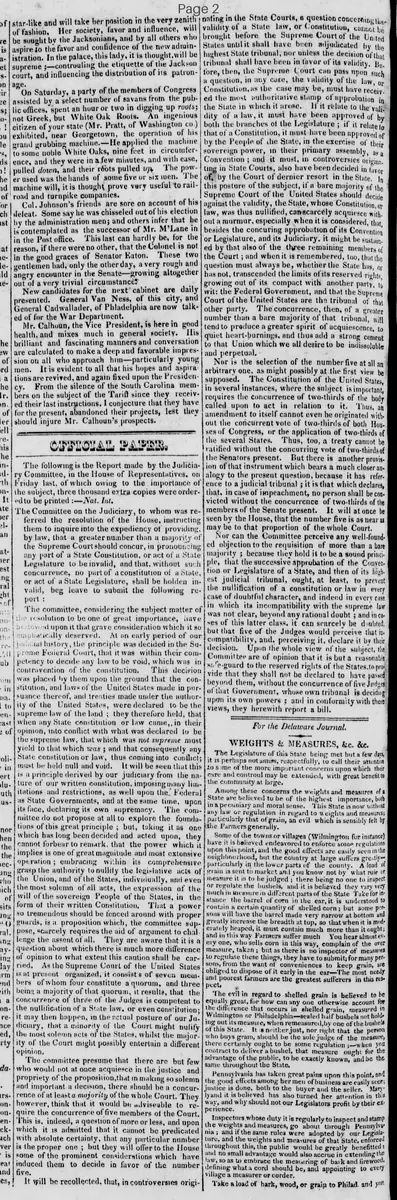
The following is the Report made by the Judiciary Committee, in the House of Representatives, on Friday last, of which owing to the importance of the subject, three thousand extra copies were ordered to be printed :-Nat. Int.
The Committee on the Judiciary, to whom was referred the resolution of the House, instructing them to inquire into the expediency of providing, by law, that a greater number than a majority of the Supreme Court should concur, in pronouncing any part of a State Constitution, or act of a State Legislature to be invalid, and that, without such concurrence, no part of a constitution of a State, or act of a State Legislature, shall be holden invalid, beg leave to submit the following report :
The committee, considering the subject matter of the resolution to be one of great importance, have bestowed upon it that grave consideration which it so emphatically deserved. At an early period of our judicial history, the principle was decided in the Supreme Federal Court. that it was within their competency to decide any law to be void, which was in contravention of the constitution. This decision was placed by them upon the ground that the constitution, and laws of the United States made in pursuance thereof, and treaties made under the authority of the United States, were declared to be the supreme law of the land ; they therefore held, that when any State constitution or law came,, in their opinion, into conflict with what was declared to be the supreme law, that which was not supreme must yield to that which was ; and that consequently any State constitution or law, thus coming into conflict: must be held null and void. It will be seen that this is a principle derived by our judiciary from the nature of our written constitution, imposing many limitations and restrictions, as well upon the Federal as State Governments, and at the same time, upon its face, declaring its own supremacy. The committee do not propose at all to explore the foundations of this great principle ; but, taking it as one which has long been decided and acted upon, they cannot forbear to remark, that the power which it implies is one of great magnitude and most extensive operation; embracing within its comprehensive grasp the authority to nullify the legislative acts of the Union, and of the States, individually, and even the most solemn of all acts, the expression of the will of the sovereign People of the States, in the form of their written Constitution. That a power so tremendous should be fenced around with proper guards, is a proposition which, the committee suppose, scarcely requires the aid of argument to challenge the assent of all. They are aware that it is a question about which there is much more difference of opinion to what extent this caution shall be carried. As the Supreme Court of the United States is at present organized, it consists of seven members of whom four constitute a quorum, and three being a majority of that quorum, it results, that the concurrence of three of the Judges is competent to the nullification of a State law, or even constitution; it may then happen, in the actual posture of our Judiciary, that a minority of the Court might nullify the most solemn acts of the States, whilst the majority of the Court might possibly entertain a different opinion.
The committee presume that there are but few who would not at once acquiesce in the justice and propriety of the proposition,that in making so solemn and important a decision, there should be a concurrence of at least a majority of the whole Court. They however, think that it would be advisable to require the concurrence of five members of the Court. This is, indeed, a question of more or less, and upon which it is admitted that it cannot be predicated with absolute certainty, that any particular number is the proper one ; but they will offer to the House some of the prominent considerations which have induced them to decide in favor of the number five.
It will be recollected, that, in controversies originating in the State Courts, a question concerning the validity of a State law, or Constitution, cannot be brought before the Supreme Court of the United States until it shall have been adjudicated by the highest State tribunal, nor unless the decision of that tribunal shall have been in favor of its validity. Before, then, the Supreme Court can pass upon such a question in any case the validity of the law or Constitution, as the case may be, must have received the most authoritative stamp of approbation in the State in which it arose. If it relate to the validity of a law, it must have been approved of by both the branches of the Legislature ; if it relate to that of a Constitution, it must have been approved of by the People of the State, in the exercise of their sovereign power, in their primary assembly, as a Convention ; and it must, in controversies originating in State Courts, also have been decided in favor of, by the Court of dernier resort in the State. In this posture of the subject, if a bare majority of the Supreme Court of the United States should decide against the validity, the State, whose Constitution, or law, was thus nullified, can scarcely acquiesce without a murmur, especially when it is considered, that. besides the concurring approbation of its Convention or Legislature, and its Judiciary, it might be sustained by that also of the three remaining members of the Court ; and when it is remembered, too, that the question must always be, whether the State has, or has not, transcended the limits of its reserved rights, growing out of its compact with another party, to wit: the Federal Government, and that the Supreme Court of the United States are the tribunal of that other party. The concurrence, then, of a greater number than a bare majority of that tribunal, will tend to produce a greater spirit of acquiescence, to quiet heart-burnings, and thus add a strong cement to that Union which we all desire to be indissoluble and perpetual.
Nor is the selection of the number five at all an arbitrary one, as might possibly at the first view be supposed. The Constitution of the United States, in several instances, where the subject is important. requires the concurrence of two-thirds of the body called upon to act in relation to it. Thus, an amendment to itself cannot even be originated without the concurrent vote of two-thirds of both Houses of Congress, or the application of two-thirds of the several States. Thus, too, a treaty cannot be ratified without the concurring vote of two-thirds of the Senators present. But there is another provision of that instrument which bears a much closer analogy to the present question, because it has reference to a judicial tribunal ; it is that which declares, that, in case of impeachment, no person shall be convicted without the concurrence of two-thirds of the members of the Senate present. It will at once be seen by the House, that the number five is as near as may be to that proportion of the whole Court.
Nor can the Committee perceive any well-founded objection to the requisition of more than a bare majority ; because they hold it to be a sound principle, that the successive approbation of the Convention or Legislature of a State, and then of its highest judicial tribunal, ought, at least, to prevent the nullification of a constitution or law in every case of doubtful character, and indeed in every case in which its incompatibility with the supreme law was not clear, beyond any rational doubt ; and in cases of this latter class, it can scarcely be doubted but that five of the Judges would perceive that incompatibility, and, perceiving it, declare it by their decision. Upon the whole view of the subject, the Committee are of opinion that it is but a reasonable safe-guard to the reserved rights of the States,to provide that they shall not be declared to have passed beyond them, without the concurrence of five Judges of that Government, whose own tribunal is deciding upon its own powers ;and in conformity with these views, they herewith report a bill.
What sub-type of article is it?
What keywords are associated?
Domestic News Details
Event Date
On Friday Last
Outcome
the committee reports a bill requiring concurrence of five supreme court judges to nullify state constitutions or laws.
Event Details
The Judiciary Committee reports on the resolution inquiring into requiring more than a majority of the Supreme Court to concur in declaring state constitutions or legislative acts invalid, recommending five members' concurrence to safeguard state rights and submitting a bill.