Thank you for visiting SNEWPapers!
Sign up free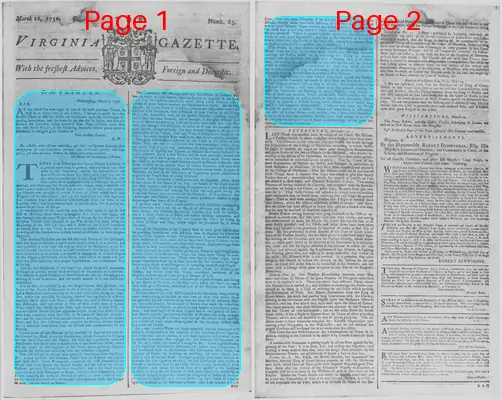
The Virginia Gazette
Richmond, Williamsburg, Richmond County, Virginia
What is this article about?
A letter from Williamsburg, Virginia, dated March 3, 1752, advocating for smallpox inoculation as a safer alternative to natural infection. The author, R.W., discusses its history from Ethiopia and Circassia, benefits, methods, and addresses prejudices and religious objections, citing Dr. Mead and successful cases among slaves.
Merged-components note: The text on page 2 continues directly from the letter to the editor on page 1 without interruption, forming a single coherent component on the advantages of inoculation.
Clippings
1 of 2
OCR Quality
Full Text
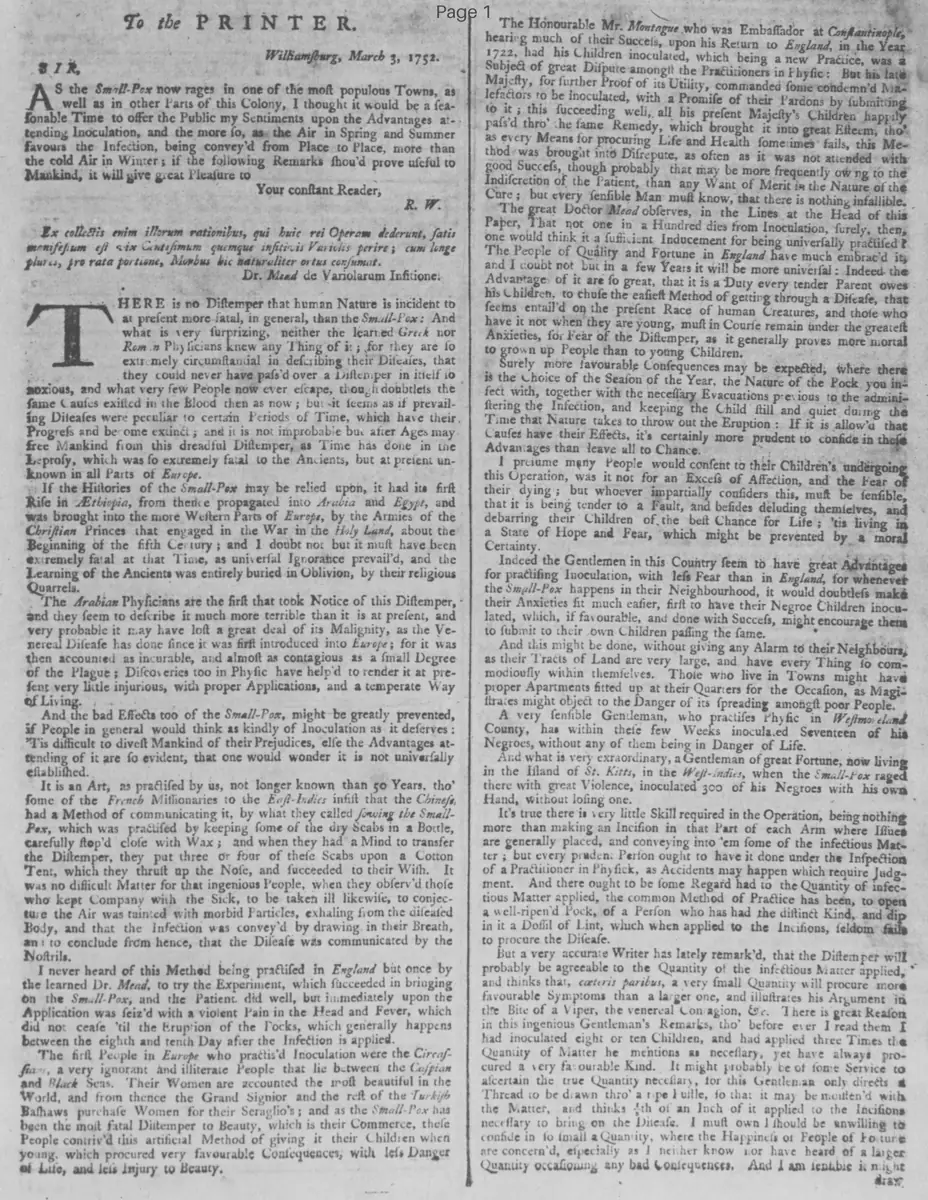
Williamsburg, March 3, 1752.
SIR,
As the Small-Pox now rages in one of the most populous Towns, as well as in other Parts of this Colony, I thought it would be a reasonable Time to offer the Public my Sentiments upon the Advantages attending Inoculation, and the more so, as the Air in Spring and Summer favours the Infection, being convey'd from Place to Place, more than the cold Air in Winter; if the following Remarks should prove useful to Mankind, it will give great Pleasure to
Your constant Reader,
R. W.
Ex collectis enim illorum rationibus, qui huic rei Operam dederunt, atis manifestum est ex centesimum quemque inventis Variolis perire; cum longe plures, pro rata portione, Morbus hic naturaliter ortus convaluat.
Dr. Mead de Variolarum Inoculatione:
There is no Distemper that human Nature is incident to at present more fatal, in general, than the Small-Pox: And what is very surprising, neither the learned Greek nor Roman Physicians knew any thing of it; for they are so extremely circumstantial in describing their Diseases, that they could never have pass'd over a Distemper in itself so noxious, and what very few People now ever escape, though doubtless the same Virus existed in the Blood then as now; but it seems as if prevailing Diseases were peculiar to certain Periods of Time, which have their Progress and become extinct; and it is not improbable but after Ages may free Mankind from this dreadful Distemper, as Time has done in the Leprosy, which was so extremely fatal to the Ancients, but at present unknown in all Parts of Europe.
If the Histories of the Small-Pox may be relied upon, it had its first Rise in Ethiopia, from thence it was propagated into Arabia and Egypt, and was brought into the more Western Parts of Europe, by the Armies of the Christian Princes that engaged in the War in the Holy Land, about the Beginning of the fifth Century; and I doubt not but it must have been extremely fatal at that Time, as universal Ignorance prevail'd, and the Learning of the Ancients was entirely buried in Oblivion, by their religious Quarrels.
The Arabian Physicians are the first that took Notice of this Distemper, and they seem to describe it much more terrible than it is at present, and very probable it may have lost a great deal of its Malignity, as the Venereal Disease has done since it was first introduced into Europe; for it was then accounted as incurable, and almost as contagious as a small Degree of the Plague; Discoveries too in Physic have help'd to render it at present very little injurious, with proper Applications, and a temperate Way of Living.
And the bad Effects too of the Small-Pox, might be greatly prevented, if People in general would think as kindly of Inoculation as it deserves: Tis difficult to divest Mankind of their Prejudices, else the Advantages attending of it are so evident, that one would wonder it is not universally established.
It is an Art, as practised by us, not longer known than 50 Years. tho' some of the French Missionaries to the East-Indies insist that the Chinese had a Method of communicating it, by what they called Sowing the Small-Pox, which was practised by keeping some of the dry Scabs in a Bottle, carefully stop'd close with Wax; and when they had a Mind to transfer the Distemper, they put three or four of these Scabs upon a Cotton Tent, which they thrust up the Nose, and succeeded to their Wish. It was no difficult Matter for that ingenious People, when they observ'd those who kept Company with the Sick, to be taken ill likewise, to conjecture the Air was tainted with morbid Particles, exhaling from the diseased Body, and that the Infection was convey'd by drawing in their Breath, and so to conclude from hence, that the Disease was communicated by the Nostrils.
I never heard of this Method being practised in England but once by the learned Dr. Mead, to try the Experiment, which succeeded in bringing on the Small-Pox, and the Patient did well, but immediately upon the Application was seiz'd with a violent Pain in the Head and Fever, which did not cease 'til the Eruption of the Pocks, which generally happens between the eighth and tenth Day after the Infection is applied.
The first People in Europe who practis'd Inoculation were the Circassians, a very ignorant and illiterate People that lie between the Caspian and Black Seas. Their Women are accounted the most beautiful in the World, and from thence the Grand Signior and the rest of the Turkish Bashaws purchase Women for their Seraglios; and as the Small-Pox has been the most fatal Distemper to Beauty, which is their Commerce, these People contriv'd this artificial Method of giving it their Children when young, which procured very favourable Consequences, with less Danger of Life, and less injury to Beauty.
The Honourable Mr. Montague who was Ambassador at Constantinople, hearing much of their Success, upon his Return to England, in the Year 1722, had his Children inoculated, which being a new Practice, was a Subject of great Dispute amongst the Practitioners in Physic: But his late Majesty, for further Proof of its Utility, commanded some condemn'd Malefactors to be inoculated, with a Promise of their Pardons by submitting to it; this succeeding well, all his present Majesty's Children happily pass'd thro' the same Remedy, which brought it into great Esteem, tho' as every Means for procuring Life and Health sometimes fails, this Method was brought into Disrepute, as often as it was not attended with good Success, though probably that may be more frequently owing to the Indiscretion of the Patient, than any Want of Merit in the Nature of the Cure; but every sensible Man must know, that there is nothing infallible.
The great Doctor Mead observes, in the Lines at the Head of this Paper, That not one in a Hundred dies from Inoculation, surely, then, one would think it a sufficient Inducement for being universally practised? The People of Quality and Fortune in England have much embrac'd it, and I doubt not but in a few Years it will be more universal: Indeed the Advantages of it are so great, that it is a Duty every tender Parent owes his Children, to chuse the easiest Method of getting through a Disease, that seems entail'd on the present Race of human Creatures, and those who have it not when they are young, must in Course remain under the greatest Anxieties, or Fear of the Distemper, as it generally proves more mortal to grown up People than to young Children.
Surely more favourable Consequences may be expected, where there is the Choice of the Season of the Year, the Nature of the Pock you infect with, together with the necessary Evacuations previous to the administering the Infection, and keeping the Child still and quiet during the Time that Nature takes to throw out the Eruption: If it is allow'd that Causes have their Effects, it's certainly more prudent to consider in these Advantages than leave all to Chance.
I presume many People would consent to their Children's undergoing this Operation, was it not for an Excess of Affection, and the Fear of their dying; but whoever impartially considers this, must be sensible, that it is being tender to a Fault, and besides deluding themselves, and debarring their Children of the best Chance for Life; 'tis living in a State of Hope and Fear, which might be prevented by a moral Certainty.
Indeed the Gentlemen in this Country seem to have great Advantages for practising Inoculation, with less Fear than in England, for whenever the Small-Pox happens in their Neighbourhood, it would doubtless make their Anxieties sit much easier, first to have their Negro Children inoculated, which, if favourable, and done with Success, might encourage them to submit to their own Children passing the same.
And this might be done, without giving any Alarm to their Neighbours as their Tracts of Land are very large, and have every Thing so commodiously within themselves. Those who live in Towns might have proper Apartments fitted up at their Quarters for the Occasion, as Magistrates might object to the Danger of its spreading amongst poor People.
A very sensible Gentleman, who practises Physic in Westmoreland County, has within these few Weeks inoculated Seventeen of his Negroes, without any of them being in Danger of Life.
And what is very extraordinary, a Gentleman of great Fortune, now living in the Island of St. Kitts, in the West-Indies, when the Small-Pox raged there with great Violence, inoculated 300 of his Negroes with his own Hand, without losing one.
It's true there is very little Skill required in the Operation, being nothing more than making an Incision in that Part of each Arm where Veins are generally placed, and conveying into'em some of the infectious Matter; but every prudent Person ought to have it done under the Inspection of a Practitioner in Physic, as Accidents may happen which require Judgment. And there ought to be some Regard had to the Quantity of infectious Matter applied, the common Method of Practice has been, to open a well-ripen'd Pock, of a Person who has had the distinct Kind, and dip in it a Quill of Lint, which when applied to the Incisions, seldom fail to procure the Disease.
But a very accurate Writer has lately remark'd, that the Distemper will probably be agreeable to the Quantity of the infectious Matter applied, and thinks that, cæteris paribus, a very small Quantity will procure more favourable Symptoms than a larger one, and illustrates his Argument in the Bite of a Viper, the venereal Contagion, &c. There is great Reason in this ingenious Gentleman's Remarks, tho' before ever I read them I had inoculated eight or ten Children, and had applied three Times the Quantity of Matter he mentions as necessary, yet have always procured a very favourable Kind. It might probably be of some Service to ascertain the true Quantity necessary, for this Gentleman only directs Thread to be drawn thro'a ripe Pustule, so that it may be moisten'd with the Matter, and thinks that an Inch of it applied to the Incisions necessary to bring on the Disease. I must own I should be unwilling to confide in so small a Quantity, where the Happiness or People of Future are concern'd, especially as I neither know nor have heard of a larger Quantity occasioning any bad Consequences. And I am sensible it might draw a Man into some Disrepute, if he did not succeed in procuring the Disease, though there have been Instances of Children being inoculated two or three different Times without any Effect, and it is not improbable but they had it in Utero, which I fancy more frequently happens than we are aware of. There is another Caution which this Gentleman justly thinks of very great Importance; and that is the Necessity of having the Matter taken from the Person in the Small-Pox, convey'd by another Hand to the Person employ'd to perform the Operation.
The Reason for this Caution is obvious; if the Operator takes the Matter from the Sick, by his Stay in the Room near the Bed, and even touching the Pustules whilst he is collecting the Taint, he becomes charged with the infectious Effluvia in such a Manner, that, in all Probability, his coming into the Company of one who has not had the Disease, would be sufficient alone to communicate it : And thus, whilst the Subject is endeavouring to reap the Advantage of an artificial Infection, he unhappily receives the Infection in a natural Way likewise.
There may possibly be some People who object against this Practice, from a religious Principle, but surely it is a Duty we owe to the Author of our Being to preserve Life as long as we can ; Self Preservation is the first Law in Nature ; and there seems to be the greatest Analogy betwixt this Operation, and Bleeding, or taking Physick; and, though either of these may occasion Death, yet no Body would presume they are ever done wantonly, or with a Desire to shorten Life, but purely from a Motive to prevent a Disease having worse Effects than it would have had if it had happened spontaneously. I believe, too, there are People in Life so absurd as to think, "Death will come when it will come," and that all human Means avail nothing; but I leave these Predestinarians to enjoy their own mistaken Notions, and shall succeed to my Wish, if this helps to convince Men of sound Understandings, of the great Advantages attending Inoculation.
What sub-type of article is it?
What themes does it cover?
What keywords are associated?
What entities or persons were involved?
Letter to Editor Details
Author
R. W.
Recipient
The Printer
Main Argument
inoculation for smallpox is safer and more beneficial than risking natural infection, with lower mortality rates and controllable outcomes; parents have a moral duty to use it to protect their children.
Notable Details