Thank you for visiting SNEWPapers!
Sign up free
The Vinita Daily Chieftain
Vinita, Craig County, Oklahoma
What is this article about?
Article from National Crop Improvement Service advises on wheat quality factors including seed selection, crop rotation, soil preparation, and post-harvest care to avoid bleaching, sprouting, and pests like smut and stem maggots. Emphasizes growing pure hard wheat varieties for better prices, quoting John Field of Oklahoma Farm Journal.
Merged-components note: Related sequential articles on wheat quality, seed purity, and pest management under National Crop Improvement Service; form a cohesive agricultural advice section.
Clipping
OCR Quality
Full Text
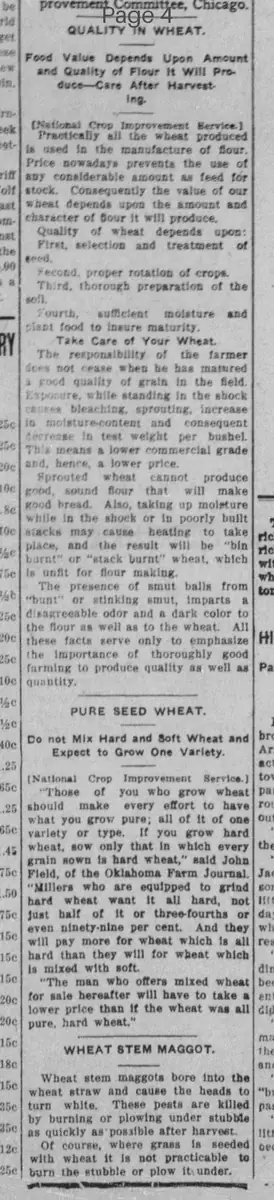
Food Value Depends Upon Amount and Quality of Flour It Will Produce—Care After Harvesting.
[National Crop Improvement Service]
Practically all the wheat produced is used in the manufacture of flour. Price nowadays prevents the use of any considerable amount as feed for stock. Consequently the value of our wheat depends upon the amount and character of flour it will produce.
Quality of wheat depends upon:
First, selection and treatment of seed.
Second, proper rotation of crops.
Third, thorough preparation of the soil.
Fourth, sufficient moisture and plant food to insure maturity.
Take Care of Your Wheat.
The responsibility of the farmer does not cease when he has matured a good quality of grain in the field. Exposure, while standing in the shock causes bleaching, sprouting, increase in moisture-content and consequent decrease in test weight per bushel. This means a lower commercial grade and, hence, a lower price.
Sprouted wheat cannot produce good, sound flour that will make good bread. Also, taking up moisture while in the shock or in poorly built stacks may cause heating to take place, and the result will be "bin burnt" or "stack burnt" wheat, which is unfit for flour making.
The presence of smut balls from "bunt" or stinking smut, imparts a disagreeable odor and a dark color to the flour as well as to the wheat. All these facts serve only to emphasize the importance of thoroughly good farming to produce quality as well as quantity.
PURE SEED WHEAT.
Do not Mix Hard and Soft Wheat and Expect to Grow One Variety.
[National Crop Improvement Service.]
"Those of you who grow wheat should make every effort to have what you grow pure; all of it of one variety or type. If you grow hard wheat, sow only that in which every grain sown is hard wheat," said John Field, of the Oklahoma Farm Journal.
"Millers who are equipped to grind hard wheat want it all hard, not just half of it or three-fourths or even ninety-nine per cent. And they will pay more for wheat which is all hard than they will for wheat which is mixed with soft.
"The man who offers mixed wheat for sale hereafter will have to take a lower price than if the wheat was all pure, hard wheat."
WHEAT STEM MAGGOT.
Wheat stem maggots bore into the wheat straw and cause the heads to turn white. These pests are killed by burning or plowing under stubble as quickly as possible after harvest. Of course, where grass is seeded with wheat it is not practicable to burn the stubble or plow it under.
What sub-type of article is it?
What keywords are associated?
What entities or persons were involved?
Domestic News Details
Key Persons
Event Details
Advises on factors affecting wheat quality: seed selection, crop rotation, soil preparation, moisture and plant food. Post-harvest care to prevent bleaching, sprouting, moisture increase, heating, and smut. Recommends growing pure hard wheat varieties for higher prices. Describes wheat stem maggots and control by burning or plowing stubble.