Thank you for visiting SNEWPapers!
Sign up free
The Chickasha Daily Express
Chickasha, Grady County, Oklahoma
What is this article about?
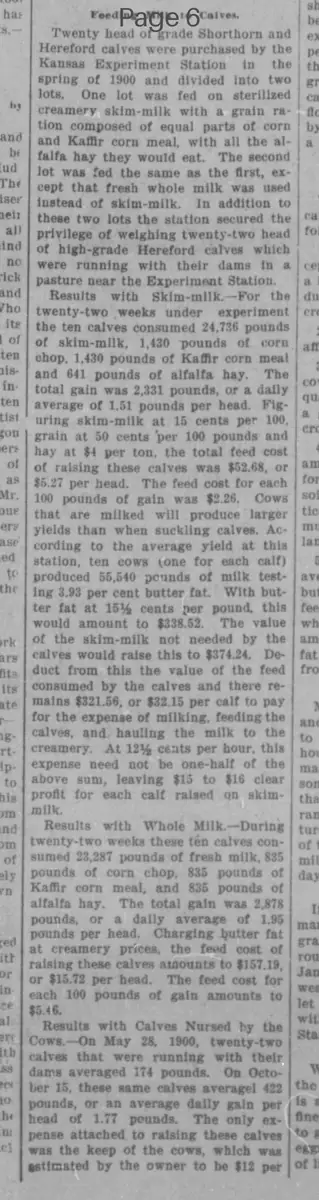
Kansas Experiment Station tested feeding 20 calves skim-milk vs. whole milk, compared to 22 nursed calves. Skim-milk proved most economical, with gains of 1.51 lbs/day at $5.27/head cost, vs. 1.95 lbs/day at $15.72 for whole milk and 1.77 lbs/day at $12 for nursed.
Clipping
OCR Quality
Full Text
Results with Skim-milk.-For the twenty-two weeks under experiment the ten calves consumed 24,736 pounds of skim-milk, 1,430 pounds of corn chop, 1,430 pounds of Kaffir corn meal and 641 pounds of alfalfa hay. The total gain was 2,331 pounds, or a daily average of 1.51 pounds per head. Figuring skim-milk at 15 cents per 100, grain at 50 cents per 100 pounds and hay at $4 per ton, the total feed cost of raising these calves was $52.68, or $5.27 per head. The feed cost for each 100 pounds of gain was $2.26. Cows that are milked will produce larger yields than when suckling calves. According to the average yield at this station, ten cows (one for each calf) produced 55,540 pounds of milk testing 3.93 per cent butter fat. With butter fat at 15½ cents per pound, this would amount to $338.52. The value of the skim-milk not needed by the calves would raise this to $374.24. Deduct from this the value of the feed consumed by the calves and there remains $321.56, or $32.15 per calf to pay for the expense of milking, feeding the calves, and hauling the milk to the creamery. At 12½ cents per hour, this expense need not be one-half of the above sum, leaving $15 to $16 clear profit for each calf raised on skim-milk.
Results with Whole Milk.-During twenty-two weeks these ten calves consumed 23,287 pounds of fresh milk, 835 pounds of corn chop, 835 pounds of Kaffir corn meal, and 835 pounds of alfalfa hay. The total gain was 2,878 pounds, or a daily average of 1.95 pounds per head. Charging butter fat at creamery prices, the feed cost of raising these calves amounts to $157.19, or $15.72 per head. The feed cost for each 100 pounds of gain amounts to $5.46.
Results with Calves Nursed by the Cows.-On May 28, 1900, twenty-two calves that were running with their dams averaged 174 pounds. On October 15, these same calves averaged 422 pounds, or an average daily gain per head of 1.77 pounds. The only expense attached to raising these calves was the keep of the cows, which was estimated by the owner to be $12 per head. Multiplying the average daily gain of these calves by 154, the number of days in previous experiment, gives a total of 272 pounds per head. With $12 as the cost of raising the calf, each 100 pounds of gain cost $4.41.
Results in Feed Lot after Weaning.-In the fall all these calves were placed in the feed lot, where they were pushed for baby beef. During the seven months under experiment, the skim-milk calves gained 440 pounds per head, the whole-milk calves 405 pounds per head, and the calves nursed by the cows 422 pounds per head. This experiment shows that the feed cost of raising a good skim-milk calf need not exceed $5.25 in contrast to $15.75 for a whole-milk calf, and $8 for one nursed by the dam. The skim-milk calf becomes accustomed to eating both grain and roughness early in life, is handled enough to be gentle, and when transferred to the feed lot is ready to make rapid and economical gains.-D. H. Otis, Kansas Agricultural College.
What sub-type of article is it?
What keywords are associated?
What entities or persons were involved?
Where did it happen?
Domestic News Details
Primary Location
Kansas Experiment Station
Event Date
Spring 1900
Key Persons
Outcome
skim-milk calves: total gain 2,331 pounds, feed cost $5.27 per head; whole-milk calves: total gain 2,878 pounds, feed cost $15.72 per head; nursed calves: average daily gain 1.77 pounds, cost $12 per head. later feed lot gains: 440, 405, 422 pounds per head respectively. skim-milk method most economical.
Event Details
Twenty Shorthorn and Hereford calves divided into two lots fed skim-milk or whole milk with grain and hay; twenty-two Hereford calves nursed by dams weighed for comparison. Experiment ran 22 weeks, assessing gains and costs.